Quick Survey: Our thoughts aside, please do us the favor of completing our Elections Poll. It won’t take more than a minute or two. We appreciate your participation.
We’ve told our readers since May that we give more weight to polling trends than individual polls, backed up by election forecast models. Those factors lead us to a moderate conviction return to our original scenarios last spring that ranked a unified Republican Congress as the more likely outcome of 2022 midterms and a divided Congress (Democrats hold the Senate but lose the House) as the second likely outcome.
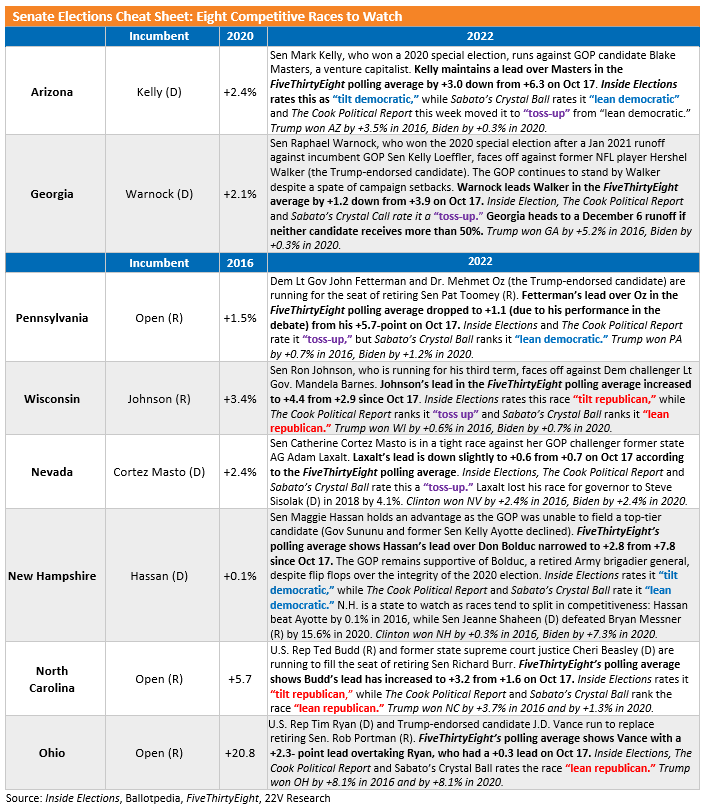
We updated yesterday the governors’ side of the six states with compelling US Senate and state chief executive contests. This note updates the Senate races (see below table) we’ve tracked in our updates since our first May 2022 report. This election has always been and remains a tight contest in the Senate, with three major phases this year:
- A clear GOP vantage was in place January through June.
- Democrats developed a swift and strong favorable trend over summer following the Dobbs decision and legislative wins (Chips bill and Inflation Reduction Act).
- And finally, a national sentiment momentum since Labor Day reverted to Republicans and that support has been evident in some Senate races the past month (Arizona, Georgia, New Hampshire, Nevada, North Carolina, Pennsylvania, Ohio and Wisconsin).
This remains a close election in the Senate regardless of data chosen, but one now clearly favoring President Biden’s opposition. All of which is consistent with historical trends of midterm elections for the party in power.
While we were watching the lopsided Phillies’ bashing of Houston pitchers last night FiveThirtyEight, our favorite model, moved to 51–49 GOP Senate a bit after 9:30 p.m. This morning at 9:43 a.m. it was updated to 52–48 further in favor of Republicans. Coupled with six steady weeks of pro-Republican trends in polls nationally and in a few key states warrants our very late-stage change to the outlook.
A surprise next week would be a known outcome by the morning of November 9, but if that develops it’s very likely to be a pro-GOP signal and one that delivers a two- or three-seat Senate margin. With so many tight races polling within the margin of error, it is more likely that we won’t know the outcome for the Senate until after a possible Georgia runoff on December 6th. We also note recent work by Gallup, which shows higher early voter than previous years that we believe could influence outcomes in a handful of states. Since early voting mail in ballots could tilt to Democrats, we would also expect that the initial night returns may favor Republicans until the mail in ballots are counted.