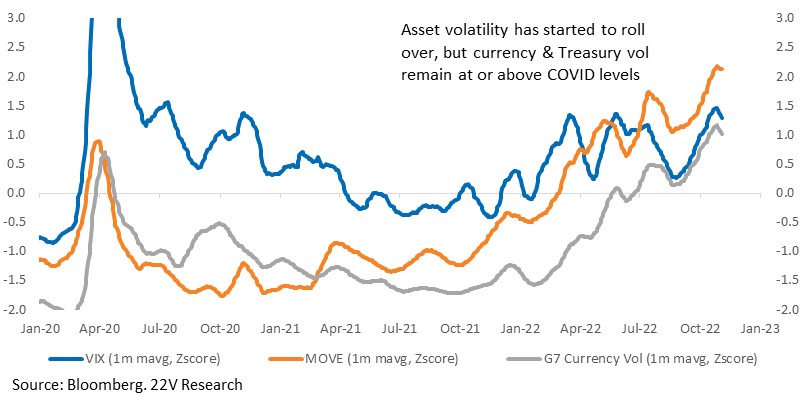
Investors surveyed by 22V last week expect policy tightening will end in a recession, but one that is a mild/short (results HERE). Today, we update our Macro Regime Classification Model (MRC), implemented using a Gaussian Mixture Model technique. Consistent with survey results, the MRC has shifted back into a Transition (previous report HERE) reflecting increased near-term recession risks.
Economic growth is on an increasingly clear slowing path, which is reflected in declining commodity prices, a range bound US Dollar, falling consumer confidence, and the recent inversion of the 10yr3mo Treasury curve. Historical data shows that yield curves tend to invert 2-8 quarters ahead of the start of recessions. The median length from the first negative yield curve reading to the official start of a recession has been ~12.5 months. A recession at some point in 2023 is increasingly likely. All those forces are helping maintain a Transitionary macro regime. To move firmly into back into a “Normal” regime, yields/curves would need to steepen, and confidence needs to move higher. A collapse in PMIs would drive recession odds MUCH higher.

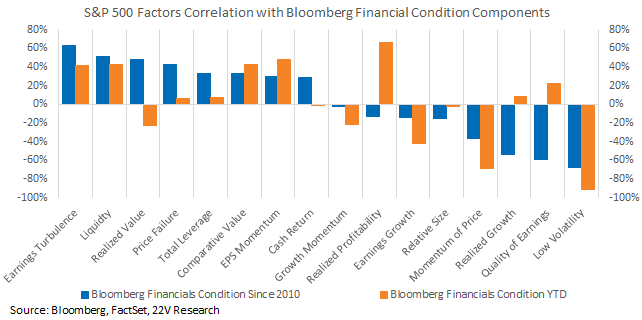
Since Transition has become the dominate macro regime, starting in March of this year, Low Volatility, Momentum of Price, and Realized Value have been leading factors at the expense of Liquidity and Earnings Turbulence (Risk-On factors). During historical Transition periods, markets were risk-off with Low Volatility the leading factor and Earnings Turbulence the worst performer.
However, factor returns have been more mean-reverting this year. YTD the returns of 7 of our 14 factors have passed the ADF mean reversal test. That suggests while Transition regime factors have led overall, there have been sharp reversals some months. Macro uncertain remains high and the Fed has done a good job communicating their policy goals (below trend growth until inflation is back on a glide path to 2%). Easing of uncertainty will continue to support risk-on rotations while weakness in key recession metrics will keep risk-off factors bid.
Transition Remains the Dominant Regime: Investors surveyed by 22V last week expect policy tightening will end in a recession, but one that is a mild/short (results HERE). Today, we update our Macro Regime Classification Model (MRC), implemented using a Gaussian Mixture Model technique. Consistent with survey results, the MRC has shifted back into a Transition (previous report HERE) reflecting increased near-term recession risks.
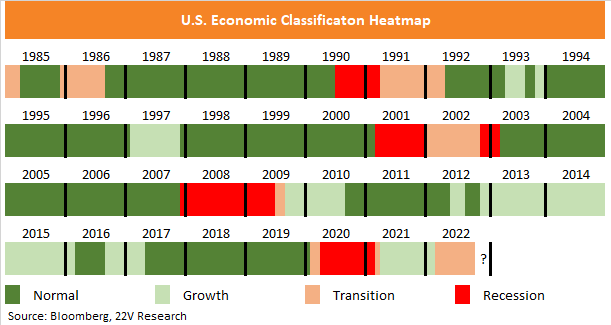
Investors are focused on today’s FOMC meeting and another potential “pivot.” Assuming there are no negative policy shocks, today’s meeting should encourage a further easing of equity, currency, and Treasury vol, all of which have eased over the past few weeks. Implied asset vol is still near its highs of the year, and Treasury/currency vol is at or above COVID levels, all of which helps explain why S&P NTM PEs are 5 points below their 2022 peak. Easing of policy uncertainty should help reduce volatility, narrowing spreads, easing currency vol and lifting stocks.
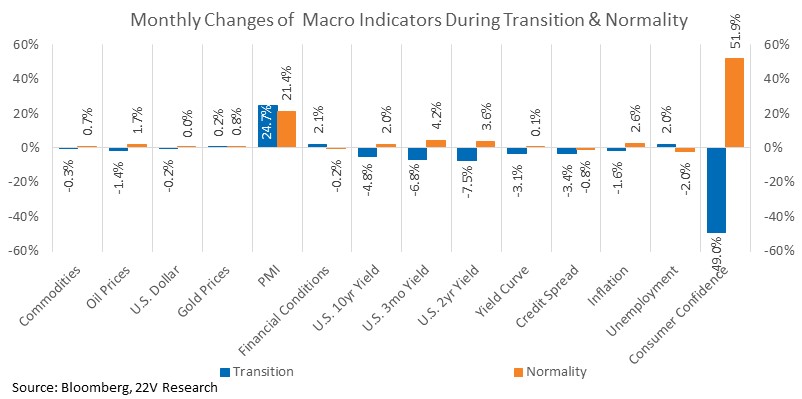
Economic growth is on an increasingly clear slowing path, which is reflected in declining commodity prices, a range bound US Dollar, falling consumer confidence, and the recent inversion of the 10yr3mo Treasury curve. All those forces are helping maintain a Transitionary macro regime. To move firmly into back into a “Normal” regime, yields/curves would need to steepen, and confidence needs to move higher. A collapse in PMIs would drive recession odds MUCH higher. For now, a recession is not a foregone conclusion, but the risks are increasing. That has important implications for factor trends.
Term structure tends to fall ahead of historical recessions. Historical data shows that yield curves tend to invert 2-8 quarters ahead of the start of recessions. The median length from the first negative yield curve reading to the official start of a recession has been ~12.5 months. A recession at some point in 2023 is increasingly likely.
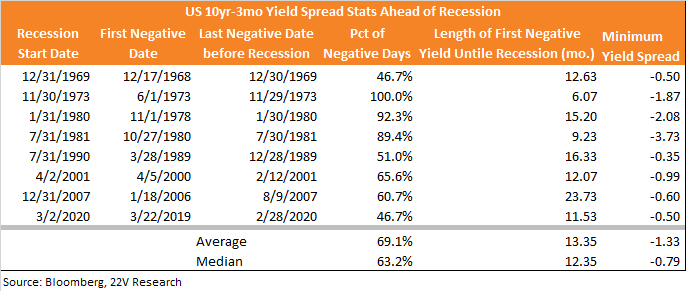
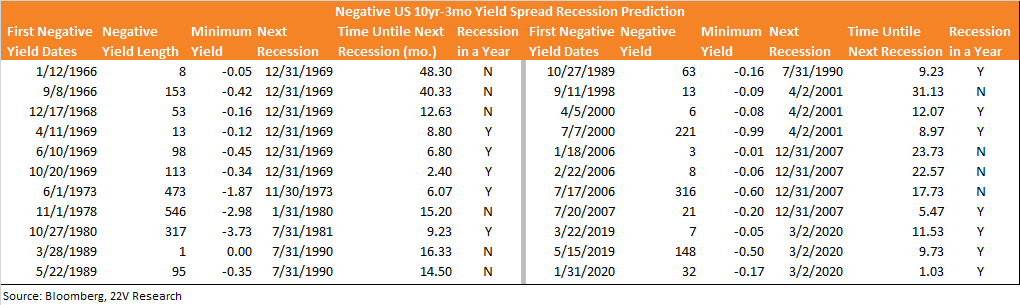
However, an inverted curve alone does not suggest that a recession should be the near-term base case. Looking at historical recession periods, there are 22 inverted curve periods, 12 of them preceded a recessions by a year and 19 of them occurred 2 years before an official recession was declared. Odds of recession in 1 and 2 years after the first curve inversion are around 55% and 86% respectively.
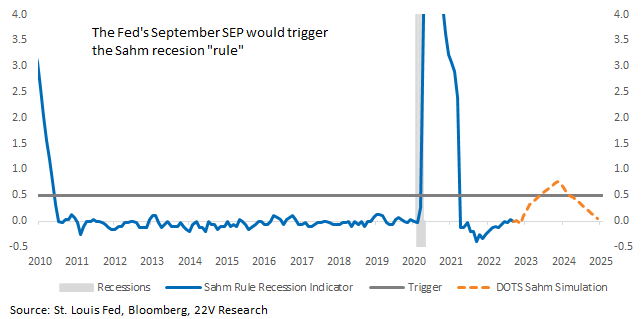
The forward path of inflation which has been the most important factor impacting the Fed Fund rate path, remains unclear. Sticky forward inflation would make a higher peak fed funds rate and lower trough growth more likely. The Fed’s SEP mapped to the latest employment report would trigger the Sahm recession ‘rule’ (+50bps off the smoothed 12-month urate low) in June of 2023. Goldman’s rule (+30bps) would be triggered in February of 2023. Stronger inflation and faster tightening would pull forward Urate-based recession risk.
Transition Regimes Favor Value + Risk-Off: Since Transition has become the dominate macro regime, starting in March of this year, Low Volatility, Momentum of Price, and Realized Value have been leading factors at the expense of Liquidity and Earnings Turbulence (Risk-On factors). During historical Transition periods, markets were risk-off with Low Volatility the leading factor and Earnings Turbulence the worst performer.
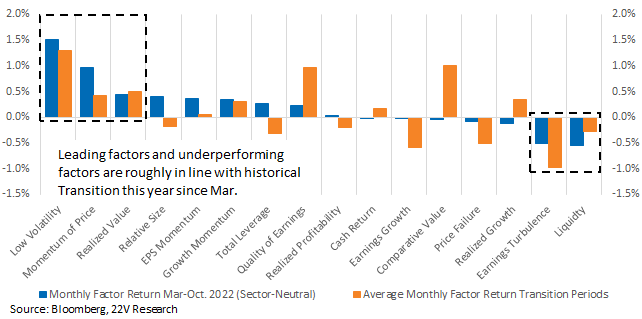
However, factor returns have been more mean-reverting this year. YTD the returns of 7 of our 14 factors have passed the ADF mean reversal test. That suggests while Transition regime factors have led overall, there have been sharp reversals some months. Macro uncertain remains high and the Fed has done a good job communicating their policy goals (below trend growth until inflation is back on a glide path to 2%). Easing of uncertainty will continue to support risk-on rotations while weakness in key recession metrics will keep risk-off factors bid.
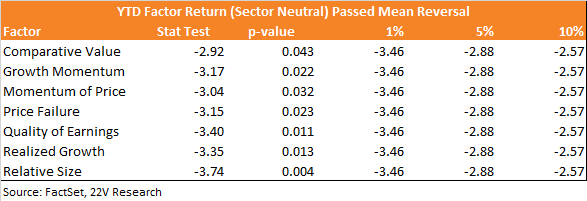
Financial condition has been one of the major macro factors driving style shift this year. Factors showing mean reversal trends have been those more positively or negatively correlated with financial conditions. Financial conditions remain tight on an absolute basis, but recent easing has helped drive the market rally in 4Q. That is likely to be a reoccurring theme into year-end and to start 2023.