Volatility remains high across asset prices, positioning is bearish, and macro uncertainty remains high. Into that backdrop, 3Q earnings reporting season is about to start, providing concrete readings about the impact of inflation and slower economic growth on corporate profits. The net percent of S&P companies reducing sales and EPS guidance are in their 90th %tiles (more negative), but have stabilized recently. Earnings sentiment, measured using the Amenity natural language processing tool, is near recession levels. How sentiment and guidance evolve during reporting will help determine the depth of the slowdown and the risk of a near-term recession.
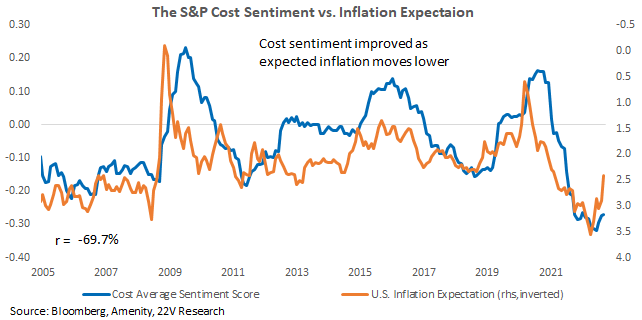
Toward Costs Easing: Since late August, inflation expectations have moved sharply lower, falling back to levels last seen in the Summer of 2021. Lower oil prices, supply chain improvements, and clear signaling by the Fed that inflation will not be tolerated have supported the decline. Inflation expectations are negatively correlated with S&P cost sentiment trends, suggesting management concerns about costs will ease further during reporting season.
Management sentiment toward the overall state of Business has remained broadly positive across sectors, suggesting the slowdown is not crushing demand. Groups that would benefit most from improved cost sentiment include Staples, Discretionary, and Communications. Pricing power, on the other hand, remains a risk. Lower Pricing Power sentiment will continue to put downward pressure on overall Earnings sentiment. Readings for most companies have turned negative this year, reflecting the building pressure on earnings.
It is worth noting that the earnings sentiment spread between Cyclicals and Defensives has improved over the past two months. Margin sentiment for Cyclicals is improving relative to Defensives. Improved earnings sentiment and margin sentiment should be a support for Cyclicals, particularly as yields backup, reducing the relative attractiveness of high-yielding, slower-growing Defensives.
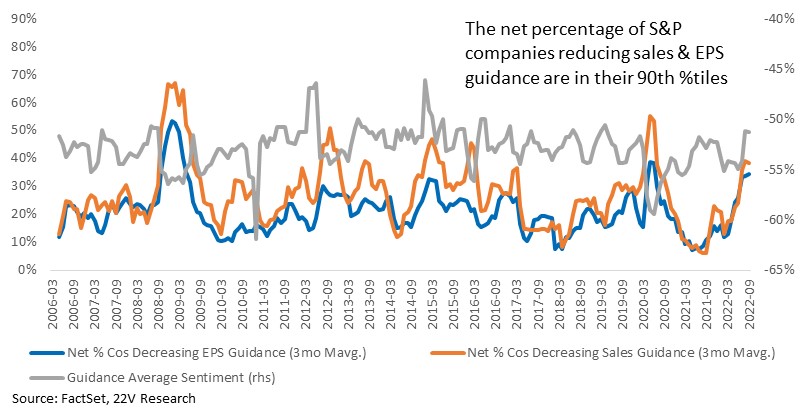
Signs of Stabilization Ahead of Reporting Season: Volatility remains high across asset prices, positioning is bearish, and macro uncertainty remains high. Into that backdrop, 3Q earnings reporting season is about to start, providing concrete readings about the impact of inflation and slower economic growth on corporate profits. The net percent of S&P companies reducing sales and EPS guidance has been climbing since early this year. Both readings are now in their 90th %tiles. Guidance has stabilized recently, suggesting near-term negativity may have peaked.
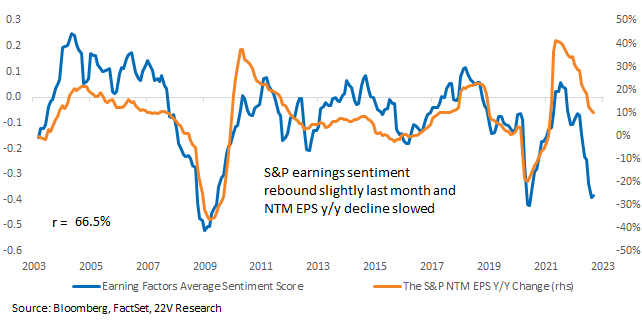
Declining leading indicators and the breadth of hard economic data show economic activity is continuing to slow. That is also reflected in NTM EPS estimates, which are declining on a y/y basis. Earnings sentiment, measured using the Amenity natural language processing tool, is near recession levels as well. How sentiment and guidance evolve during reporting will help determine the depth of the slowdown and the risk of a near-term recession.
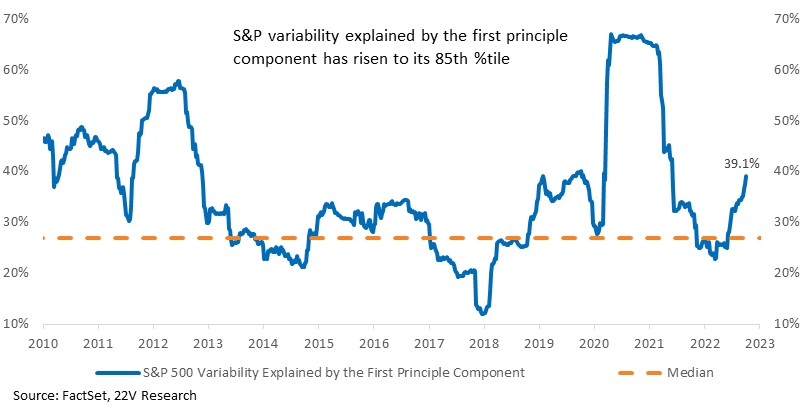
Macro influence over S&P volatility is high and climbing at a time of high macro uncertainty. That leaves the market susceptible to swings in sentiment. Reporting season will provide important signals about how rate hikes and financial condition tightening, but those readings will be hard to quantify. We apply the Amenity tool so we can objectively quantify how management sentiment is evolving at the company, industry, sector, and market level.
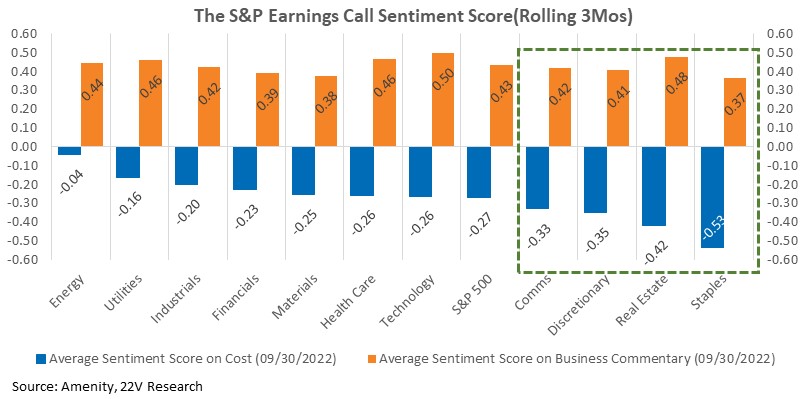
Negativity Toward Costs Easing: Since late August, inflation expectations have moved sharply lower, falling back to levels last seen in the Summer of 2021. Lower oil prices, supply chain improvements, and clear signaling by the Fed that inflation will not be tolerated have supported the decline. Inflation expectations are negatively correlated with S&P cost sentiment trends, suggesting management concerns about costs will ease further during reporting season.

The easing of cost pressures would be a tailwind for stocks with the most negative cost sentiment. Management sentiment toward the overall state of Business has remained broadly positive across sectors, suggesting the slowdown is not crushing demand. Groups that would benefit most from improved cost sentiment include Staples, Discretionary, and Communications. Real Estate would benefit as well, but the spike in mortgage rates and the Fed’s focus on easing labor market tightness will be an ongoing headwind for the sector.
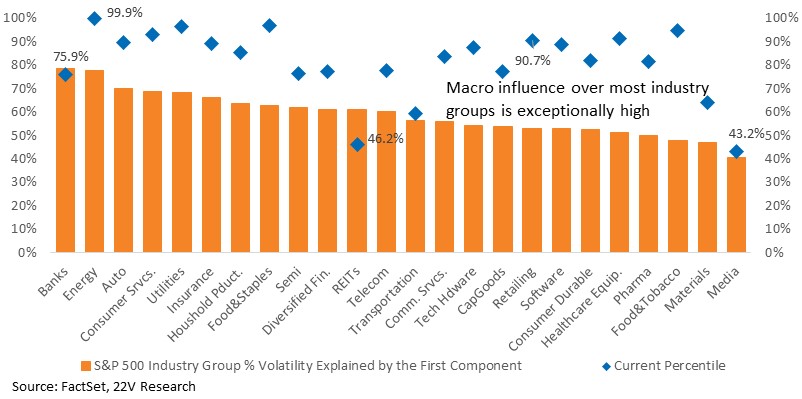
Macro influence over most S&P industry groups remains exceptionally high. Earnings narratives that indicate lower recession risk/less negative impact from rate hikes would support a broad recovery. Signs that rate hikes have a large impact on profits would be an ongoing headwind. Energy remains a nearly pure macro play, and Retail volatility is 90% macro. Median and REITs have the lowest overall macro influence.
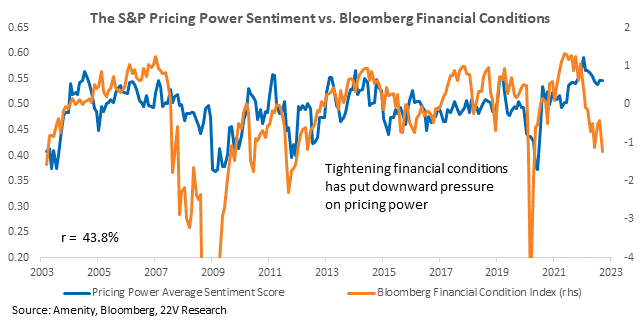
Financial Tightening Suggests Further Pricing Power Pressures: As the Fed hikes rates to reign in inflation, financial conditions have tightened to new 2022 highs. Part of the reason to raise rates is to ease inflation through lower margins (pricing power). Historically, tighter financial conditions are well correlated with changes in pricing power sentiment. Given the tightening this year, which accelerated over the past month, pricing power sentiment is likely to move lower in 3Q and 2H22.
Lower Pricing Power sentiment will continue to put downward pressure on overall Earnings sentiment. Readings for most companies have turned negative this year, reflecting the building pressure on earnings. Energy is the exception. As we showed above Energy vol is as macro-driven as it has ever been. Changes in oil prices continue to dictate sentiment for the sector. In general, Defensives still have better earnings sentiment than Cyclicals, with Utilities and Health Care leading Defensives, and Energy and Technology leading Cyclicals.
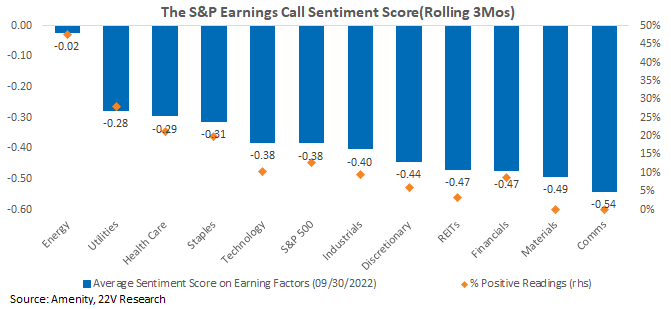
Some Cyclical Supports: It is worth noting that the earnings sentiment spread between Cyclicals and Defensives has improved over the past two months. Margin sentiment for Cyclicals is improving relative to Defensives. Improved earnings sentiment and margin sentiment should be a support for Cyclicals, particularly as yields backup, reducing the relative attractiveness of high-yielding, slower-growing Defensives.
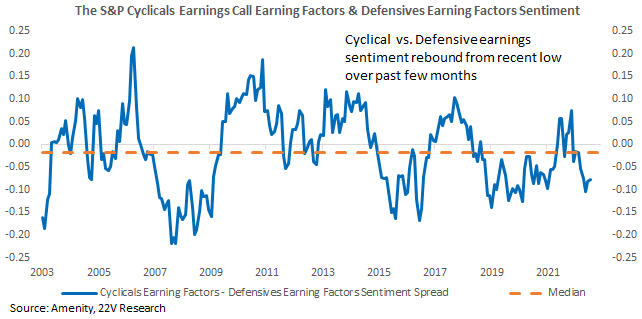
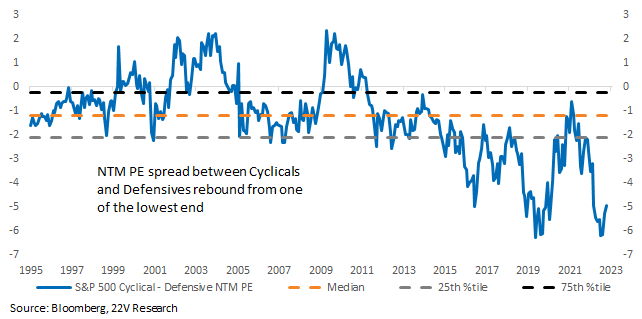
As Cyclicals underperformed Defensives this year, the NTM PE spread between Cyclicals and Defensives fell to a new multi-decade low. The extreme level is unlikely to persist and hedging weakness in the best performing sectors this year, including Utilities and Defensives in general, has become expensive now (report HERE). Recently, the PEs of Cyclicals have rebounded relative to Defensives. The initial phase of that was Cyclicals falling less quickly than Defensives, but over the past few days, Cyclicals have also risen more rapidly. Improving Cyclical sentiment readings would support ongoing relative gains.