Payroll Survey: We are running a very short survey ahead of Payrolls. Please take 45 seconds to fill out HERE. We will publish the results Thursday.
China Webinar: Michael Hirson, 22V’s new China analyst, is hosting a 4Q outlook webinar today at 10:30 AM ET. He’ll be covering the Party Congress and will discuss why a large fiscal stimulus is unlikely, and a pivot away from zero-Covid should not be expected. We highlight some of his points, and the implication for sectors, in the full report below. Webinar registration link HERE.
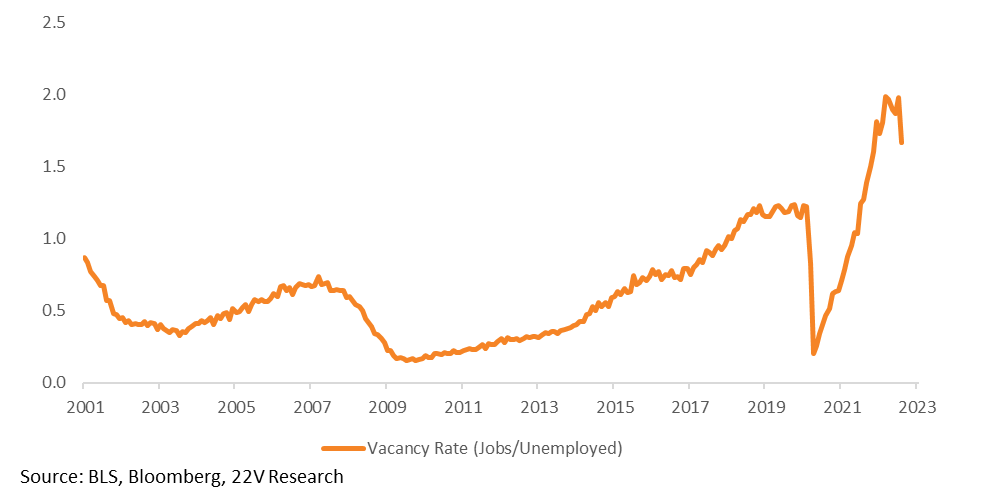
SUMMARY: The S&P has rallied +5.7% in two days, a 99.6th percentile, exceeding what was implied by the elevated VIX. Equity returns have been extreme, but so have positioning and sentiment. So, the rally is unusual, but less so under today’s backdrop. Data has helped. The vacancy rate (jobs per people unemployed) dropped significantly in August (JOLTS data is delayed). It’s still too high, but trending in the right direction. This is another weaker but not too weak data point. With multiple Fed governors either more worried about the shock risk from tightening (Brainard) or suggesting the Fed won’t go exactly to 2% on inflation (Williams), the case for an extended short squeeze is building if there is more JOLTS-like data. We are watching Payrolls Friday and CPI next Thursday.
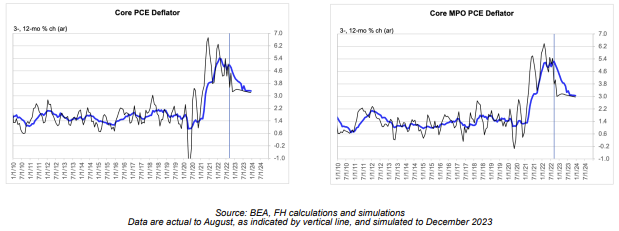
Gerard has an updated middle-up inflation simulation (HERE). He thinks goods deflation will bring inflation low enough to allow the Fed to soon pivot its rhetoric around the path of instruments. But inflation trends remain at odds with the notion that the Fed can pivot on its growth objectives. The Fed continues to pursue below-trend growth and that will probably involve a rising unemployment risk and the significantly heightened risk of recession.
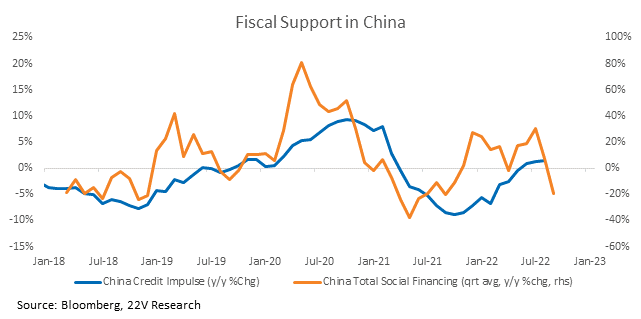
On China, Michael Hirson thinks Beijing is unlikely to announce major stimulus or policy loosening in Q4. The continued disinflationary impulse from China is a silver lining for the Fed and ECB, who can keep thanking Beijing for making their inflation fight easier. And Michael thinks a shift in language on zero-Covid at the Party Congress next week — if it comes at all — will likely only be the rhetorical start of a pivot that doesn’t gather steam until next spring at the earliest.
Low odds of meaningful fiscal stimulus and low odds that China backs away from zero-Covid quickly are a risk to deep Cyclicals (Energy, Materials), but ultimately good for other Cyclicals and risk assets in general. Most stocks/Cyclicals benefit from central bankers not having to combat renewed demand. The PE spread between Cyclicals ex Energy and Materials and Defensives is closing faster than that of ALL Cyclicals vs Defensives.
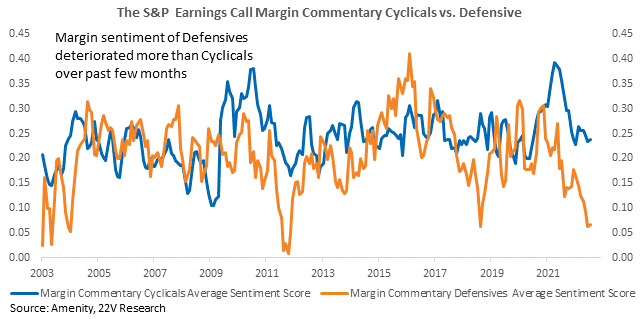
Importantly as reporting season approaches, Cyclicals margin sentiment is better than Defensives. Pricing power is and will be under pressure, so easing cost sentiment and firm profitability outlooks will be increasingly important over the coming quarters.
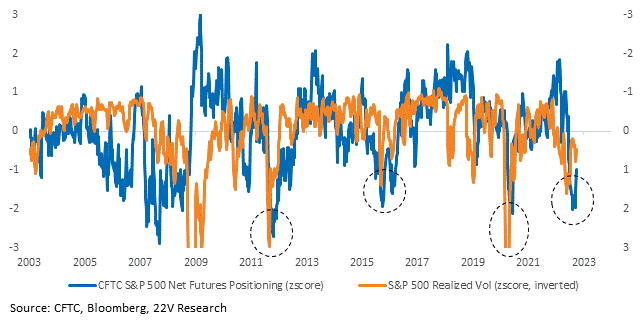
MARKET VIEWS: The Eurozone services PMI came in at 48.8, down from 49.8 in August, on weakness in the UK, Germany Italy, and Spain. The US flash service PMIs are stronger (final readings due today). Persistent strength while the rest of the world weakens is a Dollar tailwind, which is higher this morning. Weakness in today’s service PMIs would make us more comfortable that equities can move higher, but our fair value range remains 3,800-4,200. Breaking out of that range will require lower macro and policy uncertainty.
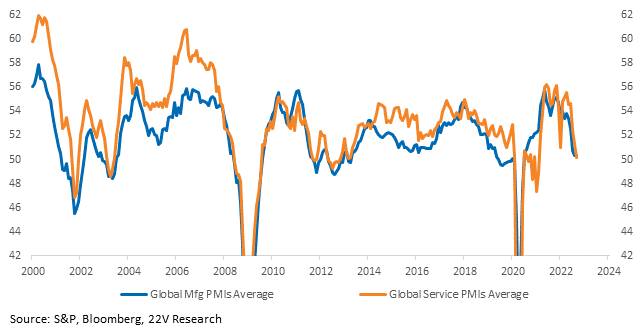
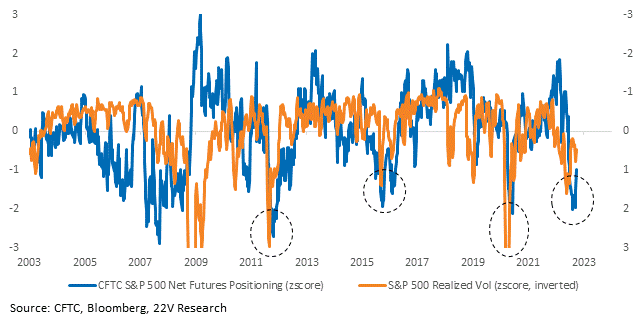
The S&P has rallied +5.7% in two days, a 99.6th percentile move. Equity returns have been extreme, but so have positioning and sentiment. So, the rally is still unusual, but less so under this backdrop. The index lost -4.3% in one day on September 13. Put simply, multiples were taken down -2 points in a month on a macro-driven narrative shift, so they can recover quickly too. 3800 was the bottom of our fair value range and we are back near that today. That doesn’t mean the bear market is over.
Data has been helping the narrative improve. The vacancy rate (jobs per unemployed) dropped significantly in August (JOLTS data is delayed). It’s still too high, but trending in the right direction. This is another weaker but not too weak data point. With multiple Fed governors either more worried about the shock risk from tightening (Brainard) or suggesting that the Fed won’t go exactly to 2% on inflation (Williams), you have the case for an extended short squeeze if you have more JOLTS-like data. We are watching Payrolls Friday and CPI next Thursday. Market volatility is and will remain high until macro/policy uncertainty moves lower.
Gerard has an updated middle-up inflation simulation (HERE). Goods deflation will slow core to about 3 1/4% by the end of next year, despite increasing service inflation. Gerard thinks that is probably sufficient to allow the Fed soon to pivot on its rhetoric around the path of the instruments, but it still remains at odds with the notion that the Fed will pivot on its growth objectives. Accordingly, the Fed is going to continue to pursue below-trend growth to reduce underlying inflation pressures, which will probably involve a rising unemployment risk and the significantly heightened risk of recession associated with that. They may soon pivot on the instrument path, but not the growth objective.
China & Cyclicals: Michael Hirson, 22V’s new China analyst, published a 4Q outlook report yesterday (HERE). We encourage everyone to check it out. Couple of main takeaways… Michael thinks Beijing is unlikely to announce major stimulus or policy loosening in Q4 sufficient to offset weak domestic demand. The continued disinflationary impulse from China is a silver lining for the Fed and ECB, who can keep thanking Beijing for making their inflation fight easier.
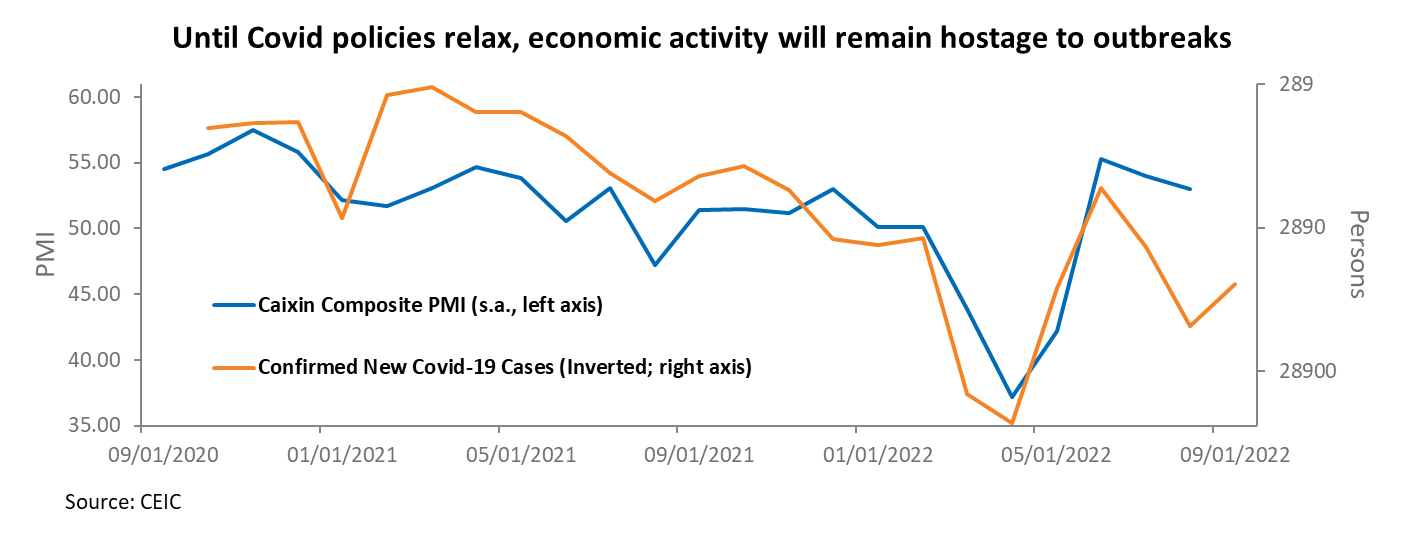
And Michael thinks a shift in language on zero-Covid at the Party Congress next week — if it comes at all — will likely only be the rhetorical start of a pivot that doesn’t gather steam until next spring at the earliest and proceeds in a highly cautious manner (monitoring this pivot will be a central theme of 22V’s China coverage in coming months). Covid policies for the bulk of 2023 and perhaps beyond will consist of high-frequency mass testing in major cities, targeted and even broad lockdowns when necessary to prevent an explosion of cases, and marginal loosening of external and internal movement restrictions.
The combination of low odds of meaningful fiscal stimulus and low odds that China backs away from zero-Covid quickly is a risk to deep Cyclicals (Energy, Materials), but ultimately good for other Cyclicals. Deep Cyclicals are missing the tailwind from renewed demand, but other Cyclicals benefit from central bankers not having to combat renewed demand. The PE spread between Cyclicals ex Energy and Materials and Defensives is closing faster than Cyclicals vs Defensives.
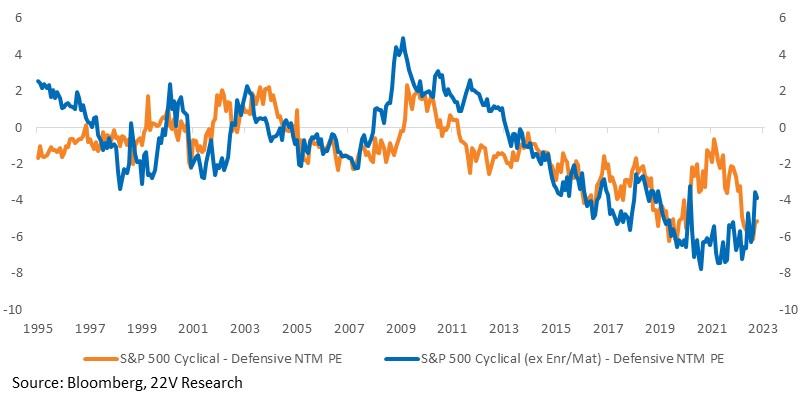
Also, Cyclicals margin sentiment is better than Defensives, which will be an increasingly important tailwind as inflation (pricing power) falls. Pricing power is and will be under pressure, so easing cost sentiment and firm profitability outlooks will be increasingly important over the coming quarters.