
SUMMARY: This midterm election has been a national exercise at least since last September. The US withdrawal from Afghanistan, gubernatorial elections in New Jersey and Virginia, inflation’s relentless bite, the very public termination of the administration’s signature fiscal plan, and then the war in Ukraine became a mix of political and economic drags on President Biden’s popularity. Even before last fall, former President Trump made clear he would remain a political factor. These developments worked against Democrats and for Republicans until last spring when the dynamic flipped, and public sentiment indicated a divided Congress was possible.
Midterm’s Sentiment Still Indicates a Divided Congress
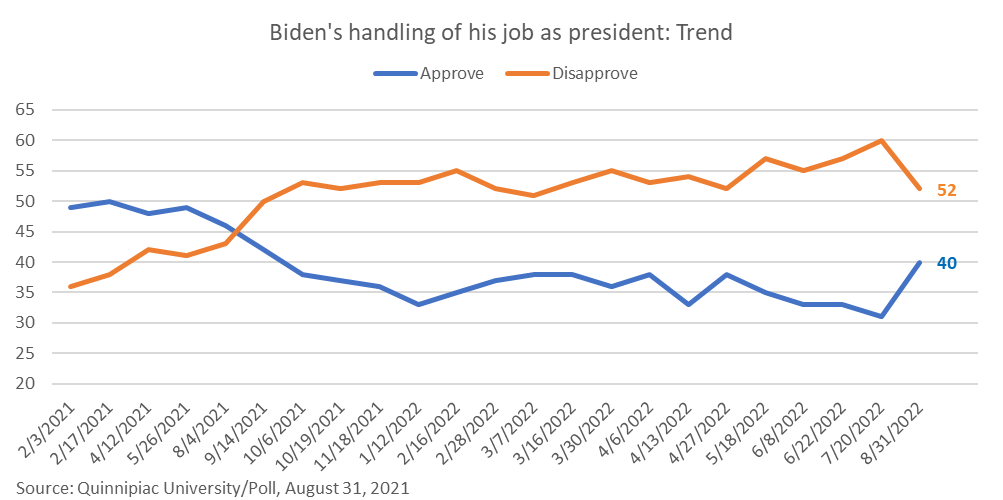
Electoral trends in place most of this summer point still to a divided Congress next January. Two notable developments bolster the likelihood that Republicans will assume control of the House of Representatives and Democrats will retain the Senate gavel. First, a productive summer agenda that appealed to many Americans or at least wasn’t vanquished by partisan overreach, produced constructive policy headlines. Second, the current and most recent former president saw their approvals move in opposite directions after nearly a year of ratings headwinds for the current officeholder. As the graph above shows, Biden’s fortunes improved with policy results not geopolitics or the Supreme Court’s Dobbs decision. Trump’s support generally and within some factions of the GOP has weakened as House hearings and Department of Justice investigations explored his actions during the final months of his tenure.
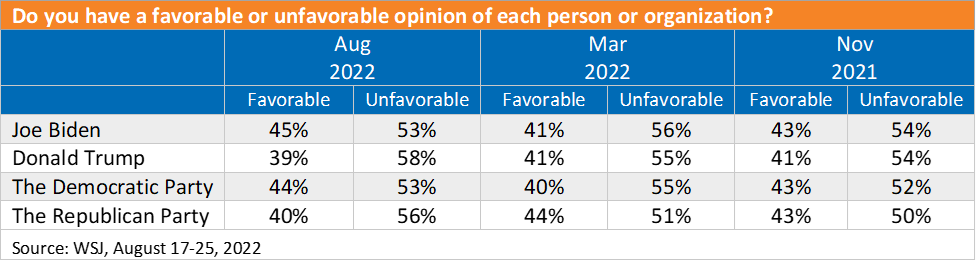
The following key points highlight current sentiment and risks:
- Balance of power scenarios driven by public sentiment point to a divided Congress, the House outcome seems less certain than even a month ago when it seemed Republicans would retake it by a large margin. Two recent surveys provide data to show this change in sentiment. Status quo in the Senate is likely with questions centered on whether the Democrats can extend their current majority rather than lose their advantage.
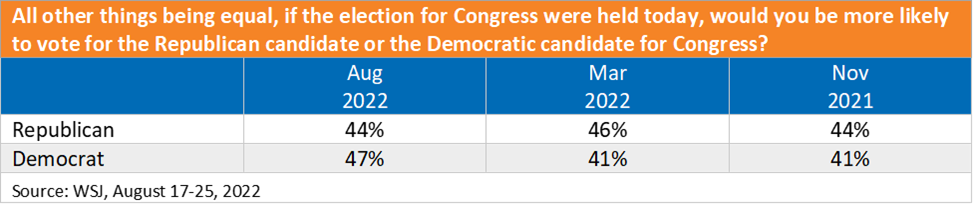
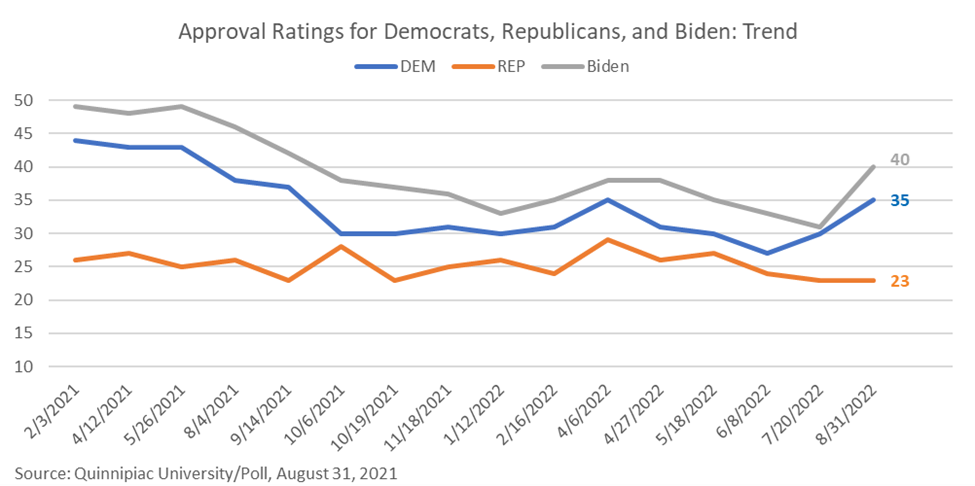
- The current Congress was sworn in months after a contentious election and once-in-a century pandemic, resultant economic shock that upended supply and demand chains, and rare combined monetary/fiscal super stimulus. In the past seven quarters, policy agenda accomplishments and public sentiment have moved away from the left and right extremes and toward moderation. Infrastructure, semiconductor, and energy/climate legislation enacted during this period were shaped by this moderation.
- In this environment, macro risk management premiums are on monetary and geopolitical policies. US fiscal programs are a net drag as the rate of growth in deficits and debt has slowed significantly since the end of extraordinary stimulus. Investors likely won’t have fiscal risk to worry about until a year from now when Washington in whatever balance of power likely will need to raise the debt limit.
- Top concerns of registered voters naturally have and will guide campaign commercials. Inflation (and the economy, generally) and abortion (along with other social issues) top those lists but perceived threats to democracy is a topic spiking in most sentiment surveys and illustrated in the below poll.
The past year in Washington reinforces the importance of Senate voting margins. A 50/50 Senate didn’t work well for Democrats until fiscal and sector policies were pushed away from aspirational to more moderate strategies. It wasn’t a smooth process, but the results validate the thesis. The chart below demonstrates cycles in Senate ideological control over the past 40 years in which Republicans led three times and Democrats led twice. This supports our political moderation theme. After plenty of volatility 1980–2009; the margin of Senate control has steadily diminished. We’re not suggesting a pre-ordained voter strategy, but outcomes demonstrate the appearance for a preference of increasingly tighter margins the past 12 years. Academics debate cause and effect of split-ticket voting while acknowledging its existence. If the cycle is changing our sense is that the moderation of the past seven quarters is the more likely winning strategy for the Senate majority.

Midterm results inform presidential re-election strategies. President Biden is using his recent ratings recovery to plan for 2024; Democrats serving in the 118th Congress and voters nationally will influence that plan. Republicans are engaged in an equally, if different, contemplation over their 2024 standard bearer. Former President Trump’s viability in that process will be influenced by a loyal base, a range of legal challenges of minor to major potential consequences, and a related GOP internal leadership debate.
Biden/Trump headlines remain politically divisive and along with economic and social policy voter concerns feed the national veneer of this off-year election. A likely divided 118th Congress grabs the most attention and may well define DC’s risk profile next year. Feeding back into the moderation theme, the last seven quarters demonstrate governing from extremes has become more fraught. It’s probable that a political Hippocratic Oath may be a keeper. In a post-pandemic, possibly pre-recession environment voters favor policies supportive of economic and national security.
Public sentiment trends suggest the House is in play more than seemed possible earlier this year, owed to social policy reactions (especially abortion) and national perceptions of the current and most recent past US presidents. Regardless of midterm election results, tight margins in both houses of Congress seem all but assured. Such a result won’t produce benign gridlock, but it should diminish odds of 2024-focused partisanship changing the current policy moderation cycle in place.

