SUMMARY: 45% of clients we surveyed think the Payroll report will be stronger than expected (30% thought lower, the rest were inline), and 80% think markets will be risk-off if payroll data is higher than expected. The “stubborn” (from the Fed’s point of view) strength in the US economy is why UST yields have had a 99th% tile MoM move higher. Investors might have already priced in a strong payroll, which could lead to a short-term rally if payroll comes in inline or slightly below expectations.
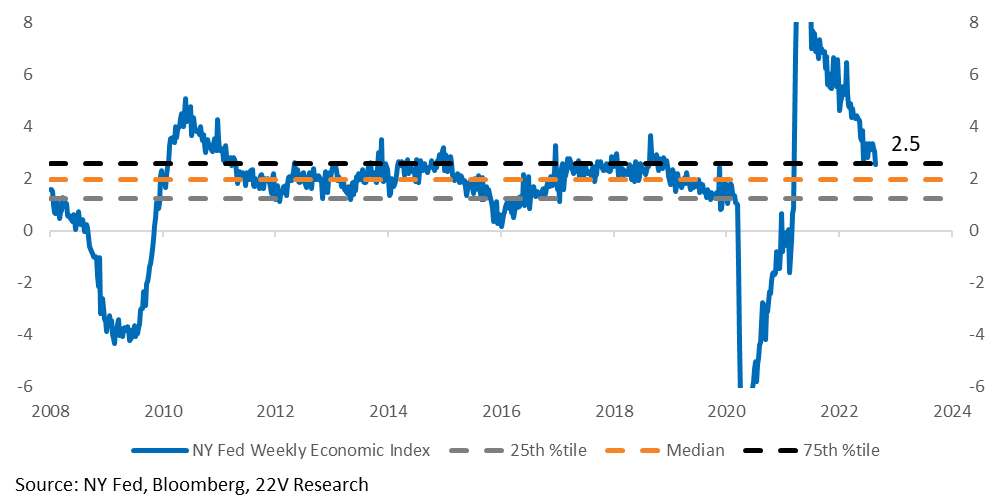
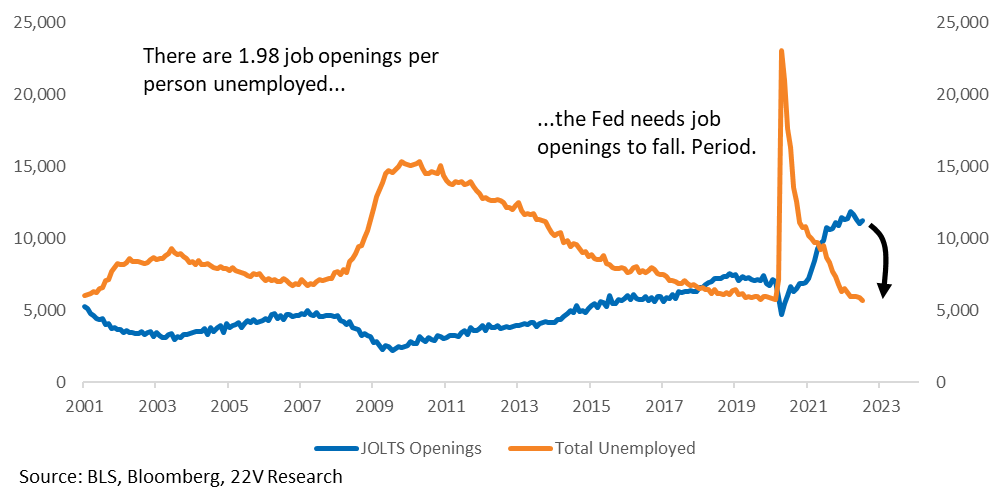
The above being noted, economic growth is still running well above trend according to the NY Fed’s weekly economic indicator, and the labor market is still tight. The latest reading from the JOLTS shows 1.98 job openings per unemployed person. Underlying demand (consumption/investment) needs to slow before risk assets have a chance to stabilize and start a sustained rally.

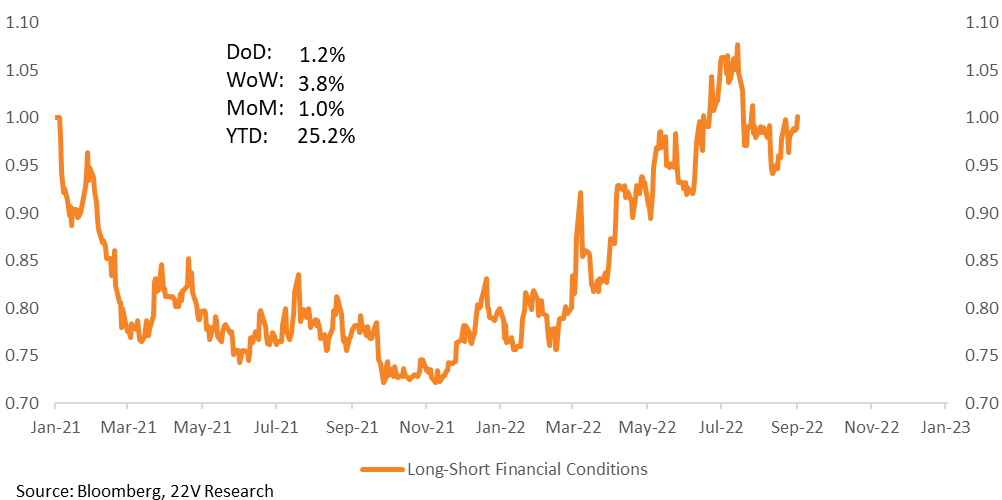
Bottom Line: Our portfolio of stocks that benefit from tighter financial conditions should continue to outperform, while labor markets are tight (job openings super elevated relative to unemployment) and demand growth is running above trend. When the NY Fed weekly Economic Index is consistently indicating 1% or below on growth (Fed has trend GDP at ~1.8%), financial conditions can ease some without causing a policy reaction, and investing in stocks that benefit from tighter financial conditions will not make as much sense. Growth and Profitability will be much more interesting then as well, relative to more purely Defensive positioning.
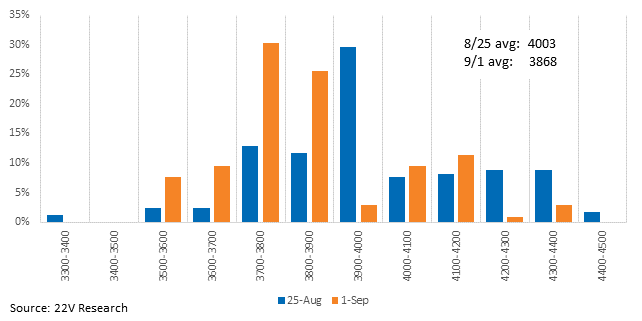
As our latest survey showed (HERE), investors think the S&P will end September around 3,870 range, down -11% from the recent high. We would not press shorts around those levels. PCE growth is headed lower (just maybe not low enough by 1Q of next year), and unless economic growth accelerates from here and terminal rate expectations move much higher, being short at that level will be tough. A couple of 500k payroll reports (today and in September) could change our view.
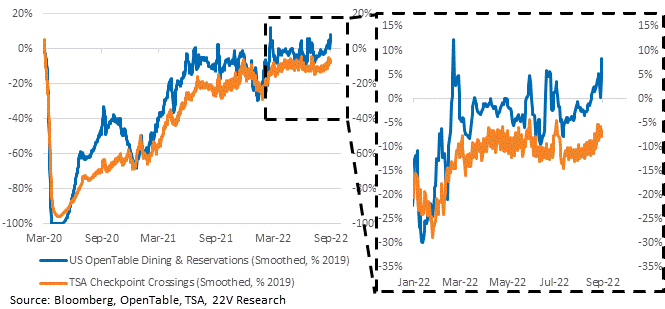
Side Note: The last time UST yields were this high the S&P was almost 200 pts lower. The differences this time are that oil prices are lower, supply chains are clearly easing (see the collapse in PMI output pricing readings yesterday), and inflation expectations are anchored. Bottom line, the real growth outlook has improved with demand remaining firm and some inflation indicators moving lower, which would normally be a good thing for risk assets. The problem is the labor market is still too tight, and spending is still strong. Spending could fall off quickly after the “revenge travel” season, which starts next week, and we will be following TSA/OpenTable data closely to see if that happens. If spending/labor market data doesn’t slow, terminal rate expectations are going higher.
Full report below…
MARKET VIEWS: 45% of clients we surveyed think Payroll data will be stronger than expected (30% lower, and the rest were inline), and 80% think markets will be risk-off if payrolls beat. Data has been strong, and the US economy seems to have regained momentum over the past month. The “stubborn” (from the Fed’s point of view) strength in the US economy is why UST yields have had a 99th% tile MoM move higher. Investors might have already priced in a strong payroll, which could lead to a short-term rally today’s reading is in inline or slightly lower than expected. But economic growth is still running well above trend according to the NY Fed’s weekly economic indicator. Underlying demand (consumption/investment) needs to slow before risk assets have a chance to stabilize and have a chance of a sustained rally.
The last time UST yields were this high the S&P was almost 200 pts lower. The differences this time are that oil prices are lower, supply chains are clearly easing (see the collapse in PMI output pricing readings yesterday), and inflation expectations are anchored. Bottom line, the real growth outlook has improved as demand stays firm and some inflation indicators move lower, which would normally be a good thing for risk assets. The problem is the labor market is still too tight, and according to the JOLTS data there are 1.98 job openings per person unemployed. That ratio needs to go back to zero at the very least and it is unlikely to move lower if US demand is still running above trend.
If the payroll number is much weaker than expected, financial conditions could have some easing bias. But even a 200k number (consensus 300K) would be consistent with a strong labor market and bias the Fed to keep financial conditions tighter.
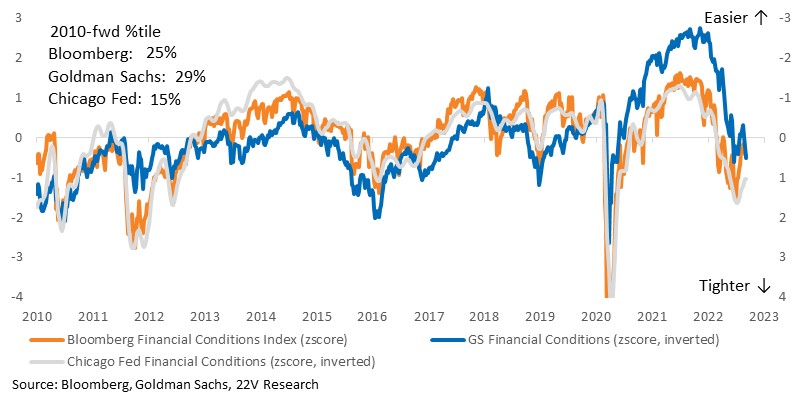
Our portfolio of stocks that benefits from tighter financial conditions should continue to outperform while labor markets are tight (job openings super elevated relative to unemployment) and demand growth is running above trend. When the NY Fed weekly Economic Index is consistently indicating 1% or below on growth (Fed has trend GDP at ~1.8%), financial conditions will be allowed to ease some, and investing in stocks that benefit from tighter financial conditions will not make as much sense anymore. Growth and Profitability will be much more interesting then as well, relative to just purely Defensive positioning.
September Returns: Last week, we asked for month-end estimates for the S&P. The average response was around 4,000. This week, that number has dropped to ~3,870. The majority of responses in both weeks were within 3700-4000, slightly worse than our estimate of fair value (3800-4200). People are still negative and pressing on the short side in the 3800 range will be difficult unless economic growth is MUCH stronger than expected.
One theory as to why demand growth has been unusually strong has to do with “revenge travel” idea. People haven’t been be able to travel or go out freely for two years, so are spending at high levels despite housing activity slowing, savings a bit lower, real incomes very weak, long lines at the airport, high gasoline prices etc., etc., We’ll be monitoring TSA crossings and OpenTable res data this fall. If the “revenge travel” theory is correct, TSA crossing and OpenTable reservation data should fall off quickly this fall. Open Table has been unusually strong recently.