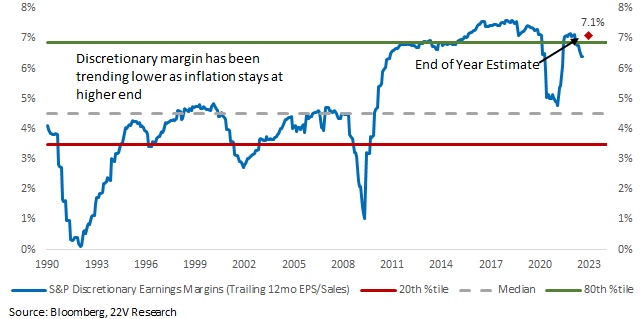
Discretionary has been the worst performing sector this year, underperforming the S&P by -7%. All four industry groups within the sector underperformed as the Fed fights high inflation in part by trying to slow consumer demand. There has been no shortage of headwinds facing the sector. Revenue pressures from a strong Dollar, financing headwinds from increased borrowing costs, margin pressures from a tight labor market and supply chain issues, and earnings pressures from the Fed fighting inflation. Discretionary sector profitability remains at the high end of its historical range but has fallen 75bps while index level margins have remained stable.
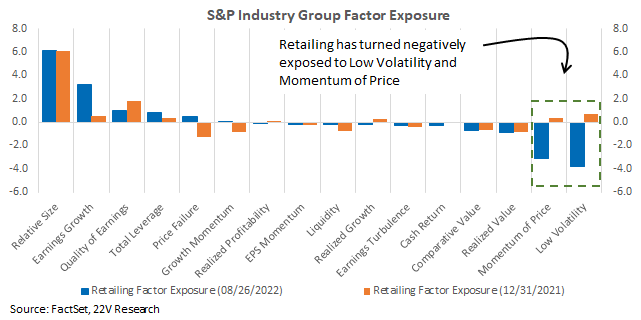
Declining profitability has come along with an internal shift in Discretionary industry group factors exposures. Retail, which had been levered to Low Vol and Price Momentum, is now under-exposed to both factors. That shift is important for two reasons. 1) Retail, though underperforming, has been the best performing Discretionary industry group, and 2) Low Vol and Momentum tend to be among the best performing factors within Discretionary as financial conditions tighten.

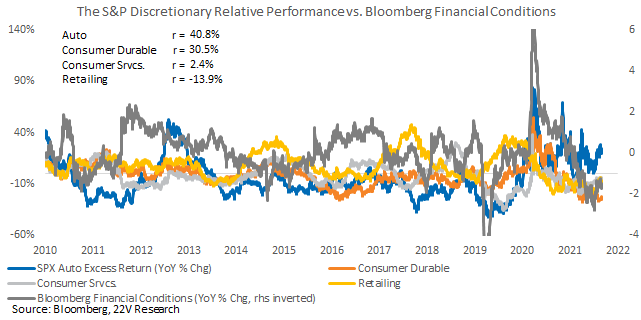
Historically, Auto and Consumer Durable have been most positively correlated with changes in the Bloomberg Financial Condition Index (they underperform as conditions tighten) while Retail has been negatively correlated. Longer-term, changes in labor market tightness and profitability as inflation subsides should drive macro returns, but near-term, financial condition volatility should remain an important contributor to industry group volatility.
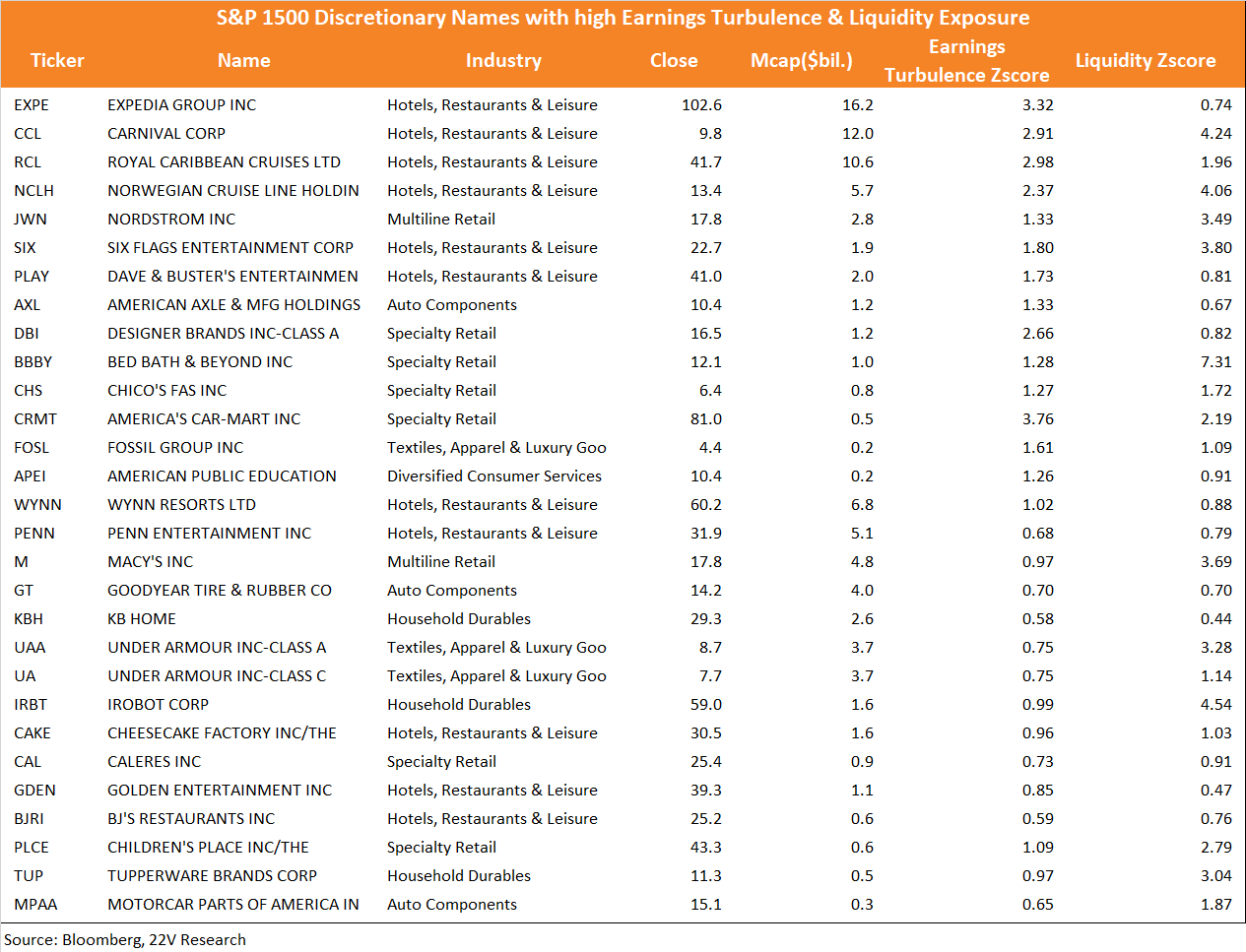
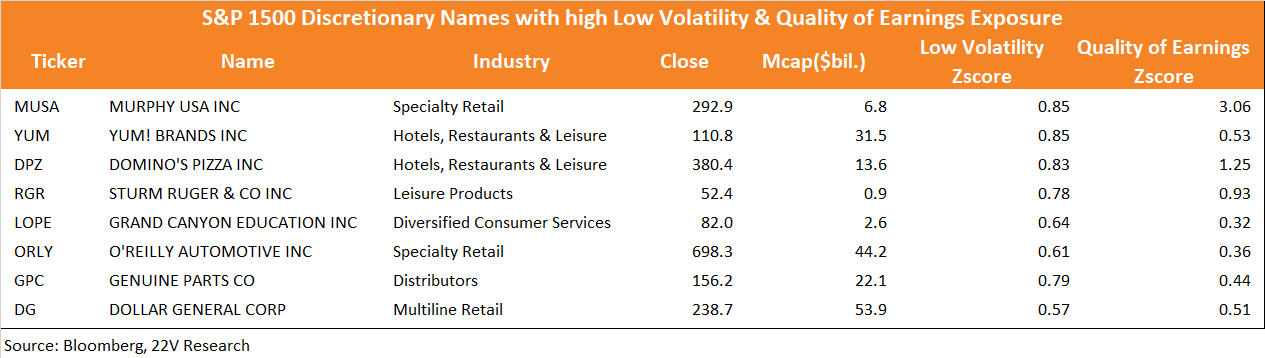
Retails Quality exposure should support the space, but the industry group should struggle relative to other Discretionary industry groups over the coming months as conditions retighten. We recommend screening within the sector for Low Vol, and Quality names, and list those stocks at the end of this report. We also highlight a list of possible shorts, which are the stocks most exposed to high Earnings Turbulence and Liquidity.
Retail Headwinds as Discretionary Factor Exposures Shift: Discretionary has been the worst sector YTD with all four industry groups underperforming. There has been no shortage of headwinds facing the sector. Revenue pressures from a strong Dollar, financing headwinds from increased borrowing costs, margin pressures from a tight labor market and supply chain issues, and earnings pressures from the Fed fighting inflation. Corporate profitability has remained extremely strong, complicating the Fed’s pursuit of lower inflation, but S&P Discretionary margins have fallen 75bp from their 2021 peak. Discretionary sector profitability remains at the high end of its historical range but is falling while most sector-level margins remain stable.
Changes in financial conditions are influencing Discretionary returns as well. In the face of broad consumer headwinds, Auto and Consumer Durable, which have the most positive correlation with financial conditions (decline as financial conditions tighten), have been the worst performing Discretionary industry groups. Retail, the most negatively correlated with Financial conditions, has been the best performer. Longer-term, changes in labor market tightness and profitability as inflation subsides should drive macro returns, but near-term, financial condition volatility should remain an important contributor to industry group volatility.
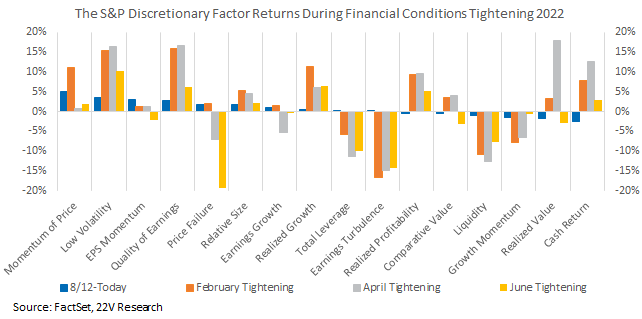
Consistent with the broad market, within Discretionary Low Volatility, Quality of Earnings, Realized Growth, and Momentum of Price outperformed during periods of tightening financial conditions. Liquidity, Earnings Turbulence, and Total Leverage were the worst performing factors within the sector. The start of tightening since mid-August has spurred another round of gains by risk-off factors, but Earnings Turbulence and Liquidity names have gained as well. As financial conditions tighten further, high Earnings Turbulence and Total Leverage names should weaken.
Currently, Autos and Retailing are most negatively exposed to Low Volatility, while Consumer Durables and Services are positively exposed. Retailing is also negatively exposed to Momentum of Price. That factor profile suggests better relative positioning for Durables and Services during the near-term tightening of financial conditions. Factor exposures remain a headwind for Autos, but are also a risk to Retail, the group that has typically performed best as conditions tighten.
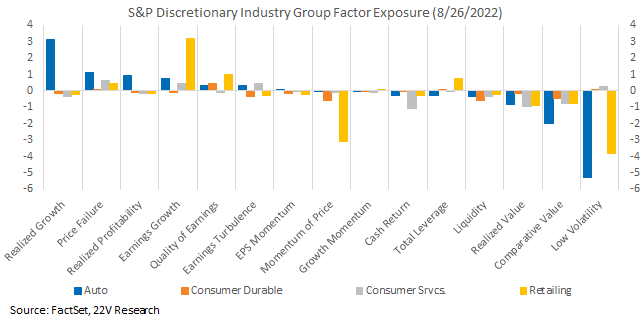
Factor exposure of Retailing has shifted this year as the industry group faced downward earnings pressure. At the start of the year, Retail was buoyed by positive exposure to Low Volatility and Momentum of Price, which was a relative support for the group. Today, those exposures have turned deeply negative, which suggests weaker Retail performance during the current round of tightening. The group is still overexposed to Quality, and we would favor those names over the coming months as the Fed pursues slower growth through tighter conditions.
Below we list the S&P 1500 Discretionary names that fall in the high Low Volatility and Quality of Earnings basket. The names are more likely to benefit from tightening financial conditions based on their factor exposure.
The short list is below, including the S&P Discretionary names with high Earnings Turbulence and Liquidity exposure. The expected tightening of financial condition will bring more headwind to the factors, and the names within Discretionary will be likely to underperform.