SUMMARY: Respondents to our investor survey expect headline payrolls ~230k, 35k short of consensus (265k). If payroll comes in at 100-200k the everything rally should remain intact. That range would reinforce lower inflation AND low recession risk. Low Volatility comes under pressure and all Cyclicals work (Tech/Energy… Cats & Dogs living together). 300k and above would support Value and Low Volatility short term. Commodity prices on a relative basis and short and long rates move higher (mostly short rates., but bad for our call that bond yields are topping).
If Payrolls are roughly in-line, internals of the report will matter more. We’ll be monitoring the urate, AHE, hours worked, etc., to glean consumer strength and inflationary pressures. Stronger consumer = lower near-term recession risk but a worse near-term outlook for inflation (and an aggressive Fed). Keep in mind the labor market is still tight on an inline payroll reading.
FYI…the VIX hits its lowest level in a month yesterday, but investors don’t seem to think the drop will be sustained. The volume of VIX calls was significantly higher than the volume of puts yesterday, indicating investors are positioning for a higher VIX. This is consistent with investors being most focused on Inflation and payroll data. The Fed is data dependent and the two biggest data points are just ahead of us. What happens today and next Wednesday with CPI will determine market internals for a while.
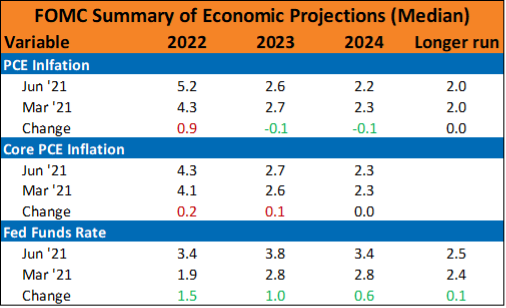
We write an important section on how to think about how the Fed will achieve its goals and data dependence being critical. PLEASE READ IT. Short version, “, if you believe the Fed forecast of 4.3% on core PCE in 2022 heading down to 2.6% in 2023 is a “rough guide” on what they are trying to accomplish, a few things follow. If the economic data trends toward those goals, financial conditions don’t have to tighten more (this is not necessarily bullish, depends on recession risk). If data is too strong to achieve lower core inflation, the Fed will threaten to move the terminal rate higher. If data tracks well below the Fed forecast, there could be less tightening going forward. That means Fed guidance is data dependent. Follow the data.
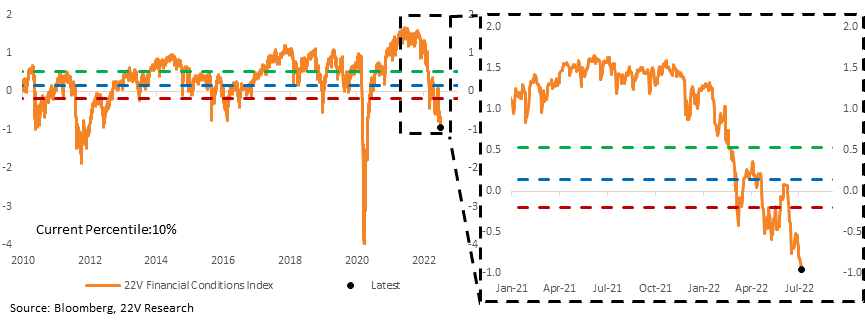
In the report we highlight the key considerations related to the above framework and what that means for sectors, factors & markets. We also take apart the idea that investors are pricing in rate cuts in 2023 being related to some type of Fed pivot. 2023 cuts being priced (from a much higher than the current rate) is because investors expect a sharp deterioration in economic growth. BECAUSE of the tightening of financial conditions happening NOW.
Full report below…
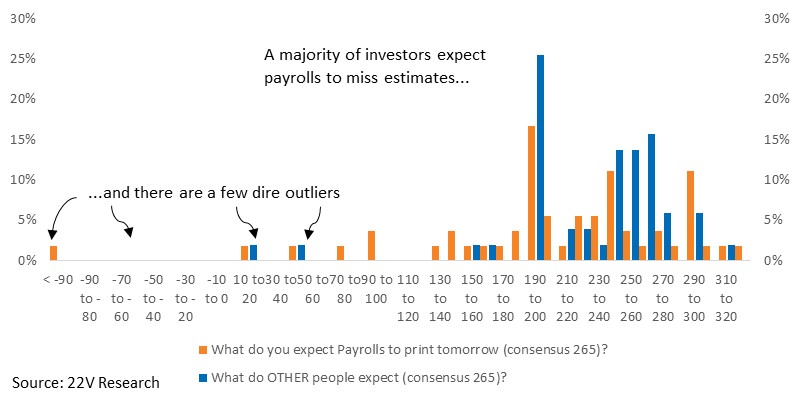
MARKET VIEWS: Investors in our survey expect payrolls to miss. Respondents expect ~230k, 35k short of consensus estimate (265k). Respondents suspect other investors anticipate a miss, but a smaller one (~250k). There are a few that expect a negative payroll print. 100-200k probably keeps the everything rally going near term. That range would reinforce lower inflation AND low recession risk. Low Volatility comes under pressure and all Cyclicals work (Tech/Energy…Cats & Dogs living together).
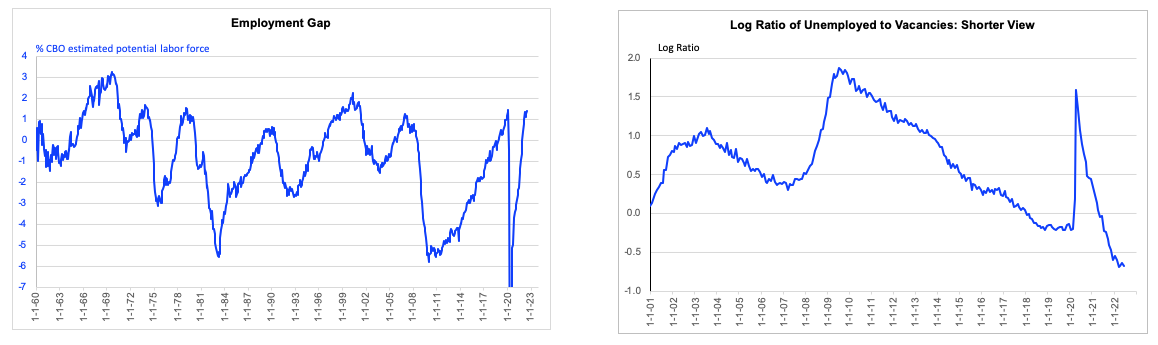
300k and above would probably restart the Value rally with the market lower and short and long rates surging higher. Especially if the urate declines to 3.5% and AHE are flat MoM (5% expected). Keep in mind the labor market is still VERY TIGHT, so even a consensus number is not bond friendly (yields would be biased higher). Bad for our longer-term lower bond yield call. FYI…Gerard’s measure of the employment gap would stop tightening, but still be very tight on a consensus number. So higher than consensus is an issue.
If Payrolls are roughly in-line, internals of the report will matter more. We’ll be monitoring the urate, AHE, hours worked, etc., to glean consumer strength and inflationary pressures. Stronger consumer = lower near-term recession risk but a worse near-term outlook for inflation (and an aggressive Fed). Yields would be biased higher. Related, the VIX hits its lowest level in a month yesterday, but investors don’t seem to think the drop is sustainable. The volume of VIX calls was significantly higher than the volume of puts yesterday, indicating investors are positioning for a higher VIX.
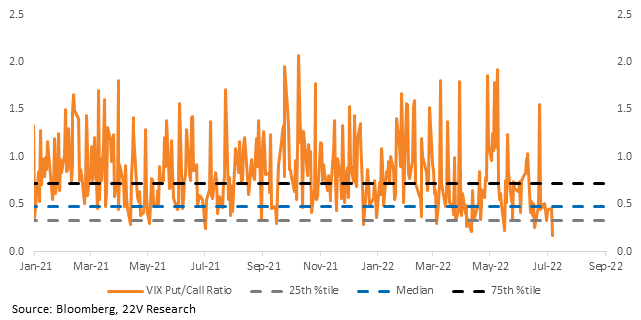
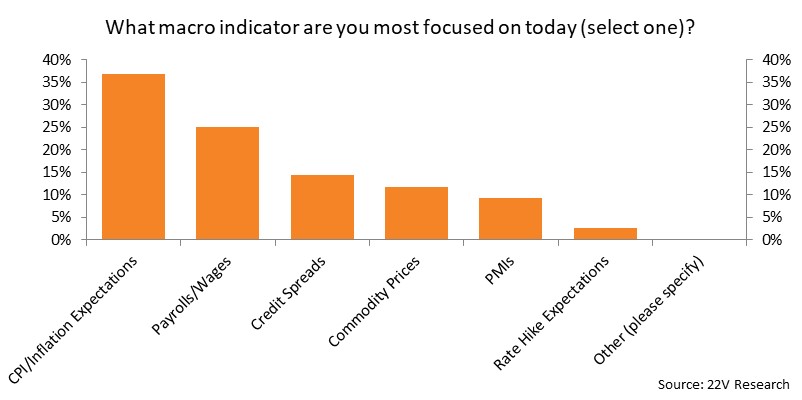
This fits with investors focus on Payroll/CPI from our investor surveys. Macro influence over equity volatility has been moving higher as growth slows and the Fed remains committed to fighting inflation despite rising recession risks. Respondents to our flash survey are most focused on inflation readings (35%) followed closely by payrolls (23%). Investors seem to have internalized the Fed’s data dependence.
How To Think About the Fed – We Feel Like We are Failing to Get Some Points Across: This is really important and we don’t if people have internalized how the Fed manages financial conditions. Here it goes…From Gerard to start “The Fed uses the expected path of the funds rate to deliver financial conditions that they judge will likely generate the least bad outcome for aggregate demand growth. And if the outlook for aggregate demand were to weaken, or if the economy started to act as though a given pace of aggregate demand growth might be less inflationary, then the Fed would be inclined to manage financial conditions to an easier setting, in large part by changing the rhetoric around the path of the funds rate.” And vice versa.

Which means…if you are “hawkish”, you think the fed needs to guide short rates higher and tighten financial conditions because economic growth and inflation are trending HIGHER than what the Fed has laid out as acceptable. What is “acceptable” if you believe the Fed forecast of 4.3% on core PCE in 2022 heading down to 2.6% in 2023. If we head to toward those goals…financial conditions don’t have to tighten more. If we are above those goals, the Fed would threaten to move the terminal rate much higher. If we start tracking well below the Fed forecast, the Fed could tighten by much less going forward. By definition, this means following the Fed guidance is useless. Follow the data.
Major Questions Related to the Above: 1) Is PCE going to slow toward the Fed target? If not (Waller seems to think growth is too strong), the Fed threatens to hike rates more. Short rates go up, real yield up, Growth stocks pummeled. If PCE growth does trend toward the Fed’s target AND a deep recession can be avoided (this week’s narrative), Cyclicals outperform, markets go up and Low Volatility stocks gets killed.
2) Will the blunt tool that is monetary policy lead to much higher recession risk near term? That was last week’s narrative. Many seem to think so. Growth outperforms, yields lower, curves invert and late Cyclicals (commodity sensitive, industrials, Financials) are in deep trouble. The S&P is flat at best and down to 3000 at worst (deep recession).
3) Soft landing possible? Maybe, but inflation would need to cool WITHOUT significant econ weakness. If inflation is not JUST supply driven, this is outcome is possible. We have sympathy for this view, but not a base case. Great for Cyclicals.
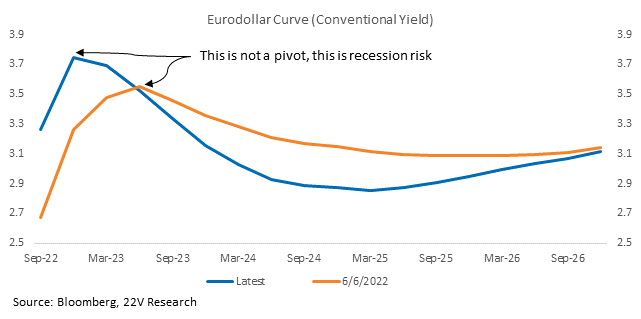
Keep This in Mind When Thinking About the Rate Path: This is counter intuitive, but important to internalize. The more the fed threatens to increase the fed funds rate, the higher likelihood they never reach a much higher fed funds rate target. For example, if mortgage rates go to 10% because the Fed is threatening to increase rates aggressively, Econ growth would crater and actual fed rate increases would not take place. Also, the Eurodollar futures curve is pricing in a deep inversion (cuts) in 2023. 1) who cares the Fed is data dependent and 2) this is related to investors pricing in much higher recession risk in 2023. So the Fed has to cut rates as the US economy moves into a recession. That IS NOT A PIVOT. It’s markets pricing in a negative economic reaction to current tightening of financial conditions.