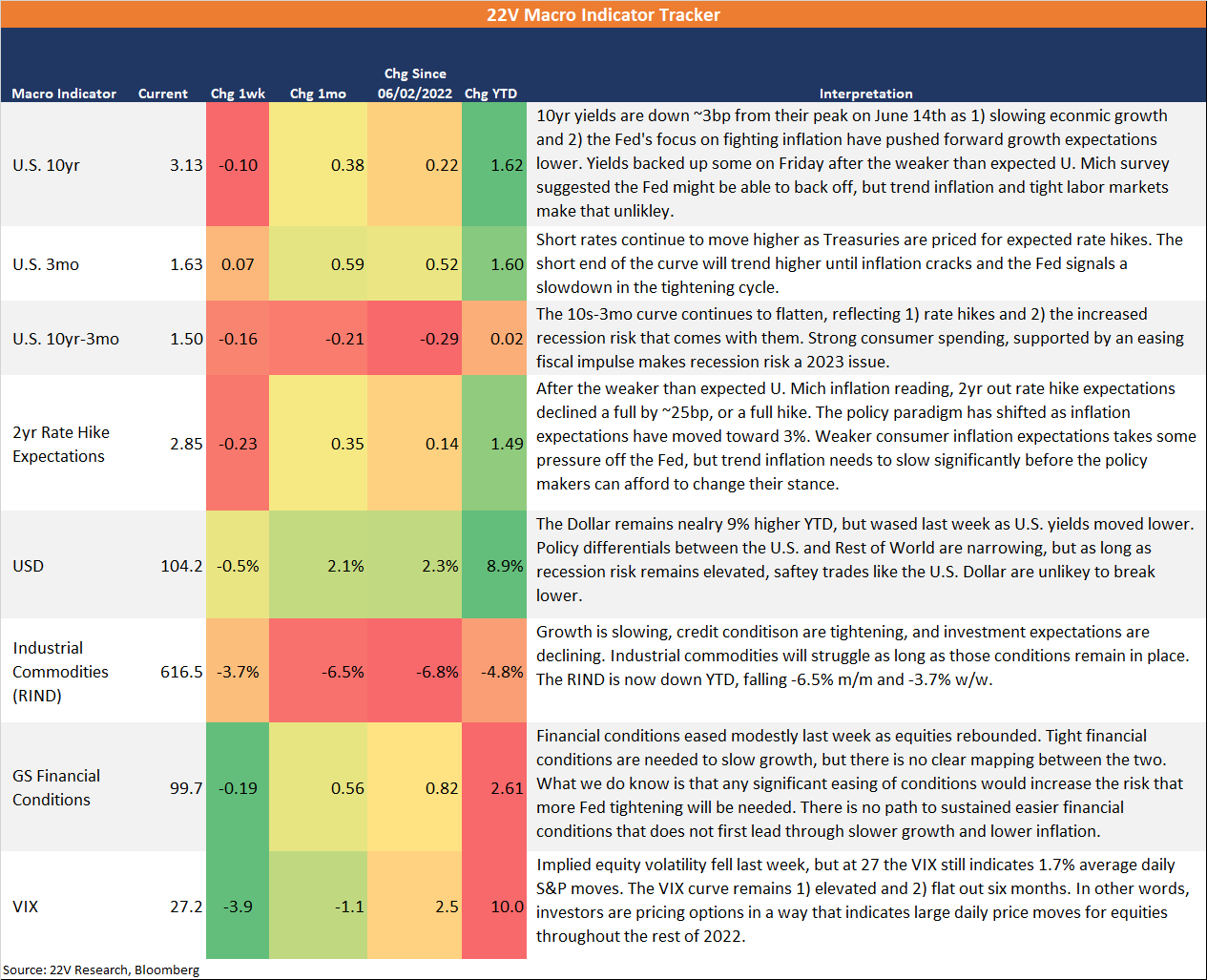
SUMMARY: Equities rallied and market internals shifted away from Value, which was the worst-performing factor w/w. Leading indicators of economic activity continue to move lower, and inflation expectations are well off their highs (5yr swap is at 3.11 from a high a 3.67 in March), and that is helping push Treasury yields lower. We have been vocally calling for a top in UST yields and that appears to be playing out as expected. 10yr yields fell about -10bp last week, and the 2yr was -12bp lower as well. Some consolidation of short rates should be expected as a new narrative is likely to form very short term.
Downside risks to inflation prints are building, but a recession is still likely 6+ months away. Although hours worked are declining and will continue to do so, the consumer still has momentum from high aggregate hours worked. Don’t expect the consumer to fall off a cliff in the next month. Also, the more inflation can be attributed to both supply and demand, and as it becomes clear supply constraints are easing, the less the Fed needs to crush growth. Inflation that is predominantly supply related is an easy path toward a deep recession being needed to offset inflation (See NY Fed Piece). Belief that inflation is supply related is why some people are calling for 4.5% to 5% fed funds.
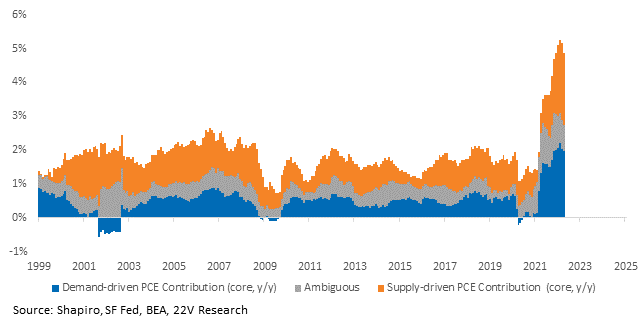
The SF Fed released a paper and data series separating demand-driven inflation from supply-driven inflation (here). They conclude supply is half, demand a third, and the rest ambiguous. If the SF Fed is correct, both demand and supply (ex-Energy) face headwinds. Supply chain sentiment has improved significantly and Shanghai to LA freight rates have declined meaningfully.
As supply constraints ease and a narrative of easing demand reducing inflation would benefit risk assets in general and Cyclicals relative to Defensives in particular (low Volatility factor will underperform). Recall, Cyclicals underperformed in the first part of the rally as rising recession risk drove commodity prices and rates lower, so Staples, Utilities, Healthcare, and Real Estate outperformed. Expect the market to rally to John Roques 4000-4200 range and IG/HY spreads to narrow. Howard Marks said in his most recent letter that he is “turning aggressive” in snapping up bargains in credit.
Also, unless inflation data surprises to the upside, don’t expect the Fed funds rate path to change much from here. Which will limit changes in financial conditions. At least until the July meeting. SF Fed Daly (leans pretty dovish) said the starting point for a July hike is 75bp. We should expect FOMC members to continue signaling 75bp and not much beyond that. They are data dependent.
Lastly, the above is a short-term call that recognizes the growing headwinds to inflation and that a recession, if it happens, is still 6+ months away. The market is not in an all-clear place at all. The Fed still needs to take on recession risk to slow inflation. That is the direction of travel. We are just trying to be nimble short term.
MARKET VIEWS: Risk assets are higher across the world this morning on hope China’s outlook is bottoming and that the decline in inflation expectations will support risk assets. After a 99th%tile WoW decline in 10yr yields, expect some consolidation. Here is why. A new short-term narrative will likely develop if it appears inflation is starting to turn lower. The narrative will be that lower inflation reduces recession risk. That would benefit risk assets in general and Cyclicals relative to Defensives in particular. Cyclicals underperformed during the first part of the rally as rising recession risk drove commodity prices and yields lower, benefiting Staples, Utilities, Healthcare, and Real Estate.

We believe economic growth will slow and recession risk will increase meaningfully, but lack of new data points and stable Fed rate hike expectations (until July 27th Fed meeting at least) will probably keep a positive Cyclical narrative in place long enough to hit John Roque sell point of 4000-4200 on the S&P. One big reason inflation expectations will remain muted has to do with realization that inflation is not ALL supply related. If that is the case, the Fed doesn’t have to cause a deep recession. The SF Fed released a paper and data series separating demand-driven inflation from supply-driven inflation (here). They conclude supply is half, demand a third, and the rest ambiguous. Both demand and supply (ex-Energy) face headwinds.
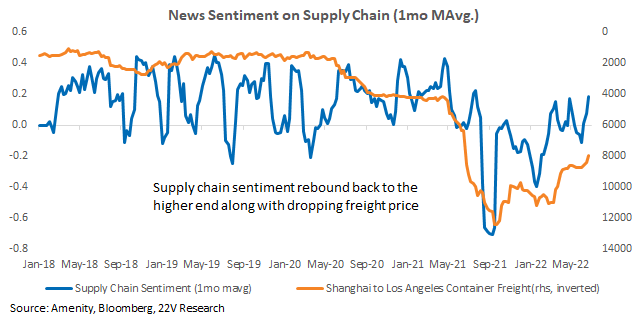
The supply chain outlook is telling. Despite China lockdowns, supply chain sentiment – measured using the Amenity Natural Language Processing tool – has improved meaningfully. That is consistent with the sharp decline in Shanghai to Los Angeles Freight rates. Goods disinflation should be assumed going forward, but it needs to actual happen to reduce the right tail risk of inflation some. It is now.
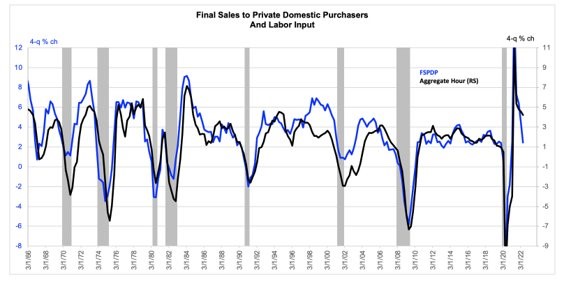
As Gerard highlighted last week, the economy is set to slow as the index of aggregate hours worked in the private sector has definitely slowed and will probably continue to do so (black line in chart below. FYI…hours worked is super important in supporting demand). However, its absolute strength is a source of momentum and is inconsistent with an immediate dip into recession. When thinking about a recession, the issue is apparently more about the period beyond the next six months – or more. We have confidence economic growth is slowing, which we have been pounding the table on, but is unlikely to fall off a cliff. If growth is “ok” and some of the inflation data slows, the bear market rally can go much further. And Cyclicals will lead.
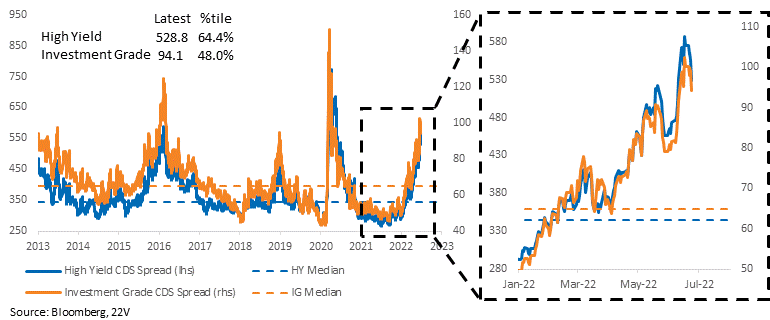
Anecdotally, credit spreads have moved meaningfully wider and influential “non-macro” investor Howard Marks said he is “turning aggressive” in snapping up credit bargains. A narrative could develop where near term downside risk to inflation means the Fed doesn’t have to force a recession, default risk will remain low and credit spreads can come in aggressively. Medium term, that could ultimately lead to a much more hawkish fed as financial conditions ease. We get that, but markets would have to ease first. The fallout would come AFTER a rally.
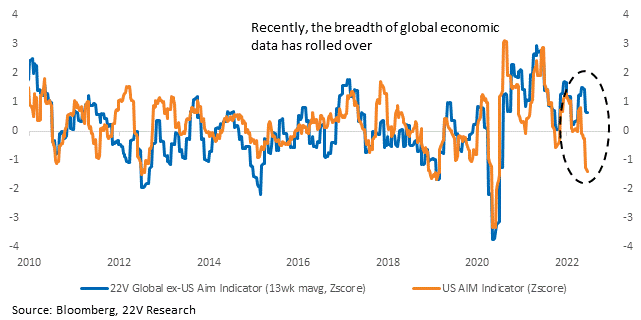
Two important things to keep in mind, even as rates consolidate and MAYBE consumer spending growth doesn’t slow quickly over the next few months. The breadth of data globally is slowing and in the U.S. it is collapsing. That should limit the upside risk to 10yr yields.
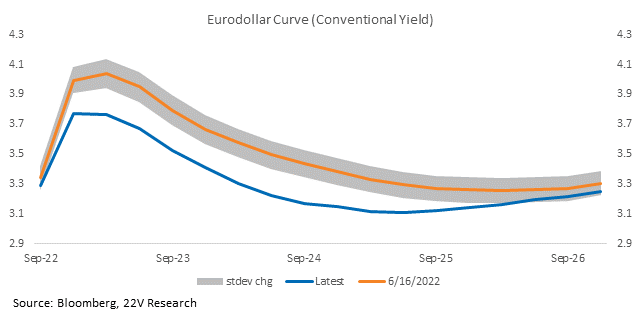
Also, unless the inflation data surprises to the upside, don’t expect the Fed funds rate path to change much from here. Which will the impact of financial conditions. At least until the July meeting. SF Fed Daly (leans pretty dovish) said the starting point for a July hike is 75bp. We should expect FOMC members to continue signaling 75bp and not much beyond that. They are data dependent.
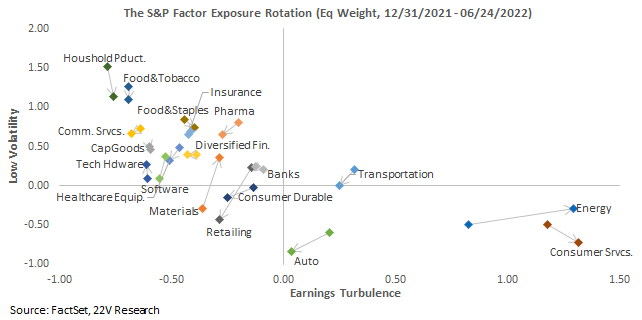
We would also be SHORT the low volatility factor Near Term: FYI – Energy and Consumer Services are moving towards more Earnings Turbulence exposed. In the meantime, some other Discretionary industry groups such as Autos and Retailing are moving towards lower volatility. As the worst performing sector this year, some stabilization of Discretionary names should be expected near term as volatility drops. How the industry groups fall is listed below.
Macro Tracker: Equities rallied last week and market internals shifted away from Value, which was the worst-performing factor on the week. Leading indicators of economic activity continue to move lower, and inflation expectations are well off their highs (5yr swap is at 3.11, from a high a 3.67 in March), and that is helping push Treasury yields lower. We have been vocally calling for a top in UST yields and that appears to be playing out as expected. 10yr yields fell about -10bp last week, and the 2yr was -12bp lower as well. Asset markets are responding to slower growth and increased acceptance that the Fed will remain committed to tightening policy until inflation declines, even if that tightening pushes asset prices lower and increases recession risk. In addition to yields moving lower, industrial commodity prices are declining; from their June highs the RIND is down -7.3%, oil is down -12%, and copper is down -17%. Policy-induced economic weakness will continue to weigh on assets levered to production and investment, and that will help drive inflation towards the Fed’s target. The growing risk to asset prices today is uncertainty about how much economic activity will slow (weaker growth, small recession, deep recession). What we know is that PE contraction has driven asset prices lower so far in 2022, and a slowdown in fundamentals (EPS) is coming over the next several quarters. If no/shallow recession and inflation moving back toward the 2% range is discounted, the decline in fundamentals will be offset by firming multiples. Unfortunately, a high conviction call on that outcome remains dependent on data that is not yet available.