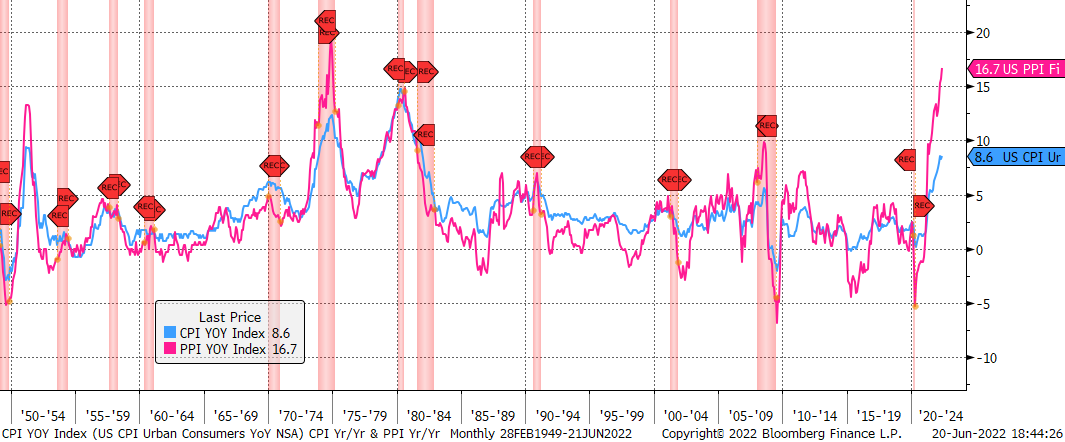
Homespun wisdom from one of baseball’s eminent philosophers – the other two being Casey Stengel and Satchel Paige – there are Yogi-isms for every occasion. But the one we’re interested in here is Yogi Berra’s, “A nickel ain’t worth a dime anymore.” We got lucky many years ago to have attended a lunch at Gallagher’s Steak House (229 W 52nd St) where Yogi was the guest of honor, but that’s a story for another time. We thought of his comment (incidentally, my mother had a similar line during the heavy inflation years in the early 1970s, but it wasn’t nearly as quippy as Yogi’s) when thinking about our own CPI (8.6% yr/yr) and PPI data (16.7% yr/yr) and PPIs for Germany (33.6% yr/yr), Italy (44% yr/yr), and Spain (45% yr/yr).
There’s no doubt that, eventually, the yr/yr readings for the CPI and PPI will peak and decline but we still think it’s worth noting that the most recent yr/yr% reading for the PPI in the US is the third highest reading over the last 74 years! Moreover, the last time the yr/yr% for the PPI was this high it took about 8 more years before the Fed had the inflation genie back in the bottle. Yogi and my mother knew exactly what they were talking about. It won’t necessarily be odd for chart aficionados, but it wasn’t until a lower peak for the PPI developed in 1980 that the 1974 Whip Inflation Now (WIN) campaign finally scored its victory.
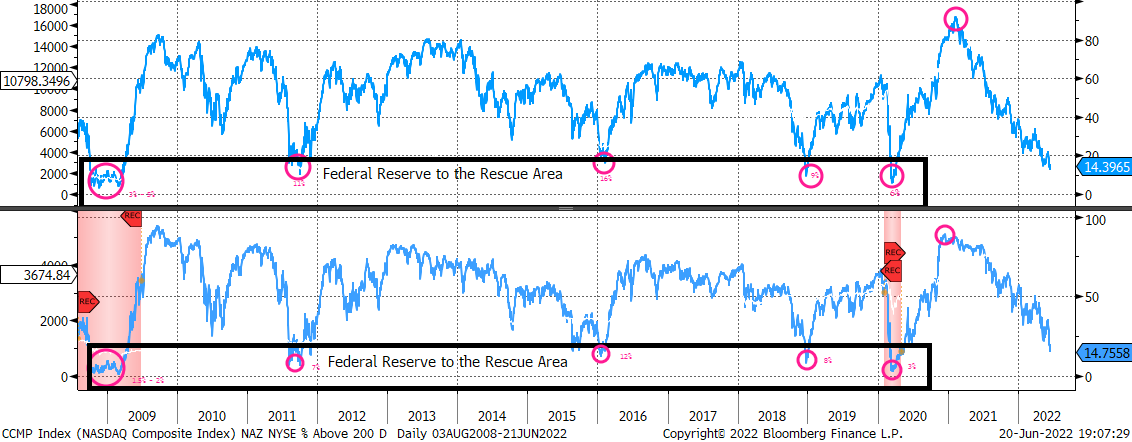
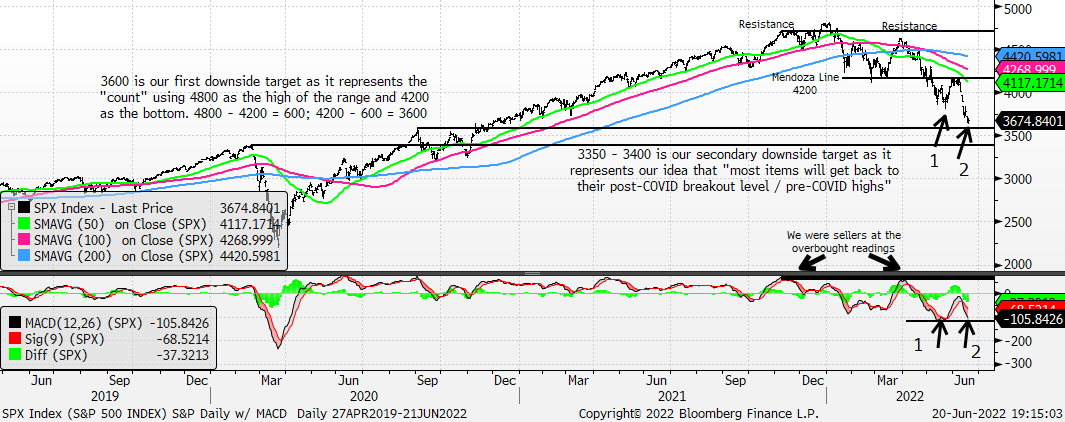
While I’m pretty confident that the bear market is not over, I believe the market is close to making a trading low. Here’s why: (1) Since the bear market started in late 2021, I’ve been going with a downside target of 3600 for the S&P. Last week the index touched 3636. It’s true that we’ve had a secondary downside target of 3350 – 3400 but getting that close to 3600 says I shouldn’t press my luck here. (2) While I’ve been looking for single-digit figures for the indicators in the charts below (I still think it can happen as I still think the bear market is not over), the % of Stocks Above Their 200-Day Moving Averages for NASDAQ is down to 14% and for the NYSE is 14.8%. These indicators are only 4% – 5% away from the single digit readings I was expecting. (3) In another single digit phenomenon, the NYSE has recorded single digit New Highs for six days in a row. Using another Yogi-ism, “You can observe a lot by watching” it reminded us of the COVID-low period in 2020 when the NYSE recorded 20 of 21 days from March 11, 2020 – April 8, 2020, when New Highs were only in the single digits. In short, it can’t get much worse in the near-term than to have a stretch of days where New Highs were only 4, 1, 4, 5, 1, and 2.
The chart below is the S&P (daily) with its 50, 100, and 200-day moving averages and its corresponding MACD. Please notice the arrow labeled 2 in the upper panel represents a lower low vis-à-vis the arrow labeled 1 in the upper panel. Now please notice the arrow labeled 2 in the lower panel is not lower than the arrow labeled 1 in the lower panel, in fact it is slightly higher (if you squint). This is a positive divergence and says the downside daily momentum that occurred over the last few weeks was not debilitating enough to create a break lower in the MACD. I realize such reasoning may very well be specious in a bear market, but we think this, coupled with the above inputs, tells us that a bear market bounce can occur here.
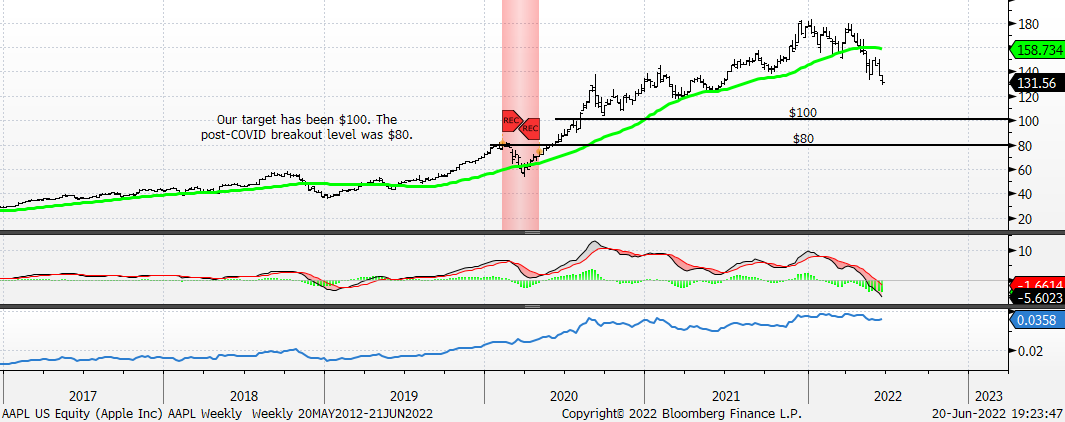
Principally, I don’t think the bear market is over because I don’t believe the excesses that developed on the upside in the “everything bubble” have been wrung out. Too, I don’t believe the bear market is over because I’m still looking, for example, for Apple to work lower to $100. A new reaction low for the S&P below 3636 and / or a new reaction low for AAPL below 129 will put the idea for a near-term bear market bounce to rest quickly.
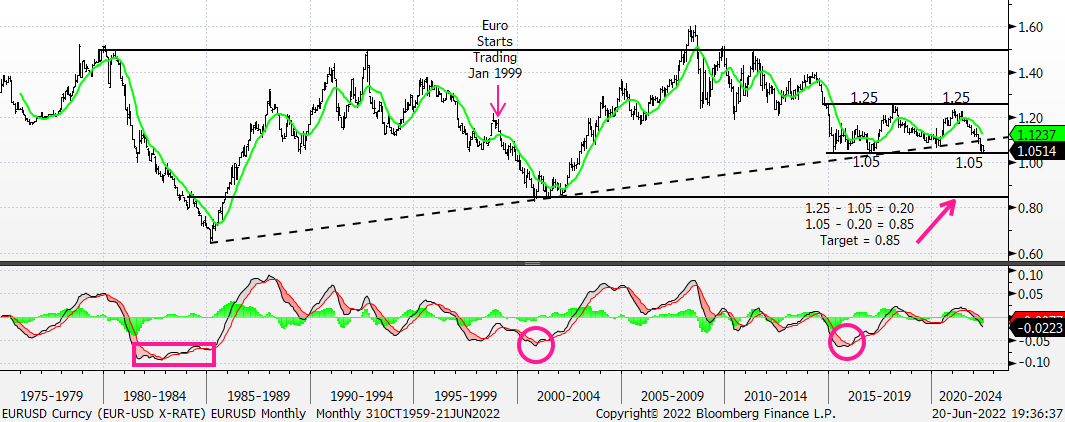
It might be a function of my age and / or the fact that I’ve been in the business for a long time, but I really like hearing people make definitive and declarative statements so that I can take a contrary point of view. Government officials are experts at making definitive and declarative statements but are not so expert on being accurate on such statements. The hubris and subsequent failure of these verbal misfires is legion and ECB Governing Council Member Mario Centeno added to it when he said over the weekend that, “There is no way the Euro is at risk.” I think Mr. Centeno is talking about something more important than the Euro working to .85 versus the $, but that’s what my work suggests.