SUMMARY: Overnight headlines continue to highlight elevated macro volatility through oil, recession risk, central banks, and economic data. Oil is down -3% overnight on news Saudi Arabia will cover sanction-related declines in Russian output. Lower oil helps in finding a market bottom (input cost relief), but the declines need to hold. The Fed and ECB delivered another slew of commentary overnight, but all that matters is if data shows inflation cooling fast enough. It is difficult to determine if the weakening of data in the EU and US will be enough to slow inflation, especially with reports like Visa’s indicating persistently strong consumer demand.
Persistently strong consumer demand, which would push up service inflation (labor markets stay tight, wages go up, and companies pass along costs. See the Airlines commentary) would lead to an assumption that the Fed needs to tighten financial conditions more. Stocks go down, credit spreads wider in that scenario. Most of the damage in fixed income, in the stronger growth scenario, would be in the short-end of the curve. Being tactically long our implied fed funds portfolio (here) might make sense (stocks that benefit from an increase in expected Fed funds).
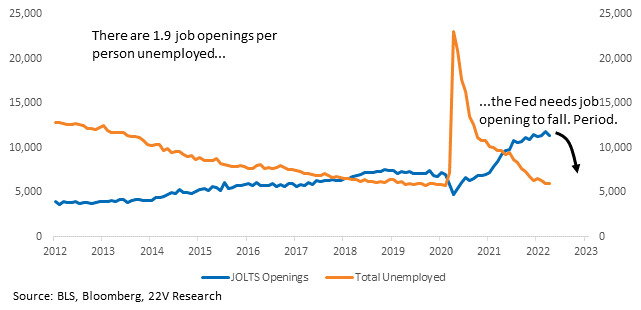
Strong data yesterday led equities lower. The ISM beat, but according to Gerard, is still consistent with a cooling goods sector. JOLTS was more important; Powell has referenced the ratio of unemployed people to job openings multiple times. Job openings per unemployed decreased marginally but may not be falling fast enough. Data puts upward pressure on UST yields near term, but if strong demand forces the Fed to be more aggressive, it will ultimately mean lower UST yields. We expect yields have peaked. FYI, JOLTS is less important than payroll Friday (JOLTS is older).

Global PMIs show evidence the stress on supply chains is easing. Whether from lockdowns easing, cooling demand, or some combination, supply chain pressures are improving, without which inflation-fighting central bankers may have had to tighten financial conditions further. They still might, and labor data will inform that more, but this is a good sign for equities and vol all else equal.
We hosted a webinar with Deitrich Vollrath, an expert on productivity and economic growth, yesterday (replay HERE). Dietrich concluded most productivity declines are due to an aging population and a transition from a goods to services focused economy, with the former outweighing the latter 5x. The societal changes behind declining productivity are highly unlikely to reverse, so it is likely trend growth will move lower again post-COVID. That means neutral interest rates will be similarly low (Bullard made the same point in his presentation yesterday). Longer-term, a return to low growth and low rates will benefit Growth stocks. Shorter-term, Dietrich’s productivity work suggests financial conditions probably don’t need to tighten more given underlying trend growth and productivity are still low. But again, data cooling fast enough for the Fed matters more.
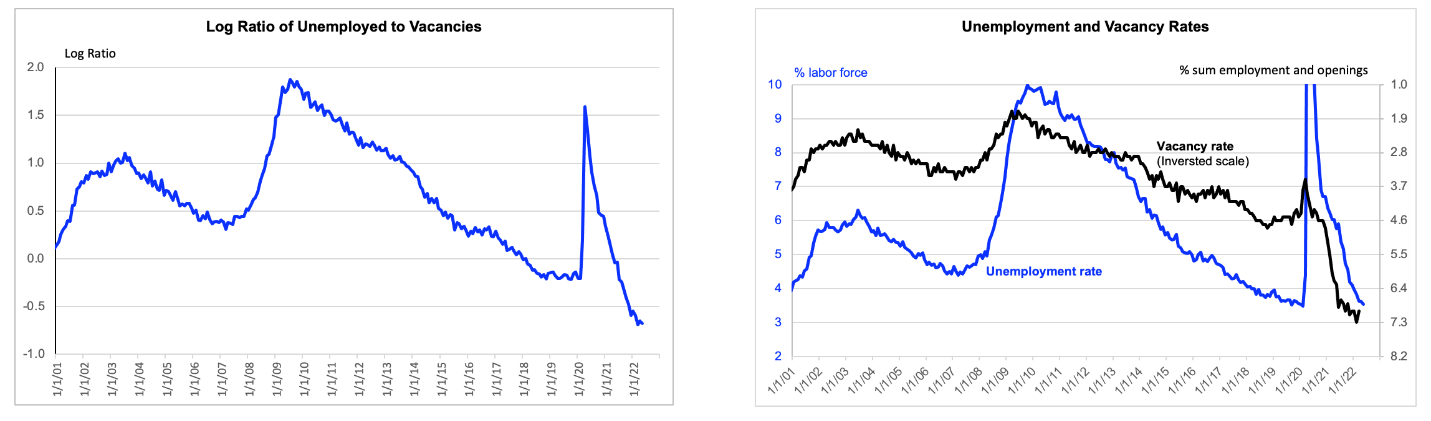
Supply chains easing and Dietrich’s low trend productivity point both suggest no additional tightening of financial conditions is needed, but data needs to cool fast enough for the Fed. And as Gerard said, if vacancies were to be unchanged in May and employment prints at the screen consensus, the ratio of unemployment to vacancies would return to its (extreme) low for this episode. And that makes a soft landing more difficult than the Fed is letting on.
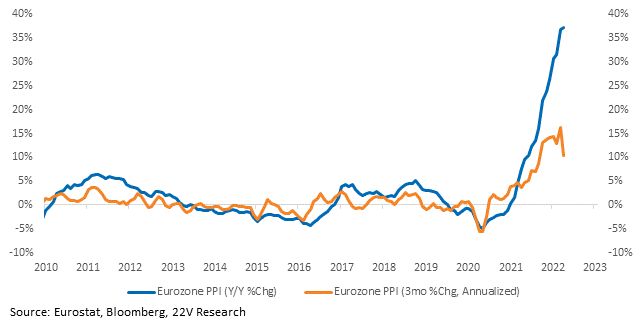
MARKET VIEWS: Oil is down -3% overnight on news Saudi Arabia will cover declines in Russia’s output, which is a good development for finding a bottom (input cost relief). Hungary is delaying the Russian oil ban, but Kim Wallace expects Hungary will get more concessions, and there will be exemptions, but the ban will be enacted. Fed and ECB central bankers delivered another slew of commentary overnight, but all that matters is if inflation cooling fast enough. Eurozone PPI is high, but the monthly rates have rolled over. It is difficult to determine if the rate of deceleration in the EU and the US will be fast enough, especially with reports like Visa’s indicating persistently strong consumer activity and travel. All the overnight headlines point to elevated macro volatility through oil, recession risk, central banks, and economic data.
Strong data yesterday led to a downturn in equities – the risk being data isn’t cooling enough and the Fed will have to tighten financial conditions further. The ISM beat, but according to Gerard, is still consistent with a cooling goods sector. JOLTS was more important; Powell has referenced the ratio of unemployed people to job openings multiple times. Job openings beat but moved lower, which is necessary. But job openings per unemployed persons only decreased marginally and might not be decreasing fast enough. The data will push UST yields higher near term, but if strong data forces the Fed to be more aggressive, that ultimately means lower UST yields. We expect yields have peaked. FYI, JOLTS is less important than payroll Friday (JOLTS is older).
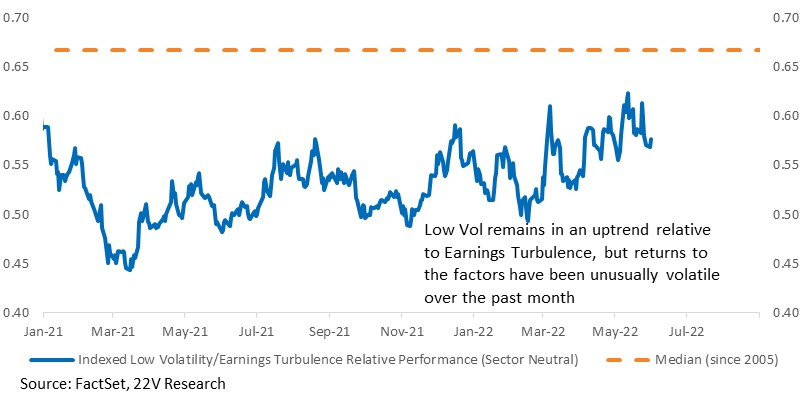
Over the past week, market internals have been risk-on, consistent with the uptrend in the S&P. Equities came under pressure yesterday and internals reflected that weakness as well. Lower volatility names rallied, gaining 1.4% (L-S, SN), far outpacing Earnings Turbulence and other risk-on factors. A stronger than expected payroll report tomorrow (more hiring or faster than expected wage growth) would add to recent volatility. The path higher for equities in general and risk-on factors in particular is through growth slowing enough to reduce inflation WITHOUT requiring more/faster Fed tightening.
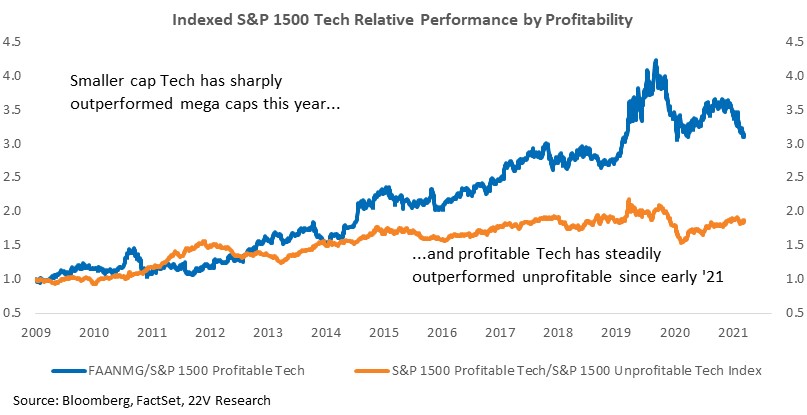
Risk factors have rallied over the past ~week (high Turbulence up 6.2% w/w), but not all areas of risk have benefitted. Since the market low, Unprofitable Tech has underperformed Profitable Tech by 200bps, and YTD profitable Tech has outperformed by 5%. The rotation within Tech is not just about profitability though. Mega cap Tech has significantly underperformed small-cap names this year (-20%) and has lost another percent since the market bottom.
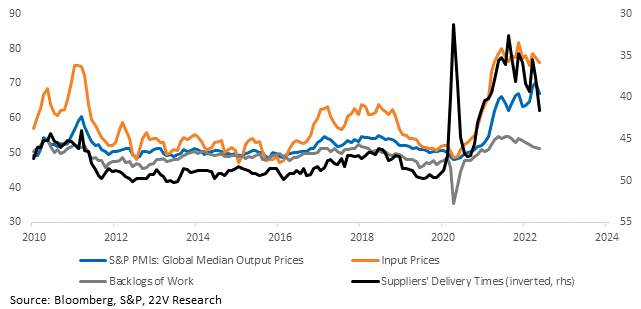
Global PMIs show evidence the stress on supply chains is easing. The median of pricing, backlogs or work, and delivery times are easing. The median is a better measure of breadth of stress than the GDP-weighted average provided by S&P. Pricing has been sticky – a phenomenon well documented by inflation data and global central bankers – but delivery times are significantly better. Of note, China’s delivery times improved substantially alongside the global metric. Whether from lockdowns easing, cooling demand, or some combination thereof, supply chain pressures are improving, without which inflation-fighting central bankers may have had to tighten financial conditions further. They still might, and labor data will inform that more, but this is a good sign for equities and vol all else equal.
We hosted a webinar with Deitrich Vollrath, an expert on productivity and economic growth, yesterday (replay HERE). Dietrich ran the numbers on declining productivity and concluded the majority of productivity declines are due to an aging population and a transition from goods to services, with the former outweighing the latter 5x. The societal changes behind declining productivity are highly unlikely to reverse, so it is in turn likely that trend growth will be lower again post-COVID and neutral interest rates will be similarly low (Bullard made a similar point in his presentation yesterday). Longer-term, a return to low growth and low rates will benefit Growth stocks. Shorter term, Dietrich’s productivity work suggests financial conditions probably don’t need to tighten more given underlying trend growth and productivity are still low. But again, data cooling fast enough for the Fed matters more.
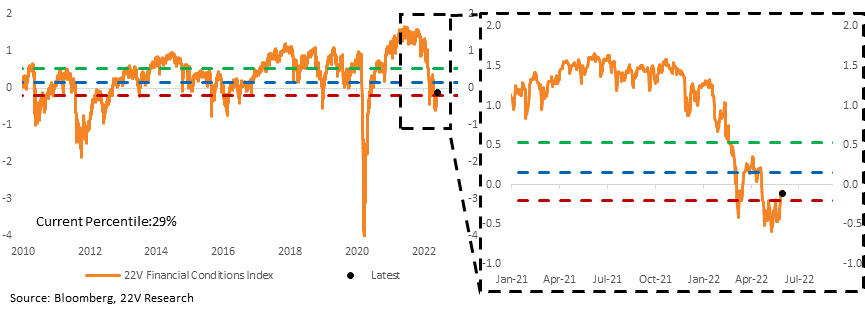
Supply chains easing and Dietrich’s low trend productivity point are both good for financial conditions NOT needing to tighten, but they pale in comparison to hard data. Payrolls on Friday matters a lot more. The data needs to cool fast enough for the Fed, bottom line. And as Gerard said, if vacancies were to be unchanged in May while the employment report printed at the screen consensus, then the ratio of unemployment to vacancies would return to its (extreme) low for this episode. And that makes a soft landing more difficult than the Fed is letting on.