Summary: The short-term high volatility backdrop will remain in place for a while, but last week saw some upside vol for the first time in a while. A general slowdown in the economic data (particularly housing data) increased the odds inflation can move toward 3%, WITHOUT financial conditions tightening more aggressively. That is consistent with the turn lower in inflation expectations, 10yr yields, and bond volatility. Bond volatility will move lower if financial conditions don’t need to tighten more. Lower bond volatility should come along with lower stock volatility and increases stock picking opportunities. Correlations should move lower.
3% On Core Is Important: 3% or below on CORE inflation by 1Q of next year is particularly important. If that happens, we can then start to discuss the Fed backing off its hawkish stance and the potential unwillingness of the Fed to go to 2% on core. The Fed driving core to 2% rapidly would cause significant labor market disruption and increased recession risk. That is why the Fed could pursue a policy of opportunistic disinflation and attempt to keep core inflation in the 2-3 range until the next recession. The Fed letting core inflation stay above 3% would risk driving inflation expectations significantly higher, which is why getting to below 3% is also important.
If it becomes obvious that core inflation is headed to 3% or below by 1Q23, that will be bullish. Core inflation in the 2-3% range and the US economy avoiding recession would significantly reduce worst case earnings scenarios. Recession risk will be 2x to 3X above normal, but we do not view it as a base case. Precisely because we know the Fed would like to avoid a recession.
Side note: when you hear economists, fed watchers etc., talk about the inevitability of a recession, keep in mind that in many cases they are assuming the Fed pushes inflation to 2% quickly. As Gerard has noted though, some Fed speakers seem to be embracing the Opportunistic Disinflation idea.
Important Point from the Minutes: The FOMC minutes indicated the Fed could pause in 2023, inflation dependent, as it assess the impact of the rapid move to a neutral policy rate. That is not consistent with the Fed tightening much more aggressively, which is what Larry Summers would like (to the 4% range) and reduces nearby recession risk meaningfully.
Bottom line: There is no positive market scenario that involves stronger economic growth and higher inflation. The only chance the market has to bottom is a scenario of slowing economic growth (and earnings) that avoids a recession. Just like we highlighted the past few weeks, in no-recession scenarios, S&P forward returns 3, 6, and 12 months after inflation peaks were all positive (1958 forward), with a median return of 9.6% (3mo), 8.4% (6mo), and 16% (1yr). If inflation is reduced without causing a recession, S&P returns should be positive, particularly if the financial condition tightening needed to slow growth is now behind us. Many things are different this time vs history, but those are the stats.
We will have the next 6-8 months to argue about how likely a recession is, but the focus now should be on how quickly inflation slows. The big upside risk to inflation is stubbornly strong consumer spending and housing data at the same time oil/gas prices move higher. We would also note that the services economy remains unusually strong, which is why we should expect some still relatively strong data points (don’t expect them to all collapse at once) and still hawkish rhetoric near term. That is why chasing short term rallies above the 4200 level and into payroll on Friday, CPI next week and the Fed meeting on June 16th could be dangerous. We think the market stays in a 3800-4200 range until the inflation relative to economic growth picture improves. Economic growth remaining stubbornly strong is the biggest risk to breaking below 3800.
Full set of charts that support what we wrote about above are below…
Macro Backdrop: Investors are discounting that the tightening of financial conditions over the past 6ish months is enough to slow economic growth meaningfully. That is consistent with the decline in the breadth of US economic data points.
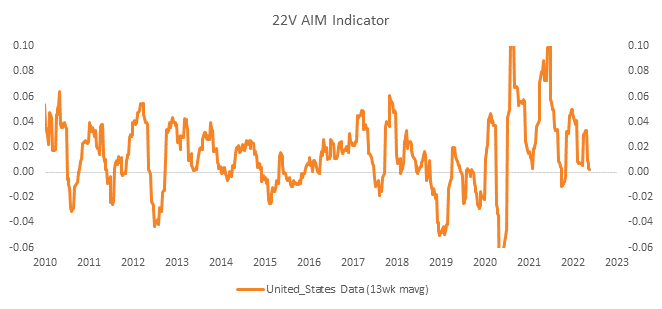
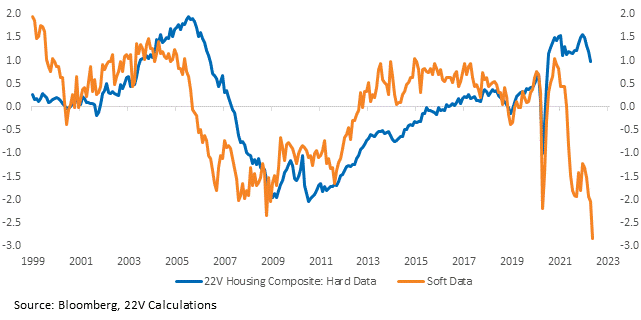
The general slowing of economic data has driven Fed rate hike expectations down and yields lower across the curve. Rising interest rates coupled with strong price gains over the past two years have driven affordability lower. Slowing in the housing market is an important part of reducing inflation, so weakness in these data are important steps along the path of 1) normalizing inflation and 2) providing the Fed to embrace opportunistic disinflation (putting inflation on a path toward ~3% and waiting for the next recession to bring inflation back to 2%).
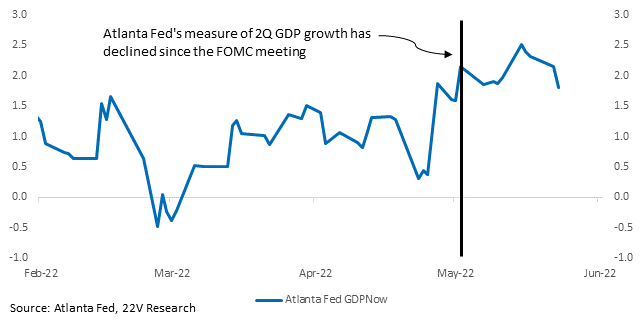
 The FOMC minutes highlighted that Fed officials expected strong growth in Q2. But growth has cooled since the FOMC’s May 4th meeting. The Atlanta Fed’s GDPNow puts 2Q real GDP growth at just 1.8%. That would suggest the slowdown in economic growth has happened a bit faster than the Fed expected. Importantly though, the labor market and spending data need to cool for the Fed to be comfortable that further tightening of financial conditions is unnecessary.
The bottom line: A rolling over of growth means bond volatility should decline. That is a function of investors discounting that financial conditions won’t need to tighten further to slow economic growth. That assumption could change (if inflation remains sticky high), but given what is going on in the rest of the world – see the negative China growth headlines that are likely impacting copper/yields – we are comfortable that economic growth will slow meaningfully over the next 6 months and 10ry yields are likely headed lower. That means bond volatility will move lower which should help reduce stock volatility and market correlations.
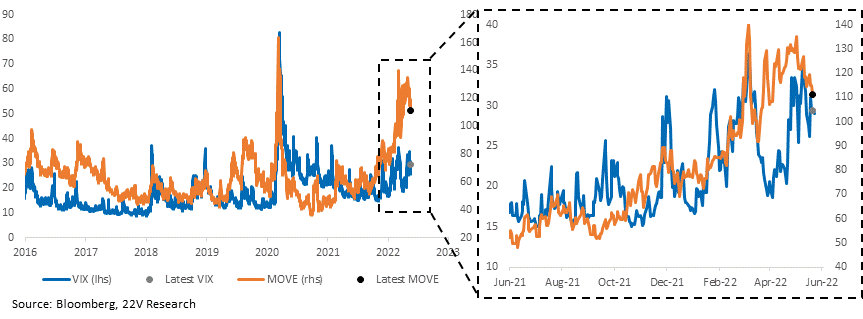
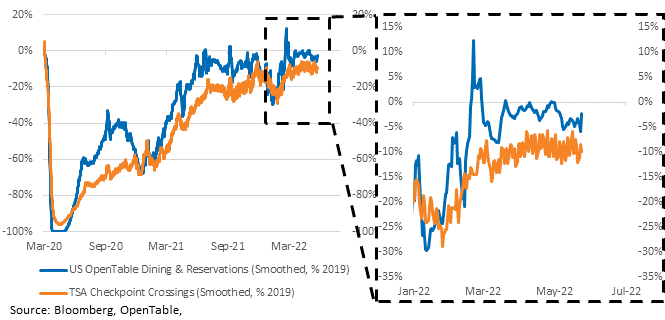
The bullish (from here) market call is getting to 3% core inflation and the fed accepting inflation in the 2-3% range from there while avoiding a recession. We are not saying it will happen, but that is what’s required. If financial conditions have tightened enough and the path to 3% on core is more likely, PE headwinds will fade. For now, growth is slowing and financial conditions may not need to tighten more. Hence the short-term rally. Our problem with getting carried away with the market bottom idea is that we JUST DON’T KNOW if enough financial condition tightening has been done. Sure, the economy is rolling over, but is it enough to push inflation toward 3% by 1Q23? That’s a much tougher call. And it is perfectly reasonable to assume that the data points will not all be terrible over the next month or so. The services side of the economy is still super strong.
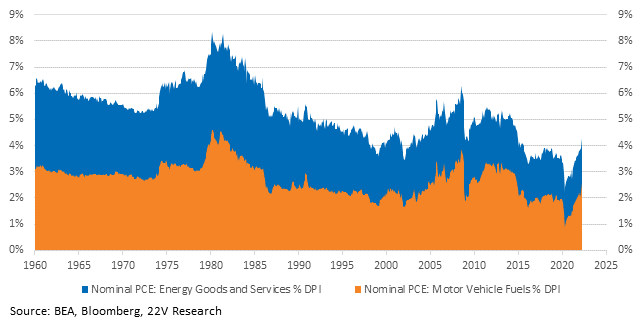
And we get that gasoline prices and energy prices in general are headwinds, but they are still a very low portion of disposable income. Both have moved up recently, but they are low historically.
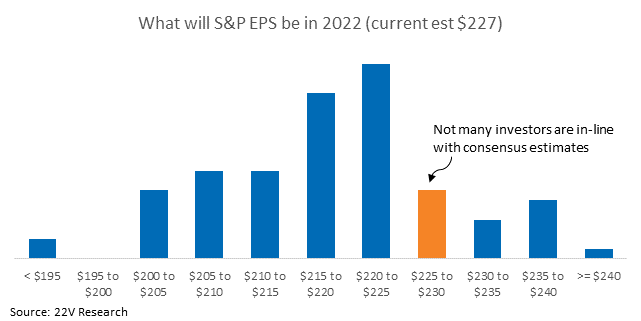
Survey Results: 82% of our respondents think 2022 earnings will be lower than consensus ($227). The consensus of our respondents is $216, which would put y/y growth rate at 4.6%. In an earlier survey, investors put the appropriate PE at 16x. Applying 16x to $216 earnings would put the S&P down at ~3,450 (down -15% from here). In a different survey, investors indicated they’d be buyers at 3,600 (down -11% from here). So, there seems to be broad consensus for a bottom around ~3,500. Keep in mind, the forward PE would likely increase substantially if earnings were expected to accelerate from a $216 level. The most important question for the market is not only what the bottom is on EPS, but how quickly earnings will rebound and where the 10yr peaks.
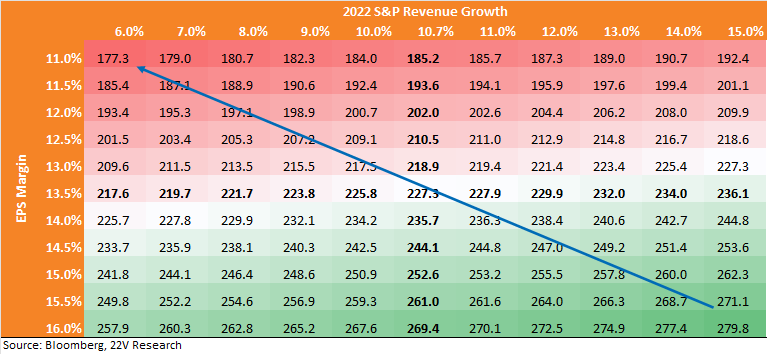
Stock Picking: The Fed is attacking revenue and margins, which will drive earnings estimates lower. That means stock volatility could move lower, but the ability of a sharp rally to take place is compromised. In this backdrop, stock selection becomes more important. And the focus is on what stocks/industries are relatively isolated from input cost pressures and/or can maintain pricing power. At the aggregate level, below is a table showing different S&P 500 EPS numbers using a range of revenue and margins estimates. 1Q22 index margins were ~13.5% and top-line growth was 10.7% (y/y). Both are heading lower, but how far they fall is an important input into fair value.
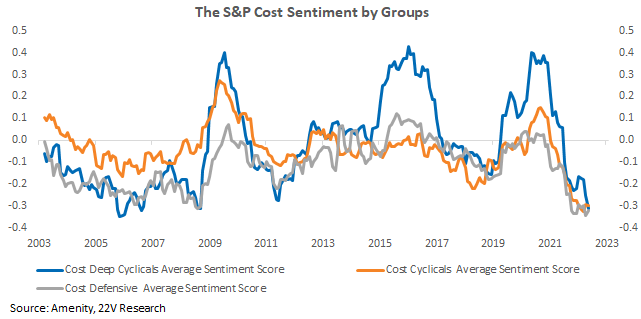
Cyclicals (Technology, Communications, Financials, and Discretionary) have had the largest decline in pricing power sentiment this year – particularly consumer facing sectors. Defensives have an issue though as they have declining pricing power. Given the likelihood of higher fixed costs for longer, Defensives have some earnings issues going forward.
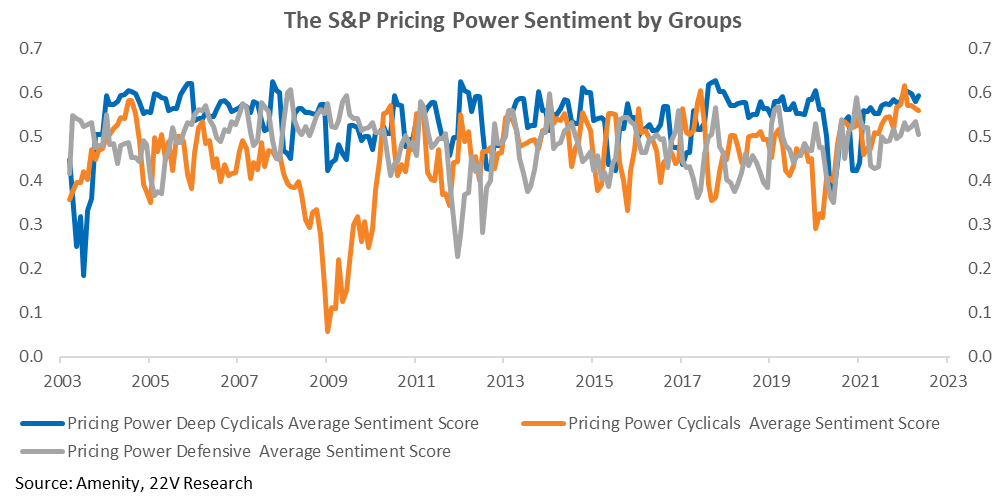
The cost sentiment for Defensives is very negative. That is true across sectors/groups, but Defensives have weakening pricing power AND have outperformed significantly.