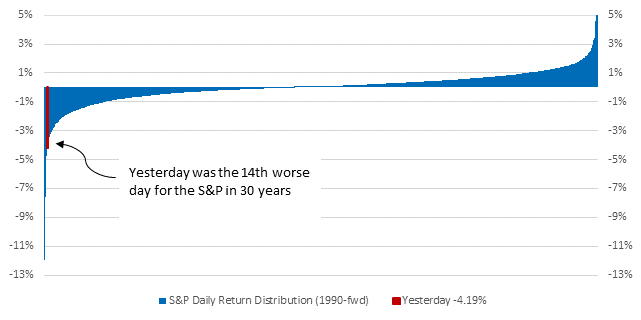
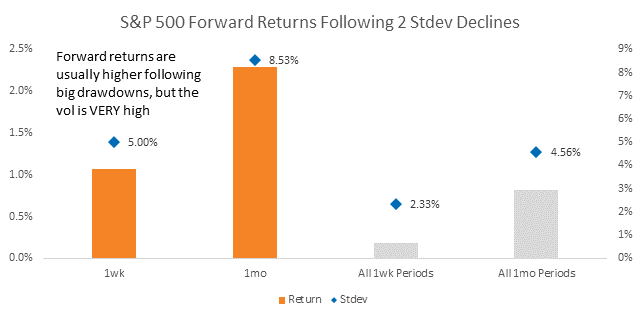
SUMMARY: Yesterday was the 14th worse day for the S&P since 1990 and the 6th worse day for the NASDAQ. Internals were sloppy as everything got taken down, but Low Vol continues to be a place to hide. Check out our rankings HERE. Forward returns are usually higher following big drawdowns, but we aren’t making the case for a bottom here. The headwinds and questions about the Fed, inflation, and recession risk are the same. More to our point, the volatility around forward returns is VERY high following large drawdowns.
The market backdrop will remain very difficult until recession risk declines, and there is a clearer path toward slowing growth and a bottom in earnings.
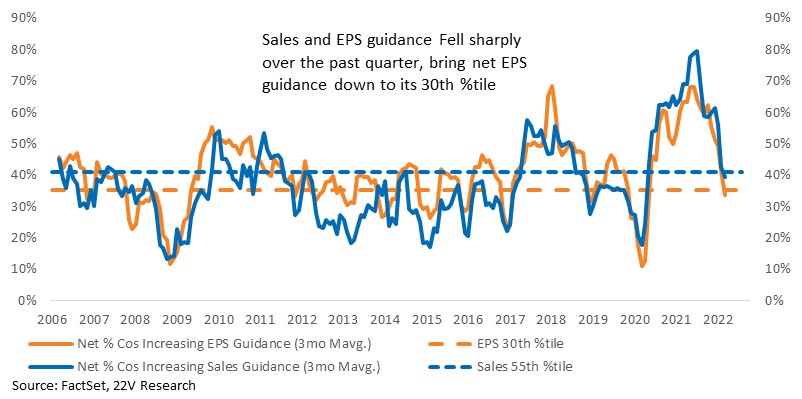
Kohl’s missed earnings this morning, similarly citing the inflationary macro backdrop. Retail earnings misses are leading to concerns that a sharp earnings/profitability slowdown is coming. Revenue and earnings guidance weakened substantially over the past few quarters, and results from large retailers suggest that will continue. Moderating goods demand will alleviate supply chain concerns and help cool inflation, but that is not going to be the focus until a bottom in earnings becomes clearer.
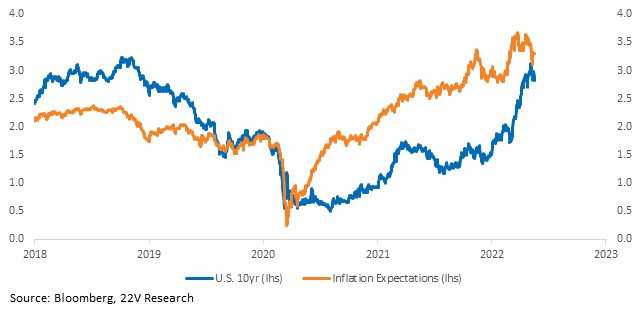
10yr yields have fallen -30bps from the peak, but inflation expectations are down too. Implied real rates continue to increase, supporting Value over Growth despite yields falling. Value ETFs are moving lower, just at a slower pace than Growth.
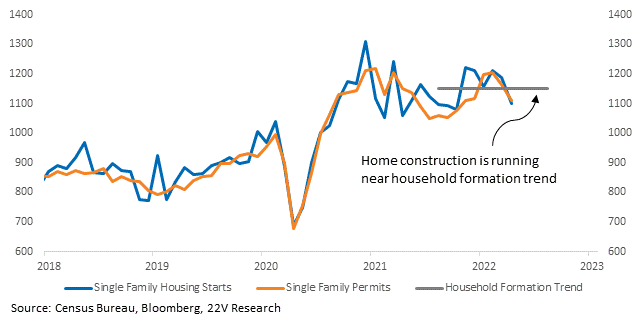
It is important for housing to slow and at first glance, recent data appears to be cooperating. Housing data is weakening – the NAHB dropped and starts and permits both declined from March. But Gerard thinks housing construction is unlikely to deliver a slowdown of aggregate demand growth to a below-trend pace. The recent prints match Gerard’s estimate of trend household formation, which isn’t indicative of a slowdown. Central bankers have work left to do.
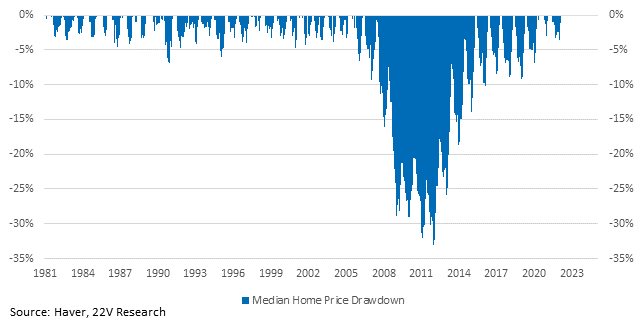
Housing affordability has dropped to its 20th percentile because of higher mortgage rates and home price appreciation. To get back to median affordability without a decline in mortgage rates, home prices would have to fall ~-12%. Outside of the housing crisis, a -12% drawdown hasn’t happened. Delinquency rates are at a record low too, implying people won’t have to sell at lower home prices. That also implies the Fed can’t rely on home price depreciation for tightening.
MARKET VIEWS: ECB meeting accounts, released this morning, showed the ECB members are widely concerned with inflation. The rate path continues to accelerate, contributing to USD weakness. Kohl’s missed earnings this morning, citing the inflationary macro backdrop that TGT, WMT cited. It won’t matter for today, but moderating goods demand will alleviate supply chain concerns and help cool inflation. Yesterday was the 14th worse day for the S&P since 1990 and the 6th worse day for the NASDAQ. Internals were sloppy as everything got taken down – Utilities and Health Care led but Communication Services, Financials, Real Estate, and Materials outperformed. Low Vol led factor returns while Growth, but also Quality of Earnings underperformed. Hiding places are difficult to find – Low Vol continues to be the safest bet. Check out our rankings HERE.
Futures extended the equity rout. Forward returns are usually higher following big drawdowns, but we aren’t making the case for a bottom here. The headwinds and questions about the Fed, inflation, and recession risk are the same. More to our point, the volatility around forward returns is VERY high following large drawdowns.
Fundamental Supports Shaking: From the recent market high in late-March, the S&P has now fallen -15.8%. Sentiment has driven stocks lower this year but until recently earnings had been a source of strength. Strong top-line growth and still high margins translated into much better than expected earnings growth for several quarters and into 1Q22.
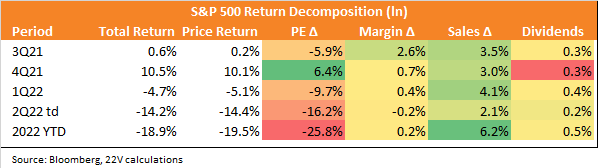
A series of earnings misses by large retailers, citing weakening consumer demand and higher costs, are leading to concerns that a sharp earnings/profitability slowdown is coming. KSS added to those concerns this morning after missing estimates and noting that “Sales considerably weakened in April as we encountered macro headwinds related to lapping last year’s stimulus and an inflationary consumer environment.” Revenue and earnings guidance weakened substantially over the past few quarters, and results from large retailers suggest that will continue.

Hide in Low Vol: 10yr yields have fallen -30bps from the peak, but inflation expectations are down too. Implied real rates continue to increase, supporting Value over Growth despite yields falling. Value ETFs are moving lower, just at a slower pace than Growth.
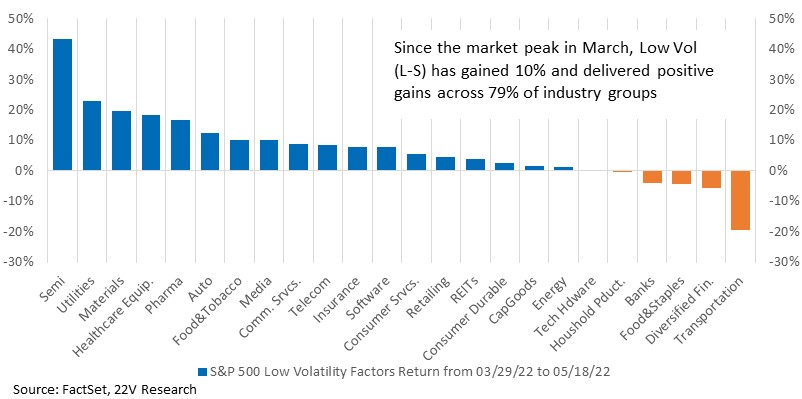
On a long-short basis, Relative Value has been the best performing factor since the market peak. But its hit rate has been in the low 60%s. A better screening tool has been Low Volatility, which tends to work when financial conditions are tightening/growth is slowing. Low Vol is up 10% since the market peak and has delivered positive returns across 79% of S&P industry groups. While recession concerns remain elevated, Low Vol should remain a good way to find places to hide.
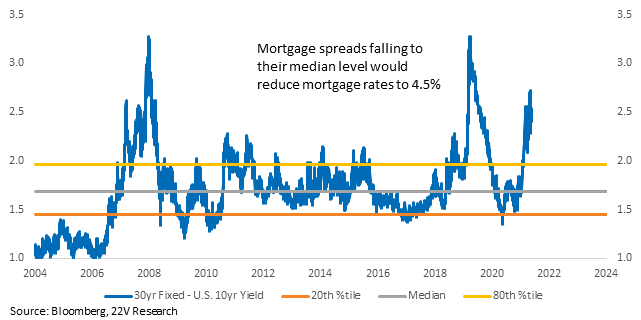
Housing Topping but Too Strong: Yesterday we highlighted how the Fed needs home price appreciation to slow and a couple months ago we revamped our financial conditions index to include mortgage spreads because the housing market was doing a lot of the tightening. Mortgage spreads have widened significantly this year as mortgage lending has tightened.
It is important housing slows. At first glance, recent data appears to be cooperating. Housing data is weakening – the NAHB dropped and starts and permits both declined from March. But Gerard thinks housing construction is unlikely alone to deliver a slowdown of aggregate demand growth to a below-trend pace. The recent prints match Gerard’s estimate of trend household formation, which isn’t indicative of a slowdown. Central bankers have work left to do.
30yr mortgage commitment rates have increased to 5.3% from 3.1% at the beginning of the year driven by 1) rising risk-free rates and 2) mortgage spreads widening above the high end of their typical range. Affordability is down to its 20th percentile at current mortgage rates. Since the start of the COVID-induced housing boom, national home prices have climbed ~42%. Incomes also rose, helping mitigate the decline in affordability. However, low mortgage rates were the main reason affordability remained high even as prices shot higher. That is no longer the case, which should contribute to a deceleration in housing activity (though it doesn’t solve the rent problem, as illustrated here).
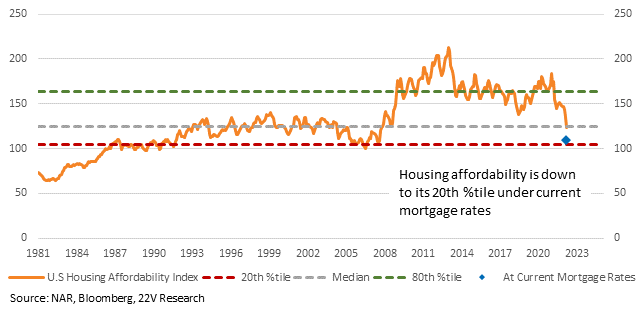
Affordability at 110 means the median family can afford 110% of the median home. To get back to median affordability, home prices need to decline ~-12%. Outside of the housing crisis, a -12% drawdown hasn’t happened. Delinquency rates are at a record low too, implying people won’t have to sell at lower home prices. Housing affordability won’t improve through this channel. That also implies the Fed can’t rely on home price depreciation for tightening.