
The timing and consequences of a ceasefire in Ukraine are materializing. Victory cannot be reliably gauged for quarters if not years, but the deadly slog in Ukraine exhibits signs of de-escalation as the next phase. Our frame of reference for thinking through this mess hinges on perceptions of what the real costs are to key stakeholders and the domains over which they seek to wield influence.
Of course, weighing the risks inherent in continuing the current hostilities suggests that a ceasefire would favor all sides. Ukraine’s performance on the battlefield wouldn’t have been possible without the dedication of its people and weapons supplied by the West. That same combination will be necessary in the country’s rebuilding phase. Increasingly, President Putin is a less determinative factor in that outcome which might be his strongest incentive to discover a way to stop hurting himself and his fellow country-people. Analyses of four policy dimensions put forth by others help build the case for de-escalation.
Geopolitical
COVID-19, war, and global macroeconomic policy adjustment are some of the catalysts just this decade forcing or allowing re-globalization. Robert Kagan’s May/June essay in Foreign Affairs reviewing the status of the US as a unique superpower doesn’t comport with current domestic headlines. However, Kagan points to advantages and obligations of US global status. We’ve previously highlighted Walter Russell Mead’s mid-April WSJ article that enumerates the longer-run cost to Russia of Putin’s gamble in Ukraine.
A recent discussion over dinner with my former neighbors, both Ivy League professors (one of which is Russian) reflected some of the sadness for the Russian people. The world’s condemnation, Putin’s misinformation (persuasive with most Russians), and the history of conflict among countries in and around Eurasia produce a range of mostly devastating emotions among her family members, all of whom reside in or near Moscow. Our friend added bite to the anguish enveloping her family’s country by assuring us that while the Russians she knows detest the war, their history is molded by a need for or subjugation to strong leaders. Misinformation, in her view, doesn’t permit them to make a totally honest assessment of Putin’s performance. Clearly, a de-escalation affords Putin an opportunity to reconcile his national objectives with the mounting apprehensions of some Russians.
Military
US Defense Secretary Lloyd Austin stated last month that degrading Putin’s war machine was and remains a key Allied objective. We’ve taken to reading UK Defence Secretary Ben Wallace’s regular Ukraine battlefield updates, the latest of which came on May 9 when Europe and Russia commemorated different aspects of the last big European war. It’s a good read on professional militarism and how that component has been replaced by scapegoating and corruption in Russia, to the disadvantage of Russians. Two recent mass media articles demonstrate the imperative perceived by many Europeans to follow through on EU promises of increased military spending. Transatlantic defense contractors likely will be long-term beneficiaries of Putin’s nudge: “Germany’s Military Industry Gears Up to Restock Its Own Forces” (NYT, May 5) and “Saab Anticipates Fresh Opportunities If Sweden Joins NATO” (FT, April 23). The renewed priority European leaders are placing on defense spending is a direct result of Putin’s incursion into Ukraine and will accelerate in the absence of a lasting de-escalation.
Economic
It was a tossup whether we included US Treasury Secretary Janet Yellen’s speech today in the geopolitical or economic vector. US support for Europe’s other long-term challenge – energy security – and financial support for Ukraine were the expected topics. We were surprised by the full-throated encouragement of re-orienting the transatlantic alliance away from China. Appropriately couched in economic policy cloth, the section of her prepared remarks at the Brussels Economic Forum were a firm repudiation of Beijing’s economic policies this century which she said, “have disadvantaged us all.” Her appeal to EU members is to band together on common interest asserting that “China is more likely to respond favorably if it cannot play one of us off against another.”
Biden administration Indo-Pacific strategy includes a bark-stripped, realpolitik approach to China. US Secretary of State Antony Blinken’s 1Q21 statement about the seriousness of the G2 competition has government-wide thick lines this administration isn’t reluctant to reiterate. The other part is an evolving basket of outreach to China’s neighbors, the most recent acknowledged this morning. Washington has prepared a $500 million military package for New Delhi in the hopes of weaning India from Russia’s military industry. We’ve seen estimates that between 50-70% of India’s weapons come from Russia.
US Treasury Deputy Secretary Wally Adeyemo last week discussed with foreign banking organizations operating in the US about sanctions risks – primary and secondary. Sanctions aren’t a precise tool but if they are to work, globally active banks cannot willingly help circumvent them. This was a page from Treasury’s successful global forums with global banks 11 years ago to explain risks from doing any business with Iran in the last episode of large-scale US financial and commercial sanctions.
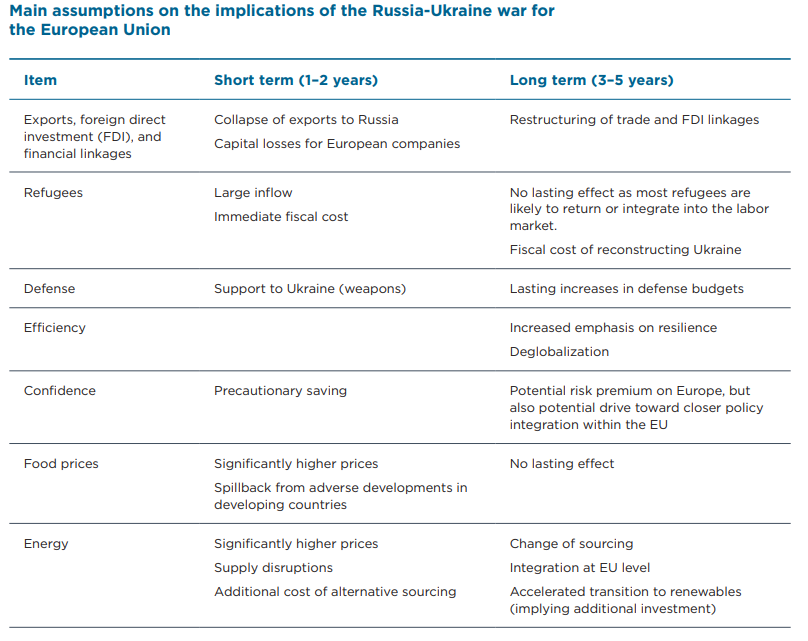
Finally, the Peterson Institute/Bruegel collaborative report on likely EU economic short-term and long-run implications of the war against Ukraine is a deep-dive into fiscal and monetary policy challenges. The pullout table from page four is a handy outline which we have included below. They and others agree that the most urgent work 1-2 years out will cost at least $100 billion; complete rebuilding is estimated to run five times that amount. Multinationals in the Agriculture, Defense, Financials, Energy, and Transport sectors likely will benefit this decade from public and private investment. From this point of view, a de-escalation would enable the rebuilding of global economic ties and indeed of Ukraine itself to begin in earnest.
Humanitarian
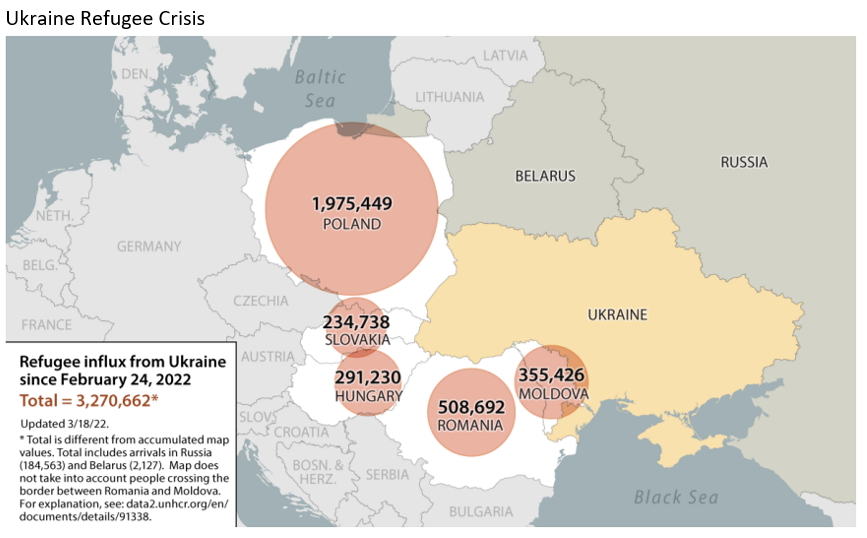
The humanitarian dimension of this invasion starts with the destruction of communities and lives but has turned into a refugee crisis as wars always do. Into the imperfect storm of 2022, inflation is adding to food insecurity exacerbated by war in one of the world’s more productive breadbaskets (Ukraine and Russia) and is assessed in a recent article published by Center for Strategic & International Studies. Yellen discusses this point as much as any other consequence of the war, inflation, and tightening financial conditions which disproportionately affect poorer countries and people. The attached link to the World Bank’s April 2022 Commodity Markets Outlook details the reasons economic, financial, and supply chain shocks will worsen imbalances and human suffering before better weather and policies can help. A Congressional Research Service report provides a good snapshot of the refugee crisis through mid-March and is most useful as a geographic impact tool.
Conclusion
Ben Wallace and Janet Yellen are the more consistent public policy analysts on military and economic realities of the war. Even as Brexit dysfunctions push back to the fore, unmistakably the British defense chief and US finance chief are regular signposts of a renewed momentum to update the transatlantic relationship. This effort last decade ran into an autocratic buzzsaw; this decade, war and macroeconomic policy adjustment are the drivers of policy. Our friend cautioned against under-estimating symbols of global integration many Russians counted as progress under a system deliberately different from the West. MacDonald’s fire sale in Russia bookends the economic and geopolitical benefits the arches represented 30 years ago to Russians, politicians, and US multinationals.
This period of re-globalization won’t quickly solve the challenges families, businesses, or policy makers are struggling to address. It took a few decades and many miscalculations by interested parties to get to this point. It will be a longer process without a sober, transparent, coordinated policy effort helping households and businesses adjust. Further missteps are also possible if not likely. A ceasefire in and rebuilding of Ukraine will stand as testament to a form of non-market risk-on appetite that could ease the macroeconomic adjustment by encouraging public and private investment in a constructive purpose with reasonable odds of facilitating multi-dimensional opportunities.

