SUMMARY: Two points on the Fed. First, Powell reiterated how important and difficult it is to fight inflation. The Fed is trying to reduce labor demand WITHOUT causing a recession, but their goal is slowing inflation. The path to achieve that is through reducing labor demand, which remains extremely high.
Second, the Fed “put” is different now. As Gerard discussed earlier this week, the Greenspan “put” developed in a period where the negative wealth effect of falling stock prices was a bigger threat to the economy than inflation. That is not true today. Inflation is a big risk. Powell, echoing comments by Daly, said as much in his recent NPR interview. “…the process of getting inflation down to 2% will also include some pain, but ultimately the most painful thing would be if we were to fail to deal with it and inflation were to get entrenched in the economy at high levels…” And as Gerard noted “Moreover, the Fed is fibbing even about how worried they are. They are more worried than they let on.” Of course, the Fed doesn’t want a recession, they are willing to take on elevated recession risk to get inflation down.

For any type of Fed put to show up credit needs to weaken. CDX spreads are wider and the percent of high yield that’s distressed is higher, but the distressed ratio is still low relative to history. In other words, some companies are feeling the pain (which is kind of the point) but the overall environment is stable.
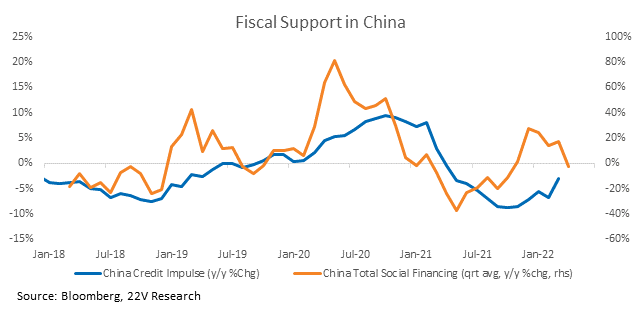
China total social financing and new loan growth for April were both much worse than anticipated. Rolling lockdowns that exact a worse economic toll than estimated will continue to put downward pressure on global growth and commodities.
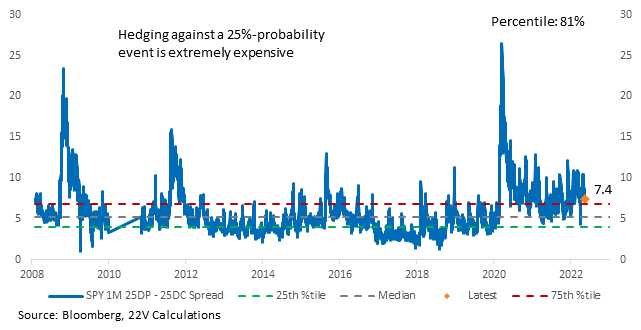
Per our survey work, most investors think the S&P is attractive within -5% of its current level. We recommend selling -10% SPY puts to fund SPY calls. The risk to the trade is if the S&P falls more than -10%, the calls expire worthless, and investors are forced to invest at SPX ~3550. But our survey work indicates most investors would buy at 3550. We aren’t options experts, and we will happily defer to them to properly structure the trade, but we note that selling June puts on SPY strike $355 can fund June calls on SPY strike $417 (selling -10% downside to fund +5% upside). Downside protection is still unusually expensive relative to upside potential.
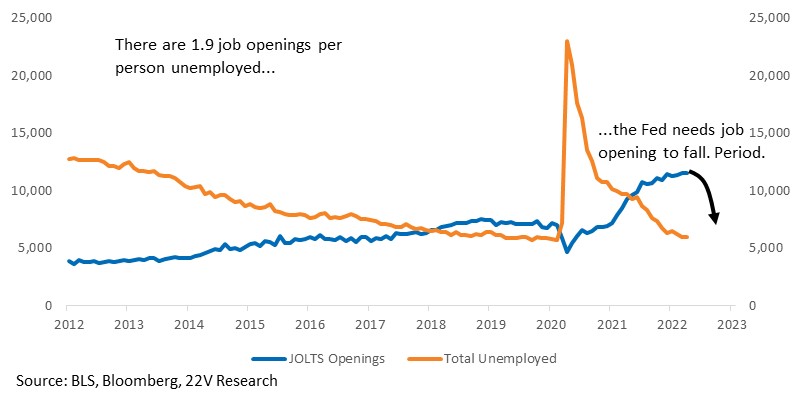
MARKET VIEWS: More text than normal today, but understanding the Fed’s stance is super important. Two points on the Fed. First, in an NPR interview yesterday (here) Powell reiterated the path through which the Fed will fight inflation. They need labor markets to ease, and he specifically cited the high level of job demand relative to supply. The Fed needs the number of jobs per unemployed worker (currently 1.9) to decline. “…there are two job openings for every unemployed person. It’s historically high-level. So in principle, and I’m not saying this will be easy to do, in principle, you could moderate demand, reduce demand to the point where job openings move down substantially, and the labor market gets much closer to being in balance… wages would still be moving up at healthy levels. They wouldn’t have to go down, but ultimately, they would be at levels that would be consistent with 2% inflation.” The Fed is trying to reduce labor demand WITHOUT causing a recession and will try to walk that path.
The second important Fed point is related to a question we are getting more and more often; where is the Fed “put?” With the S&P down -17.5% this year and -18% from its cycle high, there is a growing assumption that at some point the Fed will reduce rate hike rhetoric to calm markets. As Gerard noted earlier this week though, the Greenspan “put” developed in a period where the negative wealth effect of falling stock prices was a bigger threat to the economy than inflation. That is not true today. Inflation is a big risk. Powell, echoing comments by Daly, said as much in his interview. “I will also say that the process of getting inflation down to 2% will also include some pain, but ultimately the most painful thing would be if we were to fail to deal with it and inflation were to get entrenched in the economy at high levels…” And as Gerard noted “Moreover, the Fed is fibbing even about how worried they are. They are more worried than they let on.” Of course, the Fed doesn’t want a recession, they are willing to take on elevated recession risk to get inflation down.
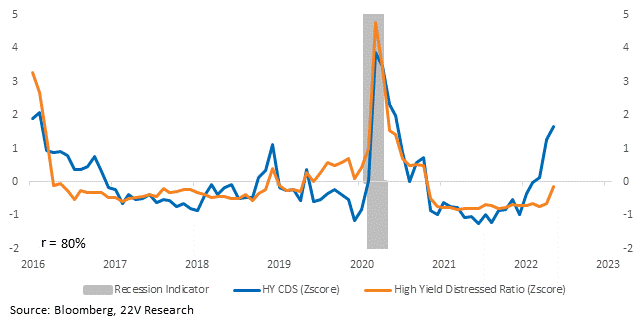
A Fed put is more likely to come into play when/if credit markets weaken. CDX spreads are wider and the percent of high yield that is distressed (defined as bonds trading above 1000 OAS) is higher, but the distressed ratio is still low relative to history. Some companies are feeling the pain (which is kind of the point) but the overall environment is stable. FYI, we lowered the OAS bar to 900bps and 800bps and the distressed ratio was the same normalized level, so we’re confident we’re not missing imminently distressed debt that will make the chart worse soon.
China total social financing and new loan growth for April were both much worse than anticipated. Rolling lockdowns are exacting an economic toll, even with whitelist measures to try to maintain activity. Shanghai is aiming for zero community spread by May 20, which would lead to an end of the lockdown, but China is committed to dynamic zero-covid, and that’s what matters. Beijing isn’t under lockdown, but restrictions are growing as COVID spreads. Continued lockdowns that exact a worse economic toll than estimated will continue to put downward pressure on commodities.
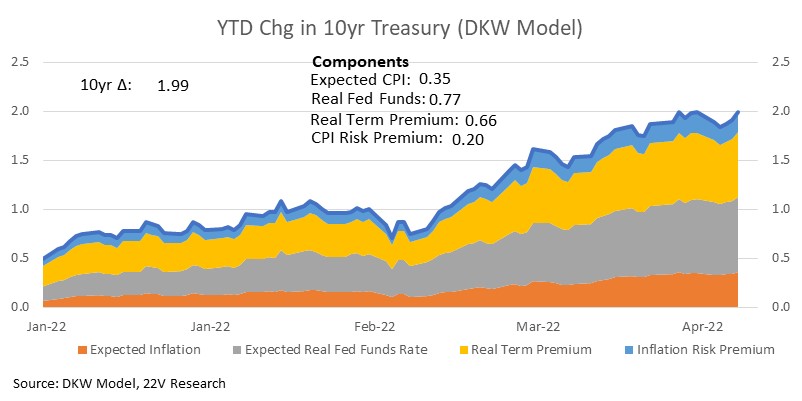
10yr Yields Topping Out: Treasury yields are higher this morning, but still down -22bp from their flight-to-safety peak. Yields and yield volatility have shot higher as markets price in higher inflation and the Fed’s commitment to moving short rates higher to slow growth. All components of the 10yr yield are higher YTD, but real Fed funds increased the most (followed closely by the real term premium or real interest rate risk). The Fed has staked out its rate hike path and growth is finally starting to slow. The tailwinds driving 10yr yields higher are fading. That could change if inflation remains high.
Survey Results & Equity Linked Strategy: Per our survey work, most investors think the S&P is attractive within -5% of its current level. Most of those (~40%) are concentrated around -2.5% to -4.5% down from current levels.
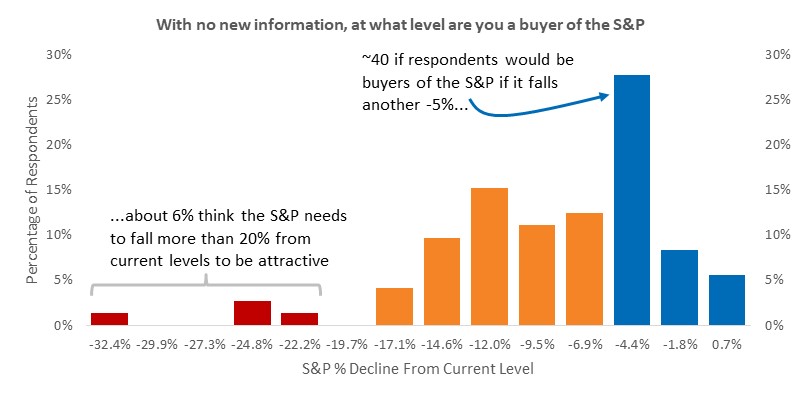
Since investors consider -10% down an attractive entry point, we recommend selling -10% SPY puts to fund SPY calls. The risk to the trade is if the S&P falls more than -10%, the calls expire worthless, and investors are forced to invest at SPX ~3550. But our survey work indicates most investors would be buyers above that level. Economic data could deteriorate and change the outlook, but that’s always a risk. We aren’t options experts, and we will happily defer to people who know options markets better to properly structure the trade, but we note that as of yesterday’s close, selling June puts on SPY strike $355 can fund June calls on SPY strike $417 (selling -10% downside to fund +5% upside). Downside protection is still unusually expensive relative to upside potential.