Thanks to everyone who responded to our inaugural topical survey. These are meant to create a quick measure of sentiment on important, topical questions. Rather than a broad survey, these will be concentrated (short) and focused on the questions we think are most pressing for clients today.
Please hit us back with feedback – our goal is to help, after all.
Asset prices and market internals have swung repeatedly between risk-on/off this year as the growth narrative has shifted. The biggest risk to growth is if the Fed will tighten too quickly and “break” something. A plurality of respondents expects a recession to start in 1Q23, BUT conviction on that start date is low. The average respondent put less than 50% odd on their call being correct.

The lack of conviction on recession reinforces a more volatile backdrop. It’s tough to press shorts in an oversold market that has unusually high cash return yields while a near-term recession is not a base case. Can we really be conviction long though? Beyond short-term trading opportunities to take advantage of oversold conditions, probably not. At least until we have more conviction that core inflation is moving toward 3% or below and the Fed can back off WITHOUT having to increase the unemployment rate. Increasing the unemployment rate to get inflation to 2% would be bad (Ghostbusters reference).
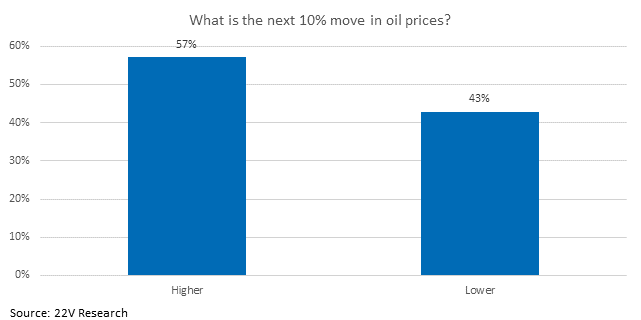
Low Conviction on Higher Oil: Similar to the view on Growth, investors remain split on the next move in oil. A slight majority (57%) expect the next move in oil to be higher and 43% expect it to be lower. The path of commodity prices should be tied to the volatility of growth in emerging markets and Europe.
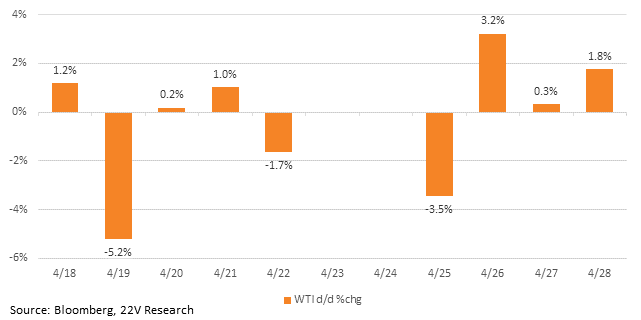
Here’s the day-over-day change in WTI the last two weeks. We aren’t surprised there’s a close split between higher and lower.
Quality OR Value: There is an interesting discrepancy between individual expectations of factor performance and what they think other people think. We asked two questions:
1) What do you think will be the best performing factor through year-end. Most respondents (47%) expect Safety (Quality of Earnings, Low Vol, etc.) to be the best performer.
2) What factor do OTHER PEOPLE think will be the best performer. 40% of respondents think everyone else expects Value to outperform. This is a play on the “surprisingly popular” method (meant to refine crowdsourcing).
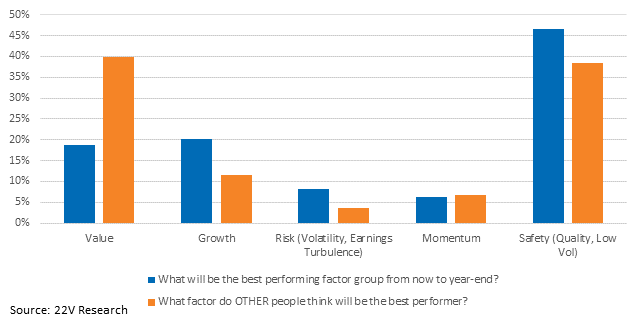
Another Re-Risking: The results of the survey set up another potential round of Value & Re-risking. There is a preference for Quality, but many investors think Value is a favorite position of OTHER market participants. That means most people are defensive and not really invested in risk-on factors…but they think other people are!
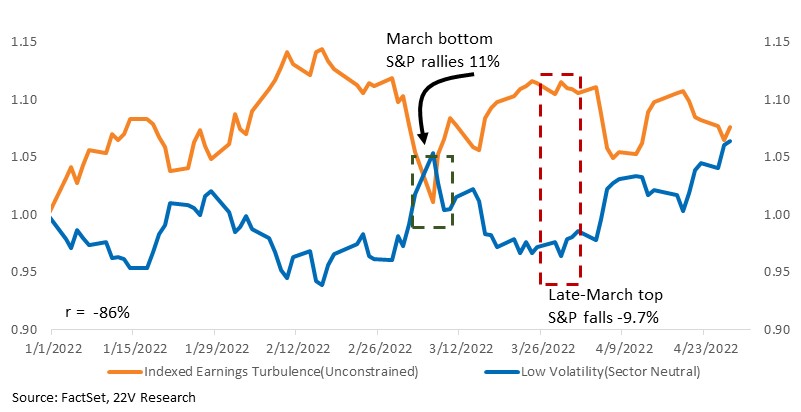
Other Stuff That You Might Find Interesting on The Re-Risking Front: Market volatility has been wild this year. The S&P posted two near-corrections (-9.7% in Jan, -9.7% in Mar) which were followed by two strong rallied (+6.7% in Feb, + 11% in Mar). Factor volatility has been comically large as well with repeated swings between De/Re-Risking factors, and between Growth/Value. Today, the S&P sits down -9.7%, slightly below the low end of our fair value range (4,200 – 4,600). The last time the S&P was near these levels, which was less than two months ago, the market rallied 11% in a matter of weeks, led higher by risk-on factors. Earnings reporting season remains strong, rate hike expectations are likely at a near-term peak, and U.S. growth readings remain robust. Assuming the Fed does not sound too hawkish at next week’s FOMC meeting, the backdrop is in place for another re-risking rotation.
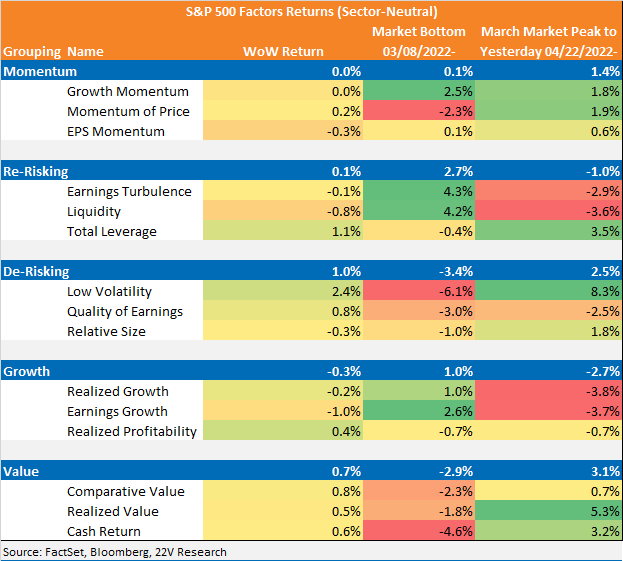
During the last market rebound, high Earnings Turbulence names outperformed Low Vol by 10.5%. Earnings reporting season has put a premium on higher-quality names, which are more likely to beat growth expectations, and Earnings Turbulence names have struggled as reporting has ramped up. After next week, the FOMC meeting will be over and reporting will be winding down, creating a backdrop that can support a re-risking. That assumes the FOMC doesn’t shift to a more hawkish stance (we don’t expect them to given the tightening of financial conditions) and that earnings estimates are not revised sharply lower, which is only likely if a recession is going to start immediately.
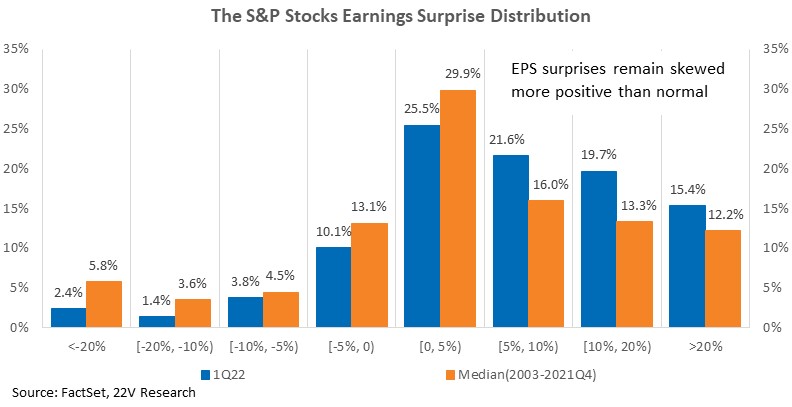
Earnings revisions have been much more positive than normal this season. With about half the index having reported, more than 80% of companies are beating estimates and intra-quarter revisions are running +2% (75th %tile historically). Earnings, through a combination of stronger top-line growth and profitability, continue to surprise to reflect the 1) strong level of nominal growth, and 2) the abundance of pricing power available in a high inflation environment.
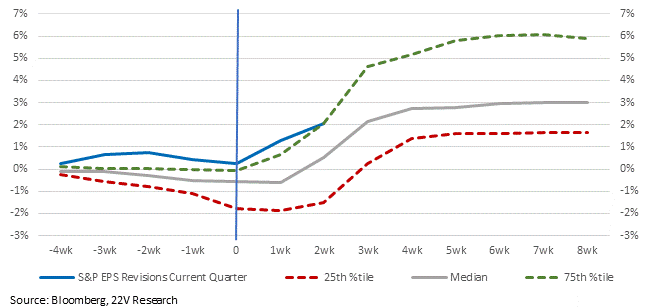
Earnings surprises have been skewed more positively than normal during 1Q reporting season.