
The trend is down. This is true generally about most of Europe’s demand for energy products and is driven by war headlines. The UN Security Council yesterday received information on gangland atrocities while Congress heard testimony from the US Secretary of Defense that the war in Ukraine could drag on for years. Dispiriting, no doubt, but most European heads of state have decided to be done with Russia, including its energy.
One month ago, the incursion may have seemed short of all-out war to many except Ukrainians. There was hope it was a short ‘statement’ incursion leading to an unappealing negotiating session for both sides. That moment seems a faint memory. Our first geopolitical risk webinar guest, Chris Skaluba of the Atlantic Council, pointedly told us in the last week of February that the notion of European security had been changed forever. That astute observation has mushroomed into a permanent change in global policy and politics.
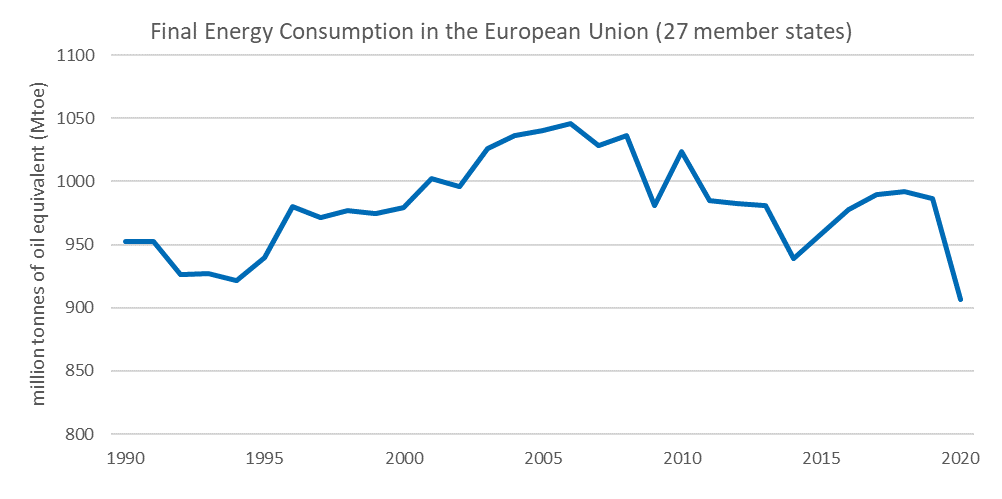
The EU is closing in on achieving 2030 targets for moving toward cleaner, greener energy. It hasn’t been linear as the chart below shows final energy consumption (total energy consumed by end users). As is true for most open societies, energy usage by capitalist economies drops during shocks (2010-2013, and 2020/21) but recovers during periods of growth. Europe’s dependency on Russian fossil fuels is a long-known vulnerability but now it is a deeply biting one. Europeans seem committed to closing that disadvantage. The white glove treatment by sanctioning nations of the Russian energy sector has been replaced with boxing gloves.
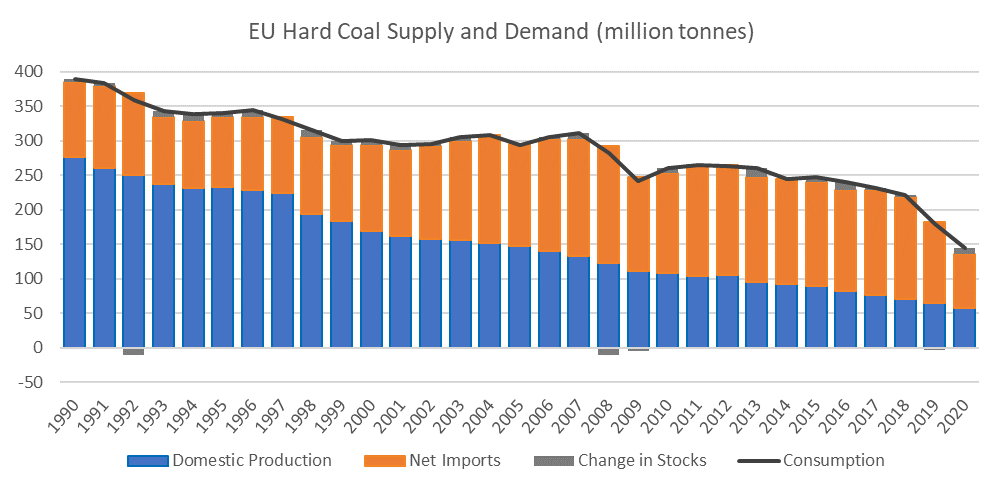
The European think tank, Bruegel, has written plenty on the topic of the ability, pain, and benefits of Europe weaning itself from Putin’s energy pipeline. Their March 17 post Can Europe manage if Russian oil and coal are cut off? contains some of their more inclusive thinking on the path and stakes. Part of the conversation is Europe’s success in moving away from coal, their own and others’. The following chart makes the case. Thirty years ago, Europe used 389 million tonnes annually, 72% of which came from European mines. By 2020 that was cut to 136 million tonnes only 42% of which came from home.
Putin forced Europe and its allies to counter his war against a non-EU member with the only tools available – economic measures. As for Hungary, the European Court of Justice enabled EU leaders to hit Prime Minister Viktor Orbán in the pocketbook. The move will eventually hurt Hungarians more than Orbán but over time sends a broader message that membership has privileges and responsibilities to a member’s populace, and the Union. That protected common purpose seems on the rise in the Union, implicitly acknowledging risks of either inaction or action and imagining more upside to the latter.
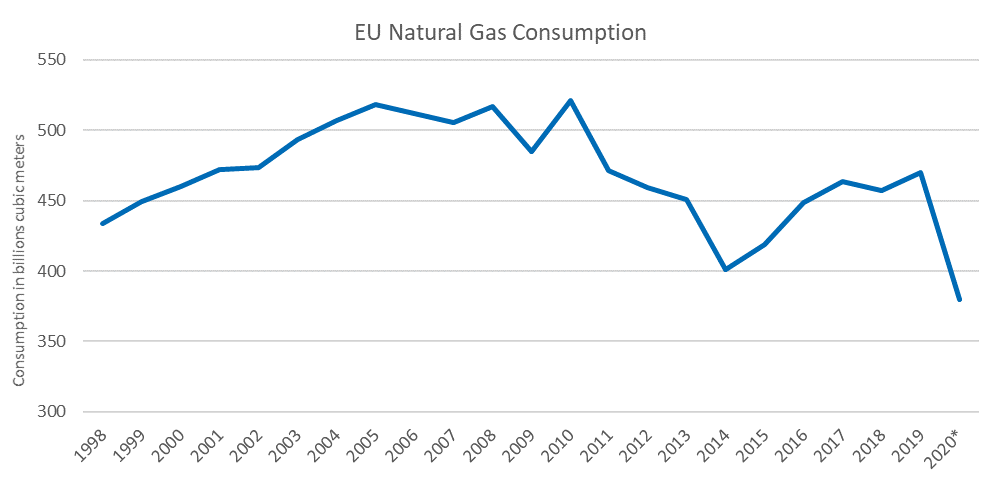
Natural gas in all its forms remains a darling of the global energy transition. Ignoring the demand hit from Covid-19 and adjusting for the exclusion of the UK from the data series in 2020, the chart below shows EU natural gas usage rising since 2014 in clear and deliberate recovery. Several EU countries are building liquified natural gas storage terminals. The Europe Gas Tracker 2021 provides a list of projects from Belgium to Estonia; Germany’s very active economic minister yesterday said two more had been recently permitted, doubling the ones under construction. Tellurian (TELL, +120% since February 22) and Linde Engineering (LIN, +19%) are among the proxies we use to follow this policy theme.
The current macro policy overhang on markets feels similar and different to previous modern episodes (2007-2012, 1999-2001, and 1987-1994). Each had an economic and/or financial factor at play, some were sprinkled with global health concerns, and a few included military conflicts. To repeat a theme we feel is becoming stickier than a slice of gum gone through a washer and dryer – few G20 policymakers have worked through such unique challenges presented by macroeconomic policy adjustment, an inflection-point war, Covid-19, and a seriously damaged global value chain.
Risks must be to the downside at least this year just considering the heavy load. But naturally there are also some opportunities, including LNG production and transport, and terminal construction, microelectronics manufacturing, many aspects of energy transition (especially EVs and renewables storage), and the range of both civilian and military uses of AI, to name a few policy-related themes. The EU has embarked on a self-investment program focused initially on energy and defense that we believe will expand to other sectors dependent on war outcomes and consequences which will inform voter tolerances.

