SUMMARY: Risk assets are being bolstered by positive news flow from Russian and Ukraine, and reports China will step in to support equities and the economy. If positive news continues there will be some normalization of risk premiums in oil, bond, and equity volatility.
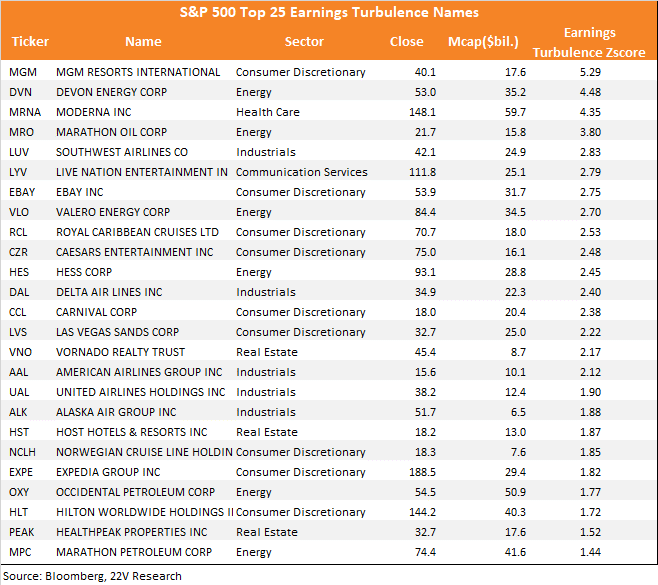
Low volatility should suffer relative to Earnings Turbulence (list of high turbulence names at the end of this report) as tail risk is reduced and odds of a real income shock, which was a significant threat a week ago, are reduced. Although recession risk is lower as oil prices come down, don’t expect deeper Cyclicals and Value to run significantly higher. The list of economic growth headwinds is significant, and the Fed is clearly trying to guide economic growth slower (they must). Don’t expect the Fed to do anything to change market pricing of rate hikes or move financial conditions meaningfully one way or the other. With low conviction, the short-term market backdrop is positive

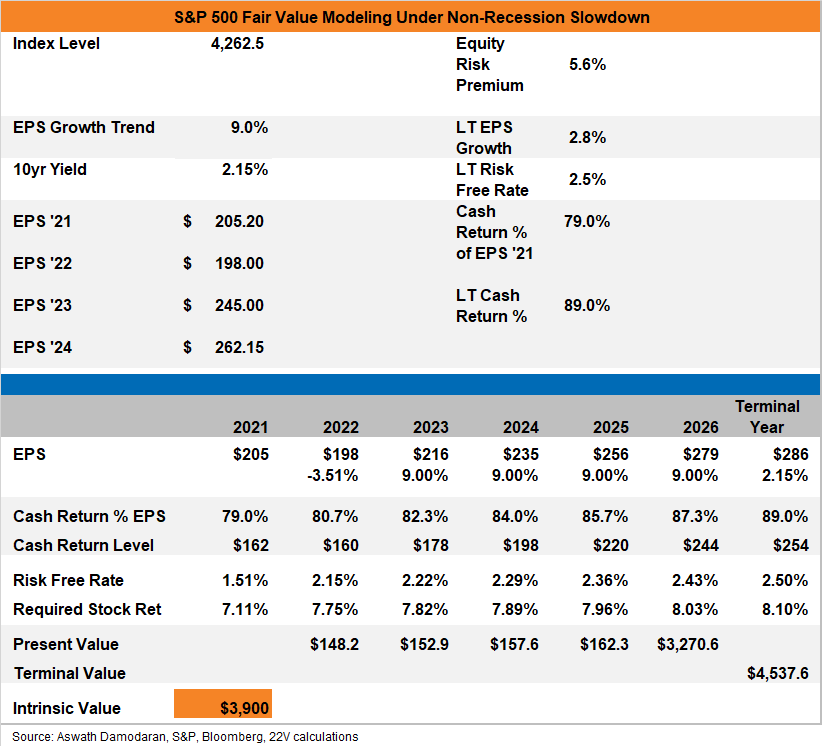
Fair Value Update: Under Aswath Damodaran’s approach, assuming current forward EPS estimates (2022 = $224, ‘23=$246, ‘24=270) and a gradual return to a sustainable cash return rate, the implied S&P equity risk premium today is around 5.6%, up from 5.3% at the start of the month. Applying that ERP to a backdrop of 1) a 50% slowdown in revenue growth and 2) a 1pp decline in earnings margins, S&P fair value would fall to ~3,900.
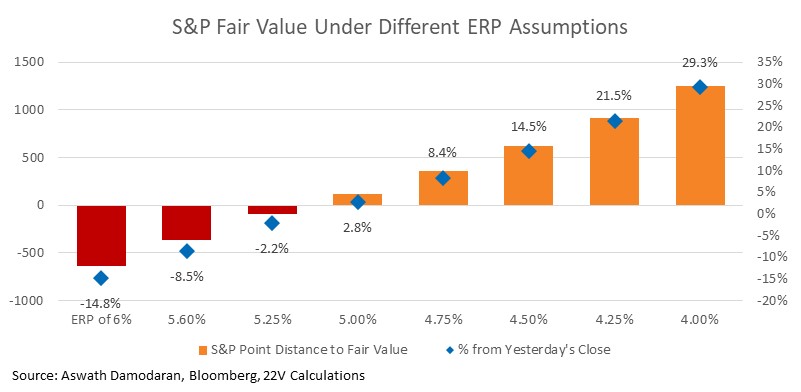
The above number needs some context though. At the start of 2022, the implied ERP was ~4.8%. Even under the sharp slowdown scenario (50% of expected revenue growth, a 1pp decline in margins), an ERP of 4.8% would put S&P fair value at 4570, or +7% from yesterday’s close. Any ERP less than 5% leaves S&P fair value higher. If the economy slows WITHOUT a recession and the Fed starts to back off, the ERP should fall as the economy moves further off the zero lower bound constraint on policy.
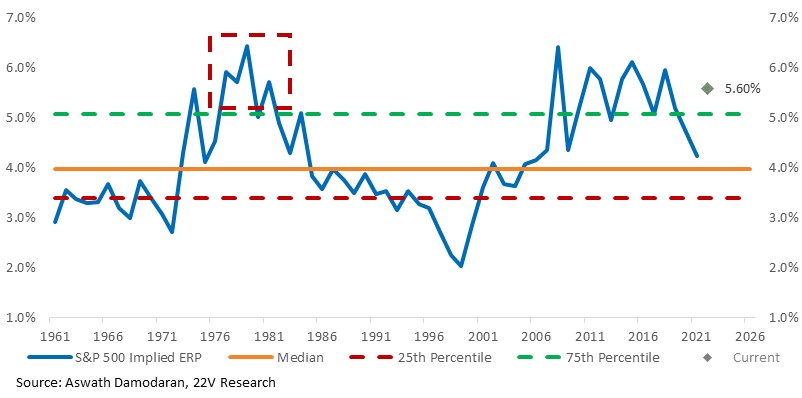
A 5.6% EPR is unusually high relative to most of history. In the post-GFC era, the ERP remained elevated for years as policy remained near the effective lower bound, inflation non-existent, and bond yields exceptionally low. The EPR has shifted lower as the economic backdrop has started to normalize. The last period that saw ERPs consistently above 5% was the 1970s stagflation period. If the economy falls into stagflation, equity downside is still limited, but upside is as well. In more 1960s style backdrop, the ERP was consistently below 3.5%, which would imply significant upside to equities from here. We mention the 60’s given it was a time of very high economic volatility and that is a regime that we think is POSSIBLE again.
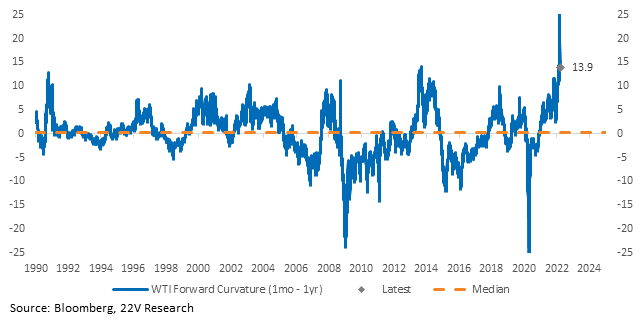
MARKET VIEWS: Risk assets are up sharply as investors are starting to discount China policymakers reacting to the slowdown and some war fatigue from Russia/Ukraine. Xinhua reported China Vice Premier Lue saying Beijing will take measures to boost economy in Q1 and take “forceful measures” to prevent risks among property developers. The report also noted China will welcome long-term institutional investors to increase stock holdings. The WSJ reported that Premier Xi is being forced to give up on his economic reforms given the abruptness of the economic slowdown. On the war front, Zelensky said Ukraine can’t join NATO (a concession to Russia) and the Kremlin said this morning that a neutral Ukraine with its own army, just like non-NATO members Sweden and Austria, is a possible compromise. A few things fall from the above. If positive news continues. First…the risk premium continues to come out of front month oil contracts. That has happened some already, but the backwardation is still at record levels historically.
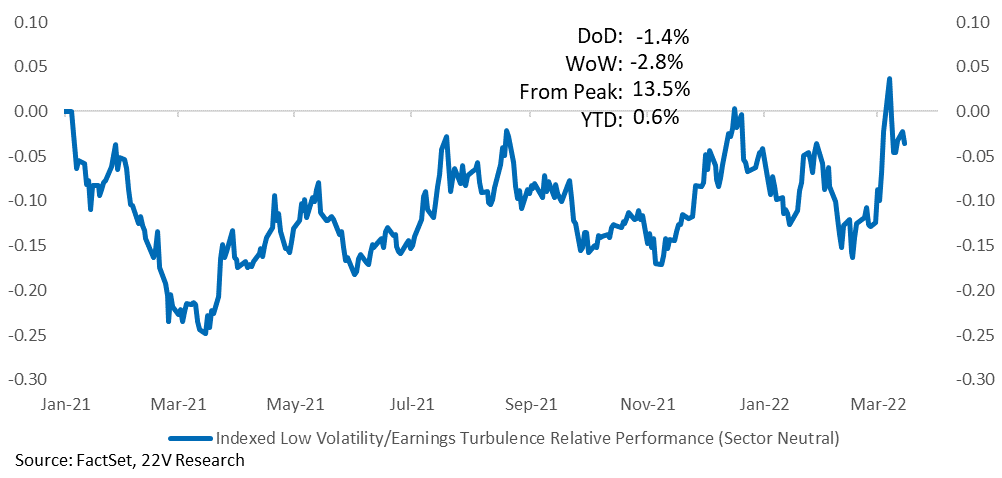
Low volatility should suffer relative to earnings turbulence short-term as economic tail risk is reduced and the odds of a real income shock, which was a significant threat just last week, decline. Although recession risk is reduced as oil prices come down, don’t expect deeper Cyclicals and Value to run significantly higher. The list of economic growth headwinds is significant, and the Fed is clearly trying to guide economic growth slower (they must). We will hear more from the Fed today of course and are not expecting anything from Powell that would change current financial conditions or rate hike expectations meaningfully (which could be considered positive very short term).
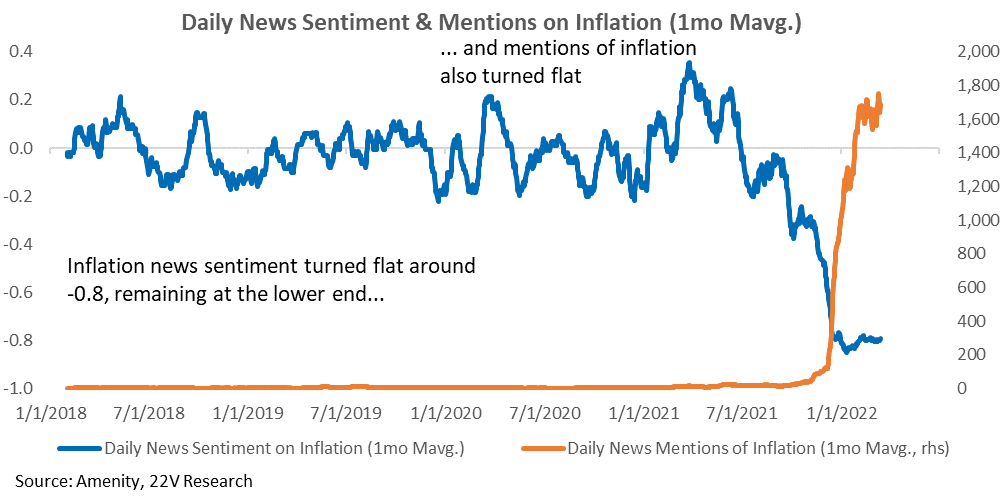
We have noted a few times that implied cash return yields are high and a support for equities but being long is difficult. If inflation sentiment turns while tail risk is reduced (still VERY early on the reduction of tail risk front) that would be a REALLY important support for sentiment. Inflation sentiment is terrible now, but at least it is stabilizing.
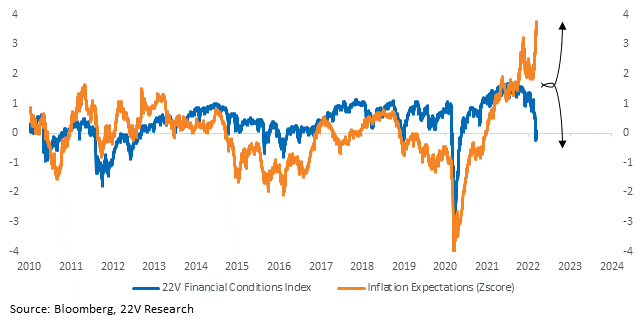
PROFIT MARGINS HEADED LOWER = LESS INFLATION: Profit margins are being pressured by weaker demand growth, associated cyclical weakness in productivity, and stronger wage growth. As Gerard noted following the PPI yesterday, the situation for margins now is “less constructive because the Fed increasingly sees the pricing power as dangerous “inflation” and is about to force – or at least oversee – a marked slowdown of demand growth to reverse it. So, the profit cycle is in the midst of a transition from a very sweet spot to a somewhat sour spot, even though pricing power itself will have supported margins in the goods sector during Q1.” Bottom line, financial conditions will remain tight in an effort to slow inflation, which is a headwind for margins. The gap between inflation expectations and financial conditions will likely close (good for growth stocks as that happens…FYI).
SCENARIOS TO THINK ABOUT FOR S&P FAIR VALUE: Under Aswath Damodaran’s approach, assuming current forward EPS estimates (2022 = $224, ‘23=$246, ‘24=270) and a gradual return to a sustainable cash return rate, the implied S&P equity risk premium today is around 5.6%, up from 5.3% at the start of the month. Applying that ERP to a backdrop of 1) a 50% slowdown in revenue growth and 2) a 1pp decline in earnings margins, S&P fair value would fall to ~3,900.
The above number needs some context though. At the start of 2022, the implied ERP was ~4.8%. Even under the sharp slowdown scenario (50% of expected revenue growth, a 1pp decline in margins), an ERP of 4.8% would put S&P fair value at 4570, or +7% from yesterday’s close. At any ERP less than 5%, leaves S&P fair value is higher. If the economy slows WITHOUT a recession and the Fed starts to back off, the ERP is highly likely to fall as the US economic moves further away from the zero lower bound constraint on policy.
A 5.6% EPR is unusually high relative to most of history. In the post-GFC era, the ERP remained elevated for years as policy remained near the effective lower bound, inflation non-existent, and bond yields exceptionally low. The EPR has shifted lower as the economic backdrop has started to normalize. The last period that saw ERPs consistently above 5% was the 1970s stagflation era If the economy falls into stagflation, equity downside is still limited given today’s ERP, but upside is as well. In more 1960s style backdrop, the ERP was consistently below 3.5%, which would imply significant upside to equities from here. We mention the 60’s given it was a time of very high economic volatility and that is a regime that we think is POSSIBLE again.
High Turbulence Stocks: Below is a list of the highest Earnings Turbulence names currently. These are stocks that should benefit from a near-term reduction in economic tail risk.