Bob Farrell is a Merrill Lynch / Wall Street legend who has been following markets since the late 1950s. Mr. Farrell spent 45 years at Merrill and was the firm’s Chief Stock Market Analyst. Years ago, while we were on the buy-side, we met Mr. Farrell and listened to him share his market wisdom with our group. The room was rapt. Too, we were even luckier to have worked with Steve Shobin when we were at Lehman Brothers as it was Steve who worked with Mr. Farrell for more than twenty years at Merrill. Some of Mr. Farrell’s wisdom rubbed off on Steve (we’ve not met anyone in the business who has been as kind and helpful to us as the nonpareil Steve Shobin) and we hope we’ve retained some of Steve’s lessons and, indirectly, Mr. Farrell’s, too.
On February 15, 2022, we hosted a panel in the first ever 22V Macro Conference and our guest was the great market polymath, Abhijit Chakrabortti of Brevan Howard. The theme of our discussion was “Regime Change.” And the following quote from Mr. Farrell seems to fit right alongside the discussion we had with Abhijit.
“Change of a long term or secular nature is usually gradual enough that it is often obscured by the noise caused by short term volatility. By the time secular trends are acknowledged by the majority they are obvious and mature. In the early stages of a new secular paradigm, however, most are conditioned to hear only the short-term noise they have been taught to respond to via the prior existing secular condition. Moreover, in a shift of secular or long-term significance, the market will be adapting a new set of rules while most market participants will still be playing by the old rules.”
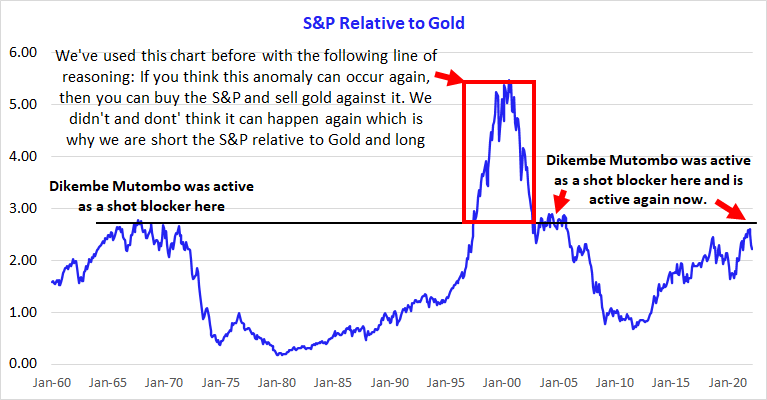
We don’t think we can do any better than the above quote regarding what is occurring vis-à-vis the transition from bull to bear market (since spring 2021), low inflation to persistently high inflation (since spring 2021), and into a full-fledged commodity bull market (since late autumn 2020). We show charts for those changes in our weekly 22V Webinars. Yet, other ways to think about “Regime Change” are via the following two items: JP Morgan (JPM) which has been a good market bellwether in prior cycles and a relative ratio showing the S&P / Gold.
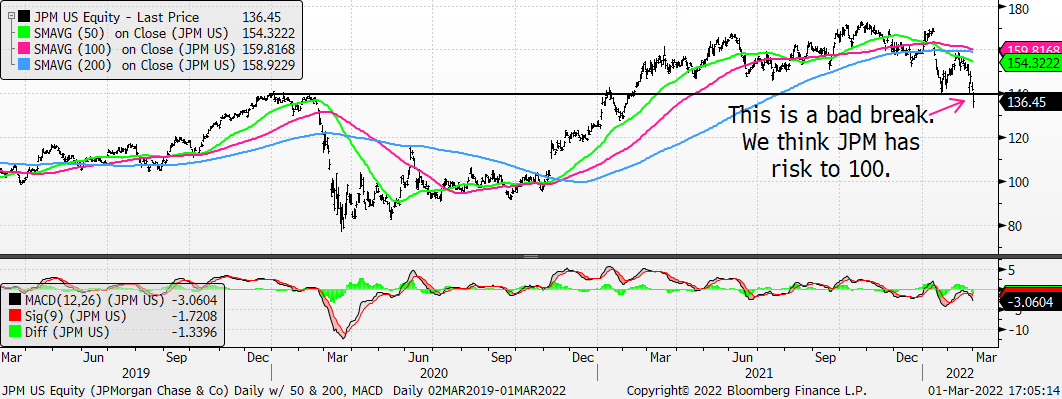
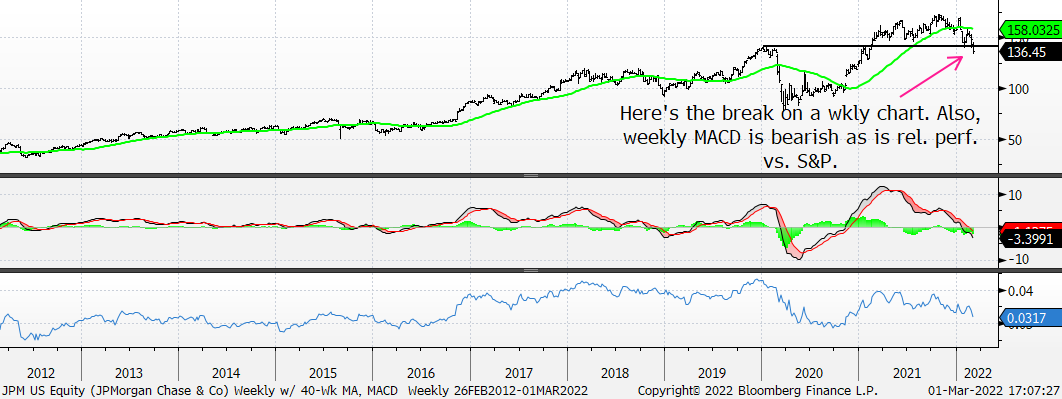
JP Morgan has a Technical Score = 0 and what makes this doubly unfortunate is that it has been a good market bellwether in prior cycles such that if it has deteriorated or faltered then it was a near impossibility that the overall market would thrive. It’s not that JPM must go up for the market to remain secure, it’s that JPM cannot go down.
The stock peaked in late October 2021 just under 173 and today it closed at 136.45, down more than $5 and 3.8% (after falling more than 4% yesterday), and it traded as low as 133.58. We’re making mention of its closing price and intra-day low because JPM is now beneath its pre-COVID high of 140. The chart below will make this clearer, but JPM’s failure to hold 140 as support suggests that its entire post-COVID breakout, above 140 and up to 173, was fake. We hate fake breakouts and, especially in this part of the cycle, fake breakouts have resulted in harmful and sharp moves in the opposite direction. What follows might just be our imagination talking, but we believe JPM has risk to 100.
JPM – Daily w/ 50-, 100-, and 200-Day Moving Averages and Daily MACD
JPM – Weekly w/ 40-Week Moving Average, Weekly MACD, and Rel. to S&P 500
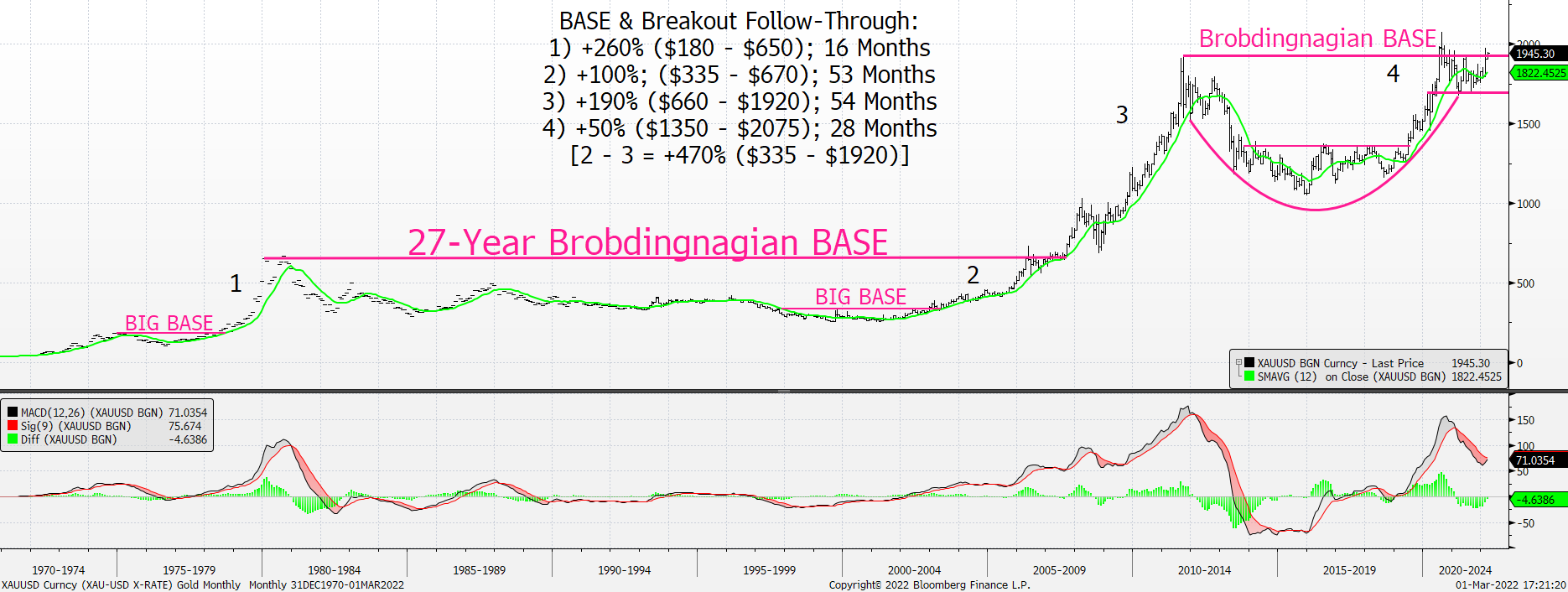
We’ve shown this S&P Relative to Gold chart a lot over the last few months and we it’s in the starting lineup of the most important market charts / relationships we monitor. The ratio is down, in favor of gold, by 15% since the end of 2021 and we’re looking for it to work much lower (the inputs are S&P lower and gold higher). It’ll likely be a bit trite by now, but this relative ratio is giving a big “regime change” message. The last chart shows gold on a monthly basis. We’re sticking with the idea, which was a much bigger call when we made it in November 2021, that gold will make a new all-time high. Please notice that gold has been a BASE & Breakout asset since spring 1978. Upside follow-on moves, post the breakout have ranged from 50% to 260% (or 470% if you want to take the longer version). The following two admonitions about gold seem as true now as they’ve ever been.
An olde (wink) English proverb (aren’t all English proverbs olde?) goes like this, “When we have gold we are in fear, when we have none, we are in danger.” And, when Christopher Columbus set sail for the New World in 1492 he carried with him the words of his patron, King Ferdinand of Spain: “Get gold, humanely, if possible, but at all hazards – get gold!”