SUMMARY: Russia-Ukraine negotiations, for now, are having little effect and won’t be much relief to markets so long as they are not corroborated by actions (overnight news – they aren’t). But global central banks will still have to confront price pressures if the Russia-Ukraine crisis doesn’t create demand-destroying commodities prices and/or demand-destroying chaos. We remain focused on the type of stocks that benefit from tighter financial conditions (Quality, Low Volatility, Size, Profitability. Good news for big cap tech theoretically) as the path of expected rate hikes is secondary to how much financial conditions need to tighten to slow growth and inflation. Again, tighter financial conditions will come from the Fed OR the war shock if it persists. The major caveat being that some sort of “peaceful” resolution would lead to a significant reversal in rates across the curve and a significant rebound in Cyclicals. Which is typical post-geopolitical conflicts.
Interestingly, the expected path of Fed rate hike expectations hasn’t changed much, yet 2yr yields have collapsed. It seems a significant amount of chaos hedging in portfolios is taking place.
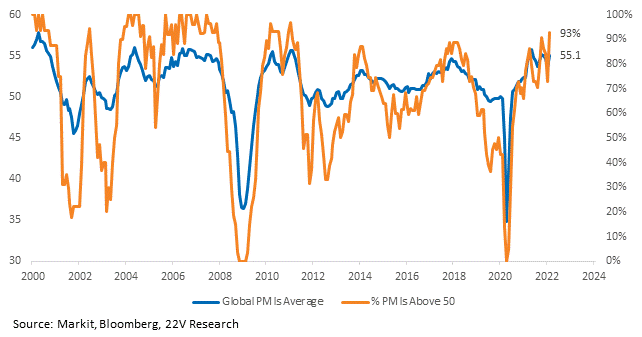
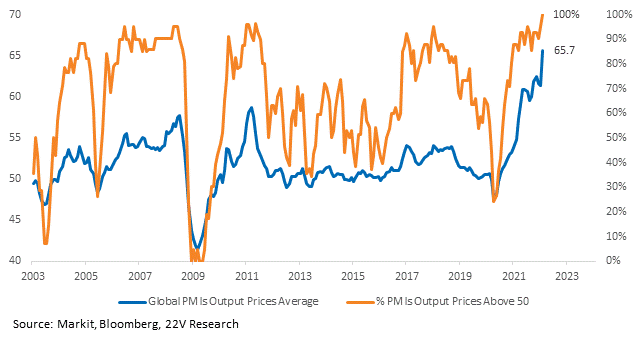
Global PMIs are being released, showing the robust economic backdrop heading into Russia’s invasion of Ukraine. The prices component is still spiking, emphasizing the need for financial conditions to tighten. Growth is still too strong for traditional stagflation to be a likely outcome. It seems stagflation-lite – high inflation and slowing growth – is what most people are worried about. How long stagflation-lite fear lasts will dependent on how long the war lasts.

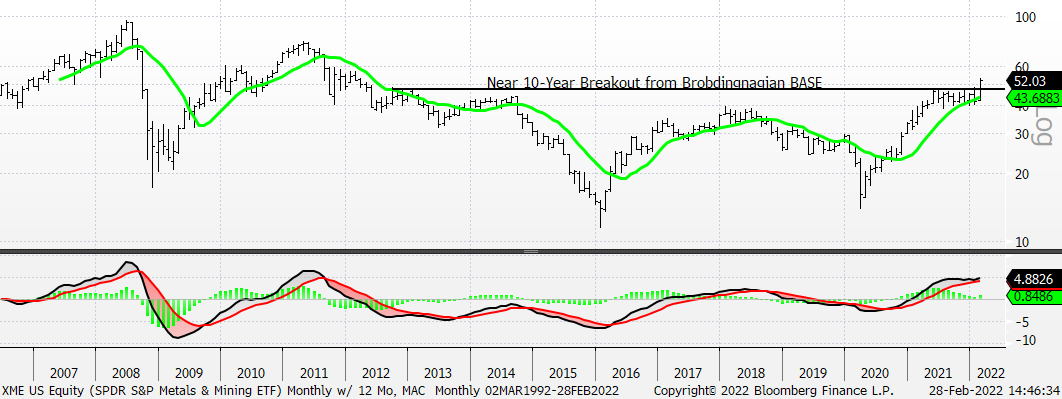
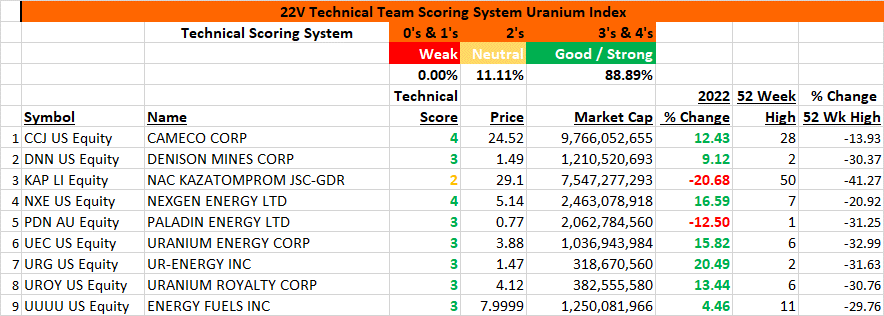
The rest of the report highlights pockets of the market that benefit from the above. John Roque, 22V’s technician, believes a commodity upcycle is in full force. Stay long commodity and commodity-related equities (check out XME) and uranium, which should get renewed interest as Europe faces an energy crisis alongside a commitment to renewable energy. Eight of the nine stocks in his uranium index have Good/Strong Technical Scores.
Kim Wallace, 22V’s policy analyst, likes beneficiaries of US defense spending and global cybersecurity companies. Geopolitical risk and midterms elections are two drivers of increased defense spending, which bottomed in 2018 as a share of GDP. XAR, the aerospace/defense ETF, is a useful proxy. We’re also watching Palo Alto Networks (PANW) as a proxy for concerns about Russia’s offensive cyber capabilities. The company reported a great quarter and US government warnings of new cyber risks to the private sector suggest that the crisis in Ukraine continues to provide tangible risks. We highlight PANW sentiment scorecard in the full report.
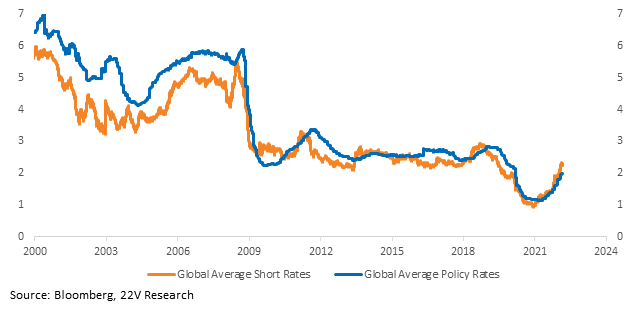
MARKET VIEWS: Russia’s Defense Minister stated Russia will continue its operation until its goals are met. Negotiations, for now, have little effect and won’t be much relief to markets so long as they are not corroborated by actions. There is a 40-mile-long column of Russian forces heading towards Kyiv while Russia is shelling civilian neighborhoods. But global central banks still need to confront price pressures if the Russia-Ukraine crisis doesn’t create demand-destroying commodities prices and/or demand-destroying chaos. We removed Russia from the below index because it had an outsized impact from the recent central bank policy changes, but the trend is toward higher global short rates. Unless demand is destroyed because of the war shock.
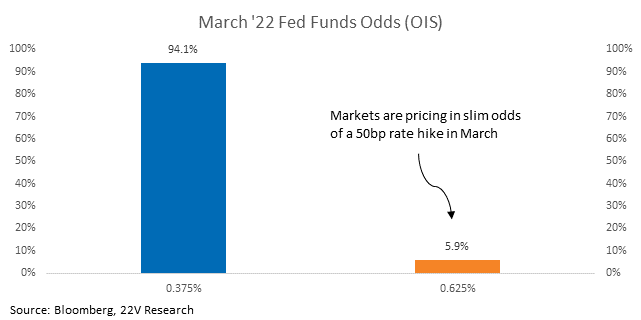
A 50bp Fed rate hike is off the table according to futures markets, a dramatic reversal from a few weeks ago when the odds were ~80%. Investors are still discounting near certainty of a 25bp rate hike though as the U.S. inflation impulse remain strong (rents, wages). But the rate path isn’t what matters most, it is how much the Fed needs financial conditions to tighten in order to slow growth and inflation. Interestingly, the expected path of rate hike expectations hasn’t changed much, yet 2yr yields have collapsed. It seems a significant amount of chaos hedging in portfolios is taking place.
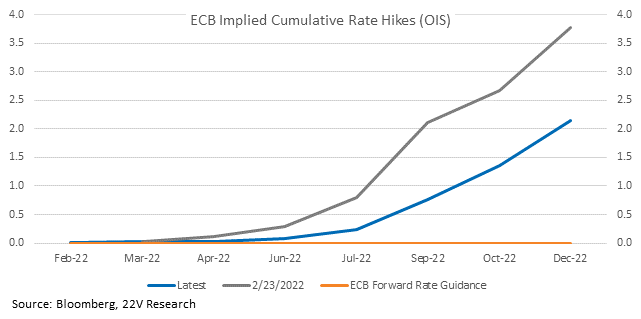
Italian CPI rose to a new Euro-area high, but bets on ECB reactions are falling too. The Russia-Ukraine situation is tightening financial conditions, which gives the Fed and ECB room to adjust policy slower (maybe to a lower end point), Bottom line is growth still needs to slow either through geopolitical shock, central bank tightening, or more likely some combination of both.
Global PMIs are being released, showing the robust economic backdrop heading into Russia’s invasion of Ukraine. The U.S. PMIs are out later this morning; the regional Fed composites already released are consistent with strong demand, a tight labor market, and healthy investment plans.
The prices component is still spiking, emphasizing the need for financial conditions to tighten. Growth (indicated above) is still too strong for traditional stagflation to be a likely outcome (it seems stagflation-lite – high inflation and slowing growth – is what most people are worried about), which are surfacing in headlines again. All else equal, commodities ought to continue to benefit.
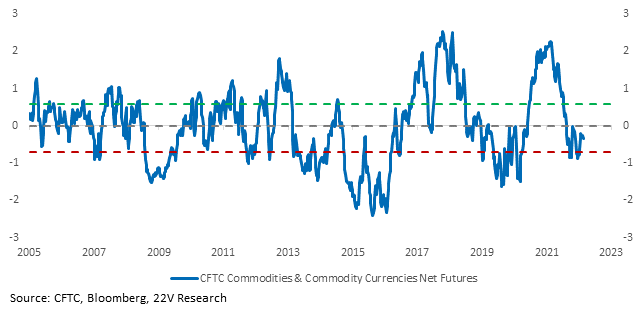
An aggregate of CFTC commodities net futures positioning – blending Copper, Crude, AUD, CAD, and Natural Gas net futures positioning – shows a reluctance to embrace a commodities boom.
John Roque, 22V’s technician, believes a commodity upcycle is in full force. John believes while investors wait on the Fed, a commodity and commodity-related equities theme should continue to be pursued. XME, the metals & mining ETF, is engineering a breakout from a 10-year “Brobdingnagian base.”
John is particularly bullish on uranium, which should get renewed interest as Europe faces an energy crisis alongside a commitment to renewable energy. Eight of the nine stocks in his uranium index have Good/Strong Technical Scores while only one, Kazatomprom, has an understandably Neutral Score.
 Source: Bloomberg, 22V Research
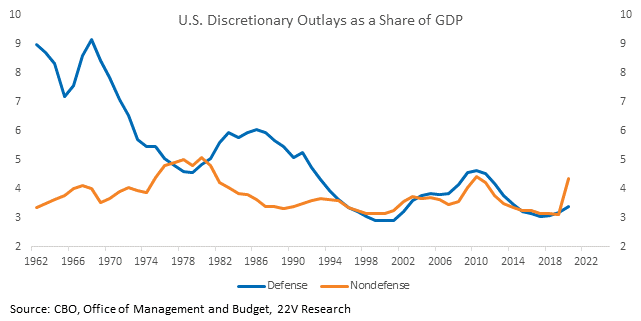
Per Kim Wallace, “Russia has the world’s attention. Two ways for investors to focus on the crisis are US defense spending and global cybersecurity companies. Congress this week will consider and likely add to and pass the Biden administration’s $6.4 billion request for humanitarian and defense spending. The latest whisper number is for the final package to exceed $10 billion. XAR, the aerospace/defense ETF, is a useful proxy. Geopolitical risk and midterms elections are two drivers of increased defense spending, which bottomed in 2018 as a share of GDP in the past two decades. Fiscal talks under divided government usually turn on tax cuts and increased Pentagon outlays.”
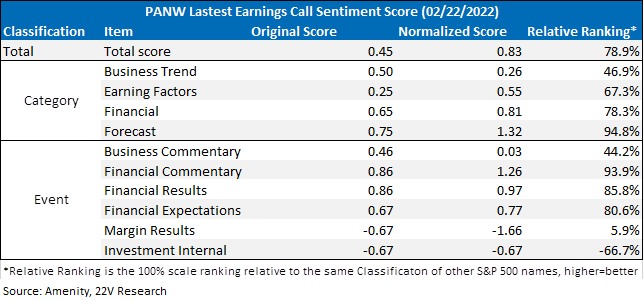
We’re also watching Palo Alto Networks as a proxy for concerns about Russia’s offensive cyber capabilities. The company reported a great quarter and US government warnings of new cyber risks to the private sector suggest that the crisis in Ukraine continues to provide tangible risks. The company’s sentiment scores, updated to reflect their recent 4Q21 earnings release, are highlighted below. Overall sentiment is strong. Financial and forecast sentiment is particularly positive, though margin results were weak. We measure sentiment using the Amenity natural language processing tool to “listen” to every S&P 1500 earnings conference call. This allows us to create an objective ranking of management sentiment toward a wide array of topics.