Summary: It was a volatile week, but our broad-based calls remain the same. The Fed will tighten financial conditions, economic growth will slow and equities will struggle until it is clear that the Fed is well on its way to accomplishing its goals of slowing demand growth/core inflation. Being long equities will be more interesting later in 2022. Over the next few months it will become more obvious that the Fed will slow demand growth (focus on the Fed’s intent, not the rate path) and that is when Cyclicals will start to suffer more.
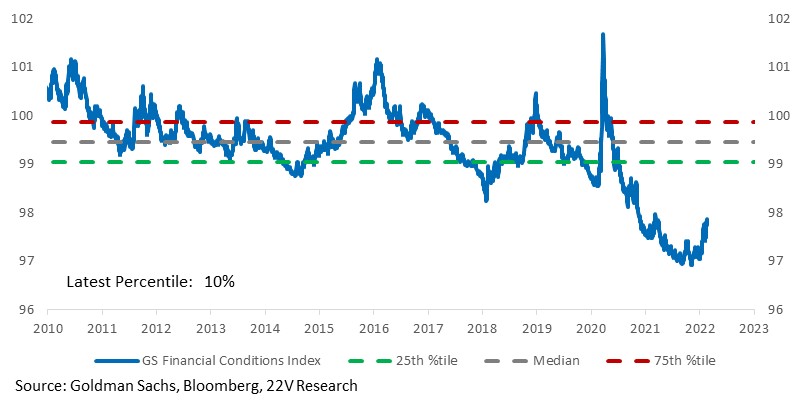
There is some risk that a conflict with Russia could spike oil prices and slow growth, leading some to expect an easing of Fed rhetoric around tightening. As Gerard noted yesterday though, “Given that the US economy is already at (current) full employment and given further that underlying inflation pressures are elevated, the Fed has no reason to try to offset developments that would tend to slow aggregate demand growth. …The question is whether they are inclined to offset a contractionary shock. And at this point the answer is, no.” Financial conditions tightened last week even as rate hike expectations moved modestly lower.
Hopefully an escalation is avoided and if that is the case, strong US demand growth (January retail sales were VERY strong), upward pressure on rents (Gerard has been all over this and the SF Fed see overall rent inflation rising to 7.1% in both 2022 and 2023.), and wages will push real yields higher. Supply Chain congestion is showing some signs of easing, and that will help ease goods inflation. BUT, that easing will not be enough to address the inflation concerns motivating the Fed’s goal of slowing growth. Year-end core PCE is still on track to be ~3%.
The more the Fed makes its intent obvious (slow growth and tighten financial conditions), the more financial conditions will tighten. The expected rate path won’t tell us much as the Fed doesn’t know how much tightening is required to accomplish its goals. What we know is core inflation is well above trend and sticky (see wages/rents), economic growth is firm and financial conditions are easy. The Fed will push back against all 3 things we just mentioned. Unless Gerard’s inflation forecasts are wrong. Gerard has been correct.
Earnings growth beat expectations again in 4Q and fundamentals continue to support risk assets. 4Q results, particularly top line growth, are another sign that economic activity remains strong and recession/stagflation risk low. January PPI came in much stronger than expected, suggesting the near-term outlook for margins remains strong.
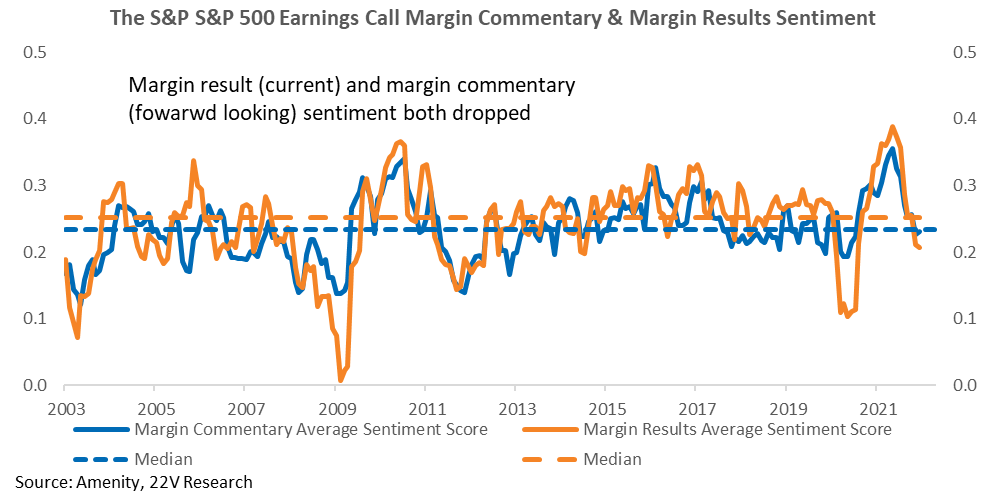
The strength in producer prices is unsustainable because the Fed is intolerant of it. The Fed will stop margin-enhancing inflation going forward. Corporate sentiment toward margins have been deteriorating and cost sentiment is at an all-time low. Margin sentiment, measured using the Amenity NLP tool, is deteriorating too. Earnings, guidance has deteriorate modestly as well. The medium term outlook for earnings is weakening.
Expect a risk asset rebound if geopolitical tensions calm down. Fed speakers are not calling for aggressive action relative to what markets have priced in for fed hikes, financial conditions have tightened but remain historically easy, earnings growth continues to offset multiple contraction, and just about every major market is oversold.
Over the medium term, equities will struggle as investors adjust to a backdrop where the Fed is pursuing slower growth through weakening of pricing power, but a resolution to the Russia situation would ease concerns near-term, supporting a short rally.
We remain long thematic baskets like pricing power, companies that benefit from higher real rates and improving supply chains. An escalation in Russia/Ukraine could lead to a much quicker tightening of financial conditions (Fed doesn’t have to do the work in this case) and limit the increase in bond yields.
Macro Backdrop: How aggressive the Fed will ultimately be in tightening financial conditions is taking a back seat to Russia and Ukraine risk. There is some risk that a conflict with Russia could spike oil prices and slow growth, leading some to expect an easing of Fed rhetoric around tightening. As Gerard noted last week, “Given that the US economy is already at (current) full employment and given further that underlying inflation pressures are elevated, the Fed has no reason to try to offset developments that would tend to slow aggregate demand growth. …The question is whether they are inclined to offset a contractionary shock. And at this point the answer is, no. It follows directly from the claim that they are “behind the curve.” Financial conditions tightened last week even as rate hike expectations moved modestly lower.
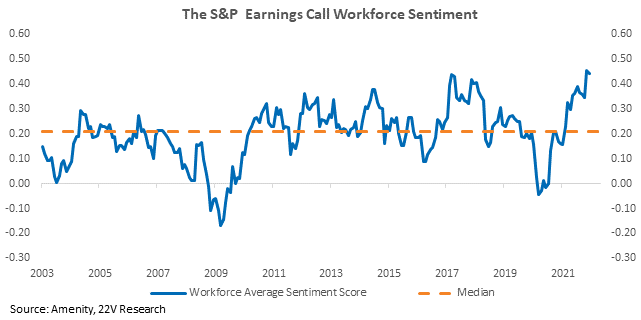
Workforce sentiment, which is sentiment around hiring/laying off, troughed in May 2020, and since then it improved. This suggests companies are still VERY positive about hiring. Strong labor markets and wage inflation are a major Fed concern.
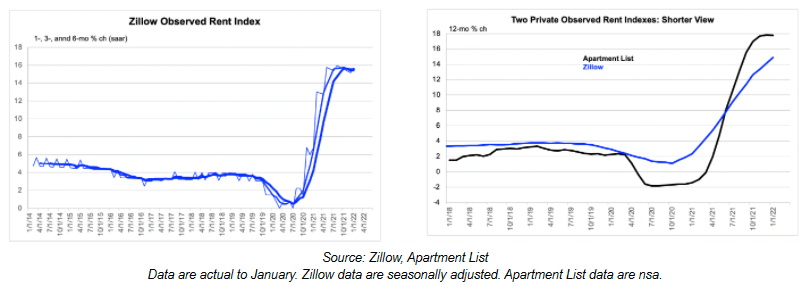
The SF Fed see overall rent inflation rising to 7.1% in both 2022 and 2023. As Gerard noted, “The duration of this move is highly relevant. As I have been pressing, average rents reprice to the latent Market Clearing Marginal Rent (MCMR) slowly over time. So, the cumulative advance of Observed Rent, and not just the most recent rate of change, matters. Fans of the green shoots of disinflation have missed this basic point.” Rent inflation will keep core-PCE elevated above what the Fed is comfortable with through year-end.
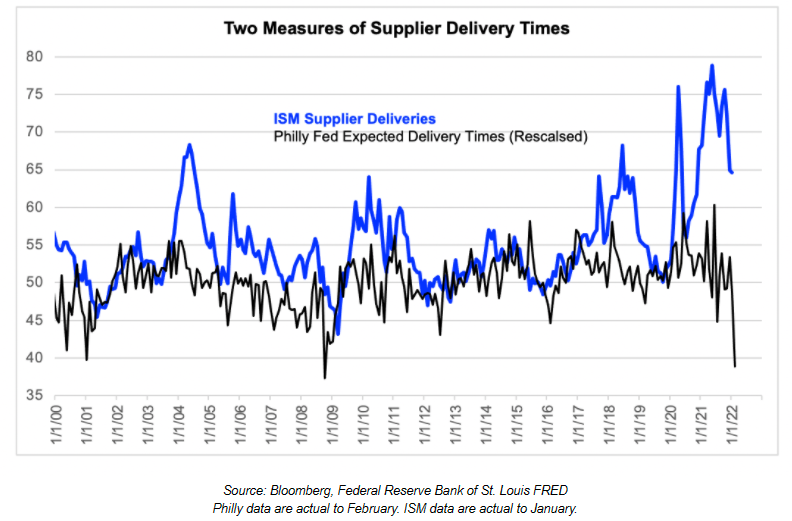
There are some more signs supply chain bottlenecks are easing, which will help drive goods inflation lower. BUT, even sharp declines in import prices, core PCE is likely to end the year around 3%, well above the Fed’s target. As Gerard noted yesterday, “last week the Philly Fed’s measure of expected supplier delivery times six months forward fell 48.9 to 38.9, when rescaled to make it directly comparable with the ISM. Many analysts have inferred from this that supply chains are about to start loosening up. That conclusion seems right to me. …The problem is that my middle-up inflation simulation suggests that even a steep decline in durable goods prices over the coming months will not be sufficient to push inflation back to target. For example, in the middle-up simulation mentioned above, I have durable goods prices falling at an annualized rate of 4 ½ %.”
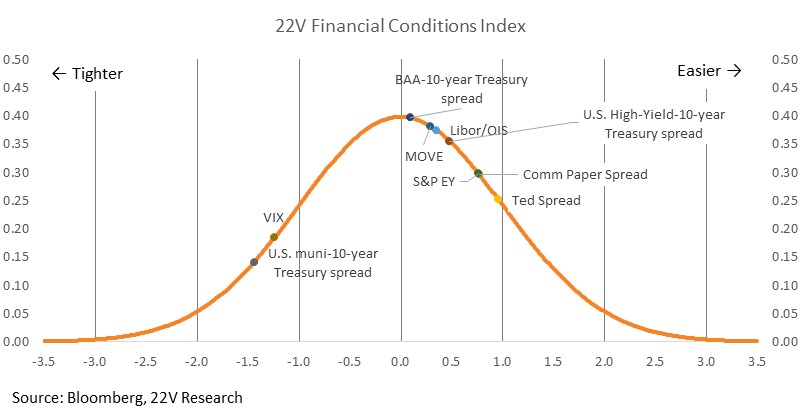
Long-term forward guidance needs to be replaced with a more flexible, data dependent framework, and Powell has been making that shift during post-FOMC press conferences. The Fed’s intent has shifted. Their goal today is to tighten financial conditions and slow growth. They have made some progress, but money market and bond conditions need to tighten further. The more the Fed makes its intent obvious (slow growth and tighten financial conditions), the more financial conditions will tighten. The expected rate path won’t tell us much as the Fed doesn’t know how much tightening is required to accomplish its goals. What we know is core inflation is well above trend and sticky (see wages/rents), economic growth is firm and financial conditions are easy. The Fed will push back against all 3 things we just mentioned. Unless Gerard’s inflation forecasts are wrong. Gerard has been correct.
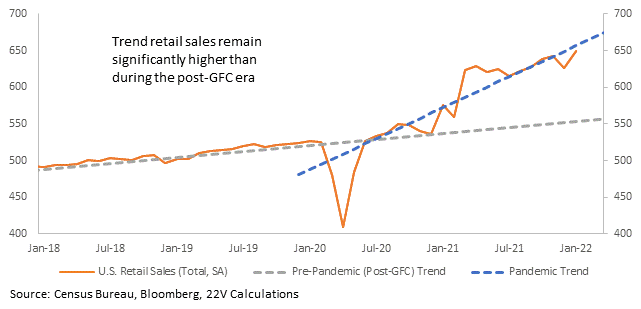
Economic Growth Remains Strong & Recession/Stagflation Risk Low: Retail sales came in very strong in January after a revised-weaker December. The debate is not on the strength of the economy anymore. Credit card data, labor market data, housing data are all telling the same story – the US econ is firm and now we will have less Omicron headwinds. The debate is if firm economic growth continues to butt up against supply constraints (rent/labor) or if stronger productivity growth can offset that (something we discussed during our macro conference this past week). We expect the Fed has to ratchet down demand growth much more aggressively to combat inflation.
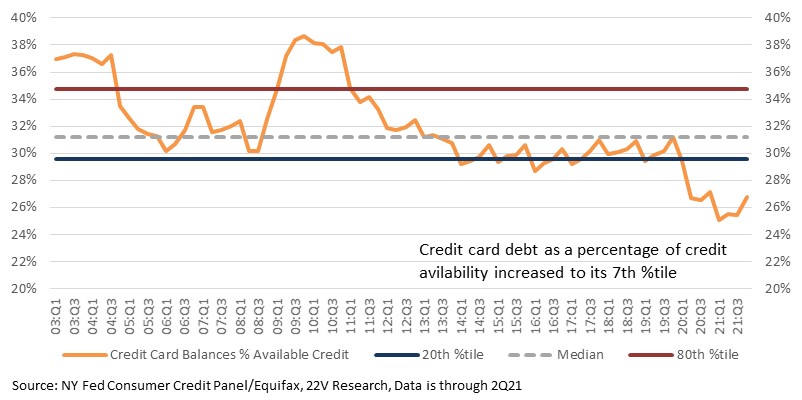
Credit card balance utilization at the end of 4Q21 was just under 27% and increased from 25.5% last quarter. So, consumers are increasing their credit card balances, but keep in mind that the 3Q21 reading was the lowest in the history of the series (starts 1Q 2003), and the 4Q reading is in the bottom 7th percentile of readings. Relative to history and in aggregate, consumers had low credit card balances at the end of last year. Side note, consumer spending has been very strong WITHOUT consumers increasing credit card balances, if they increase credit card balances now, that would add to the economic growth impulse.
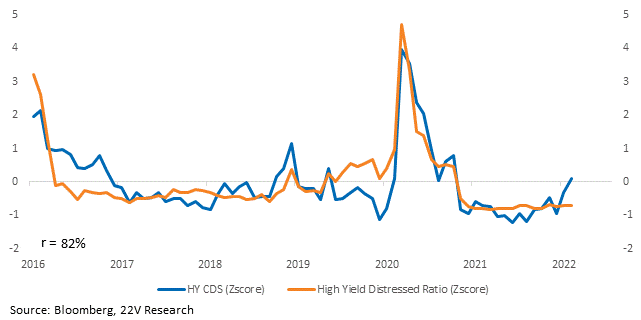
High yield credit spreads have widened out, but the percent of high yield debt that’s distressed is still unusually low (15th percentile). That means the widening out in credit has been due to interest rate risk, not default risk. If we are correct on the need for financial conditions to tighten more aggressively, default risk likely needs to increase before the Fed backs off. Which means being long the market will be much easier AFTER default risk increases.
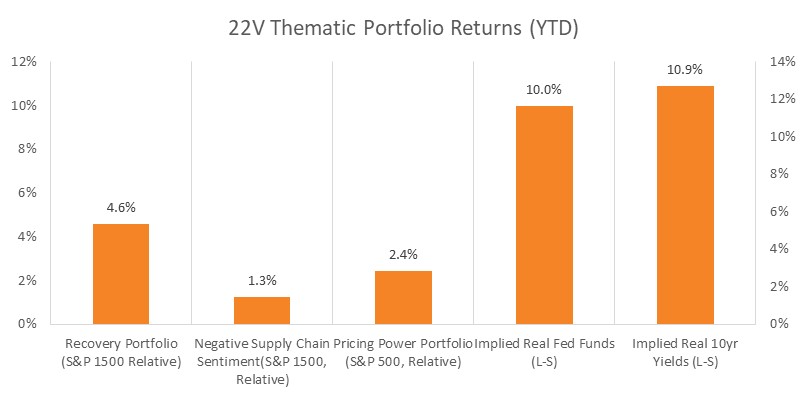
Thematic Focus: Real yields have gone straight up since the Fed pivot in November and if you believe San Francisco Fed president Daly, they should go up even more as the Fed continues to tighten financial conditions. We remain long companies that benefit from increasing real yields, but real yields should consolidate some over the next few weeks as we enter a quiet macro period. Our thematic portfolios continue to provide risk mitigation and all five have outperformed YTD. Outside of the Recovery Portfolio, which has longer-term headwinds from its factor exposure, the portfolios benefit from durable themes: rising real rates, tightening financial conditions, improving supply chains, and maintaining pricing power as the Fed fights inflation. Constituents to all our thematic portfolios can be found HERE.
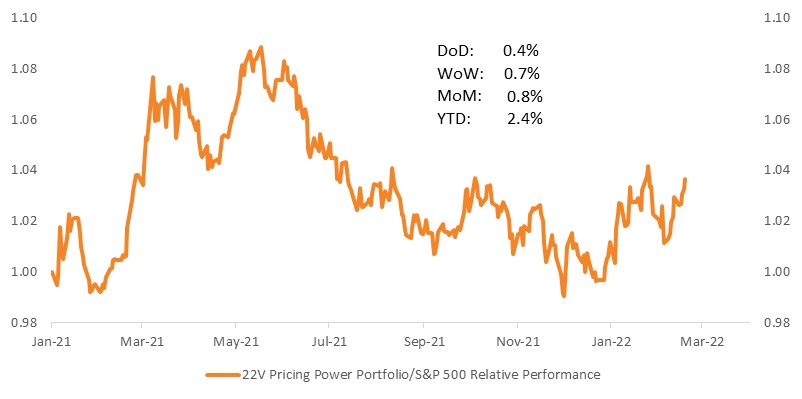
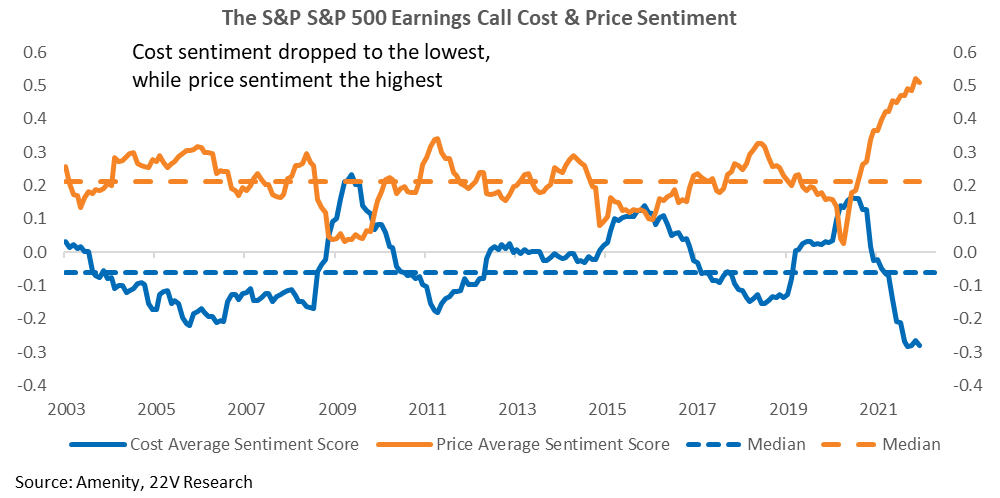
Our pricing power portfolio, which contains the companies with the strongest pricing power sentiment readings, has been outperforming this year. Inflation remains an influential factor for S&P companies. Management sentiment towards costs reached a new low in 4Q while price sentiment skyrocketed. Again, rising sales prices allowed companies to pass along increasing costs. Given the Fed’s assault on inflation, monitoring pricing power, which we also measure using sentiment analysis, will be another important component of avoiding downside risk during earnings reporting season.
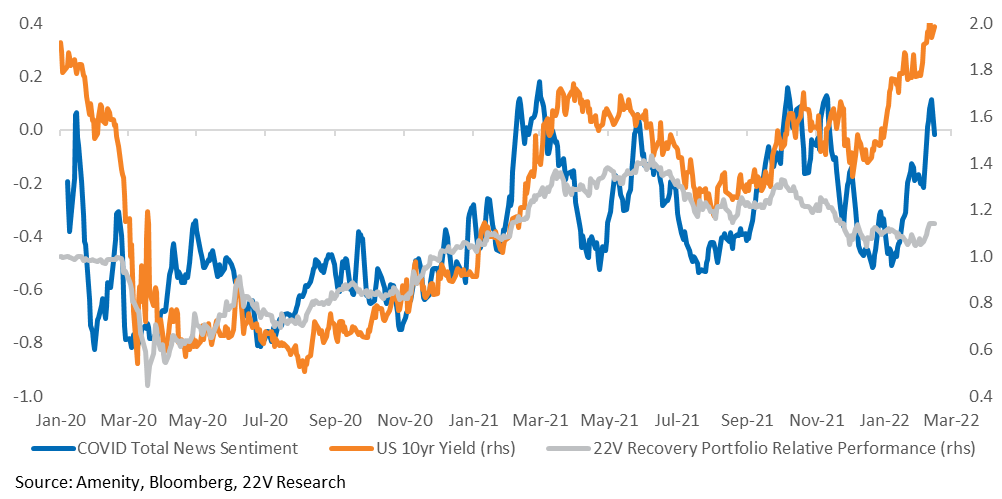
Reopening has plenty of room to “catch up” to improving COVID sentiment and 10yr yields. The correlation between improving COVID sentiment and reopening basket relative performance broke down when financial conditions tightened some in January.
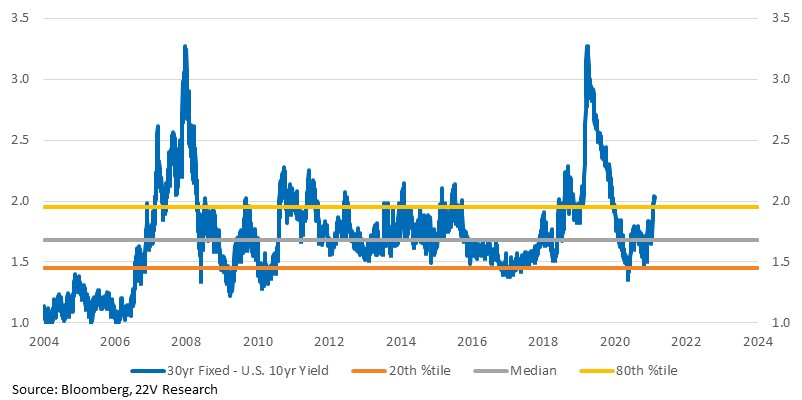
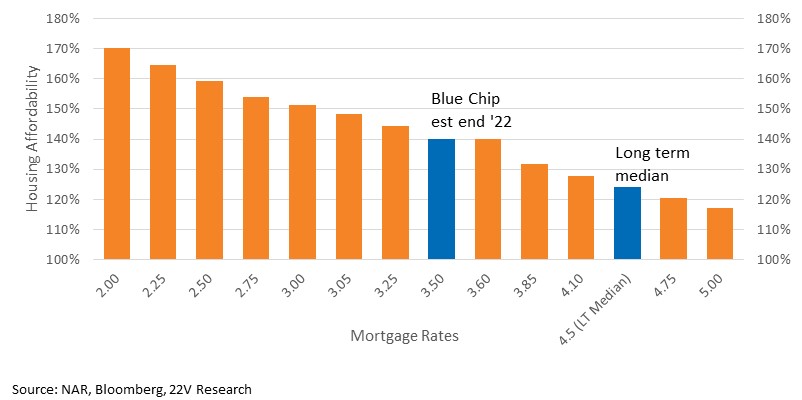
Housing: Mortgage rates are on their way up. But if rates back up to 4.5%, affordability would be at its long-term median of 125%. Low affordability is not a reason to expect the housing market to slow significantly. At least not yet. 30yr mortgage commitment rates have backed up to 3.55% from 3.11% at the start of the year. Published rates tracked by Bankrate have climbed even higher, reaching 4.0%, driven by 1) rising risk-free rates and 2) mortgage spreads widening above the high end of their typical range.
At the start of the year, the Blue Chip consensus forecast for end of 2022 mortgage rates was 3.5%. Today it looks like a return to the long-term median of 4.5% could take place during the first half.
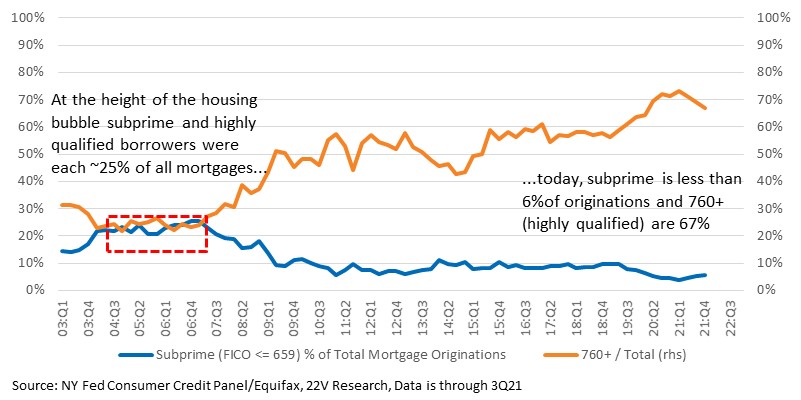
The risk of a severe increase in housing delinquencies seems low. The percentage of mortgages going to highly qualified buyers reached an all-time high in 2Q21 and remained unusually high at the end of 4Q. Subprime borrowers also make up a smaller percentage of total mortgages than normal.
Margin Pressure Coming: January PPI came in much stronger than expected. This does not indicate worse margins. Per Gerard, “the corporate sector is a producer of intermediate inputs and that surging prices therefore do not generate a squeeze on margins. If such a dynamic prevailed, then the value-added deflator for the corporate sector would fall when producer prices surged… The valued added deflator for the corporate sector correlates positively with the PPI. So, when the PPI surprises to the high side, so too will margins, other considerations held equal.” However, the strength in producer prices is unsustainable because the Fed is intolerant of it. The Fed will stop margin-enhancing inflation going forward. Margin sentiment, measured using the Amenity NLP tool, is deteriorating too.
Company cost sentiment is at a record low and price sentiment is near a record high. This is perfectly consistent with the PPI report and is not a good sign for inflation. The forward outlook is not overly positive.
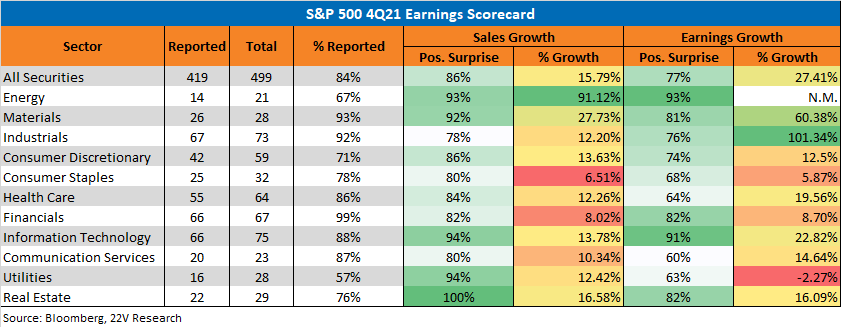
4Q results were strong, wrapping up one of the best year’s for earnings growth on record. Most of the S&P (85%) has reported, posting positive earnings and sales surprise (86% and 77% respectively), with Cyclicals growth stronger than Defensives, especially deep Cyclicals such as Energy, Industrials and Materials. 4Q results, particularly top line growth, are another sign that economic activity remains strong and recession/stagflation risk low.
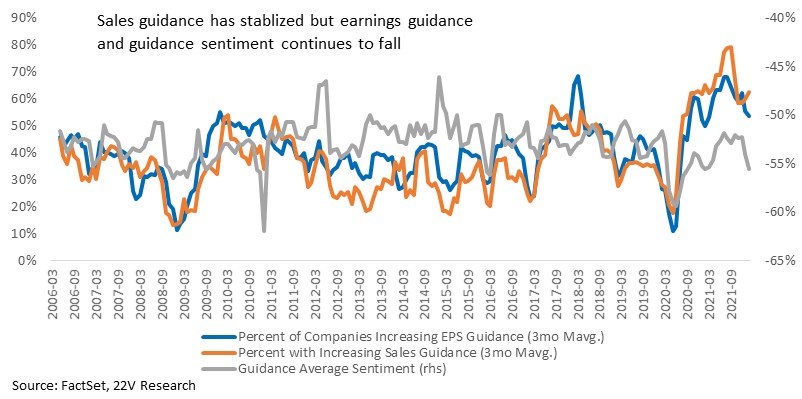
Looking ahead to 1Q22 and beyond, the EPS outlook has deteriorated some. Earnings guidance has softened with the percent of companies increasing EPS guidance moved lower. Guidance sentiment deteriorated as well. Sales guidance both rebounded and remains at a high level though, so top line growth should remain strong.
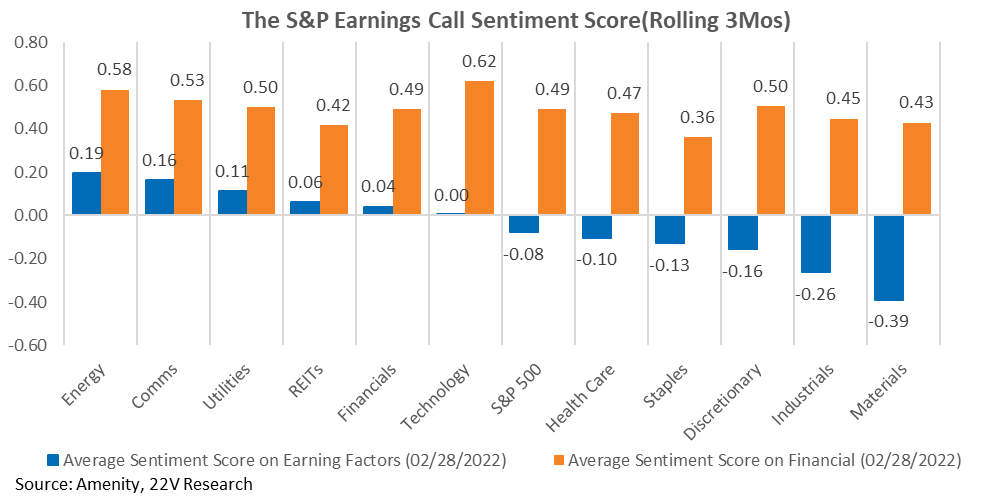
Deteriorating margin sentiment is consistent with the weakness in total earnings sentiment. Sentiment toward earning factors, which focus on forward looking earnings, have dropped and half of sectors now have negative readings. Energy and Communications have the best earnings sentiment while Materials and Industrials have the worst. S&P financials, a measure of current fundamentals, remained strong in 4Q, but forward-looking measures are more important when thinking about where fundamental supports are likely headed in 2022.
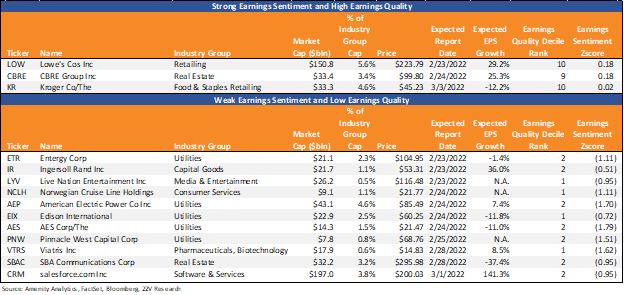
To help clients avoid earnings misses and negative guidance near-term, in the table below we list the S&P stocks with the best earnings sentiment and Earnings Quality rankings that haven’t reported earnings yet. The second basket is the short end; those names with the worst sentiment and Earnings Quality ratings and are more likely to miss. Email us for a complete ranking of remaining stocks for 4Q earnings season.