SUMMARY: Global yields are marching higher as central banks around the world join the fight against inflation. Per the NFIB small business optimism survey, inflation concerns are rising quickly and are the largest source of concern relative to pre-pandemic levels. Financing costs remain of little concern. That spread illustrates, in an admittedly overly simplistic manner, the shift the Fed is trying to make. They want to reduce inflation by raising the cost of financing. Consistent with the NFIB data, management teams of Cyclical companies are reporting easier access to cash through bonds, equity offerings, bank loans, etc., which runs contrary to the Fed’s goals.

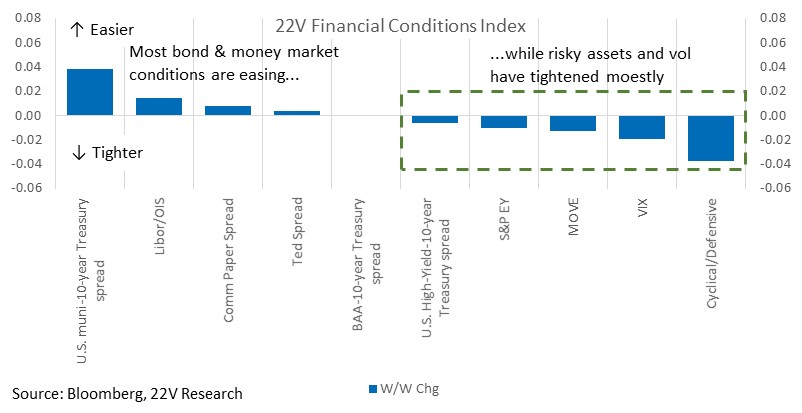
Those readings are broadly consistent with financial conditions internals, which eased over the past week. The easing in money/bond market conditions more than offset increased volatility and lower equity market conditions. That might sound like a soft-landing scenario (modest market declines, still easy financing), but given the level of inflation, the outlook for still elevated Core PCE (relative to the Fed’s goals), and recent Fed rhetoric, it seems like there is little patience for organic slowing. Side note, we started the year thinking the Fed would be able to hold off tightening until there was more organic slowing or higher productivity levels “bailed the Fed out”. The Fed blew up that thesis quickly and is now aggressively focused on inflation containment.
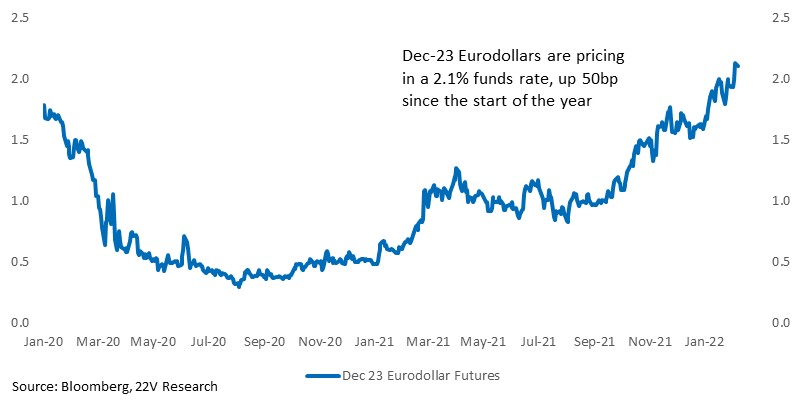
Gerard noted yesterday that the level of financial conditions is less important than their relationship with rate hike expectations. Eurodollar futures are now pricing in a 2.1% fed funds rate at the end of 2023. Based on OIS, the odds of a 50bp rate hike at the March FOMC meeting are around 25%. If certainty of a rate hike in March, musings about a 50bp rate hike, and 8 hikes by the end of 2023 are not enough to tighten financial conditions, the Fed may need to signal MORE hikes to accomplish its goals of slowing inflation. Rent inflation would need to be much lower than expected, participation much higher (unlikely), and trend economic growth weaker to maintain the current level of financial conditions. None of that seems likely over the next 6 months.
We still like Cyclicals relative to Defensive near term as the economic data rebounds as Omicron fades, but once it becomes obvious financial conditions need to tighten more aggressively to slow growth, Cyclicals will suffer. Along with some of the Value names that have outperformed.
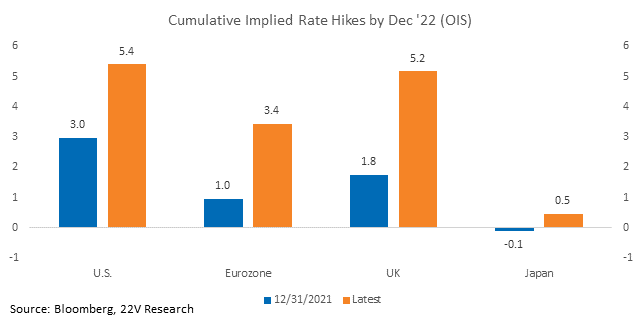
MARKET VIEWS: Overnight, Lagarde pledged gradual adjustments to monetary policy and data dependency. Her commentary had a slight effect on market-based implied rate hikes; data dependency is appropriate, but inflation readings and expectations are high. Cumulative rate hike expectations are even higher for the BOJ, which acknowledged near-term upside risk to inflation. Global yields are marching higher as global central banks join the fight against inflation.
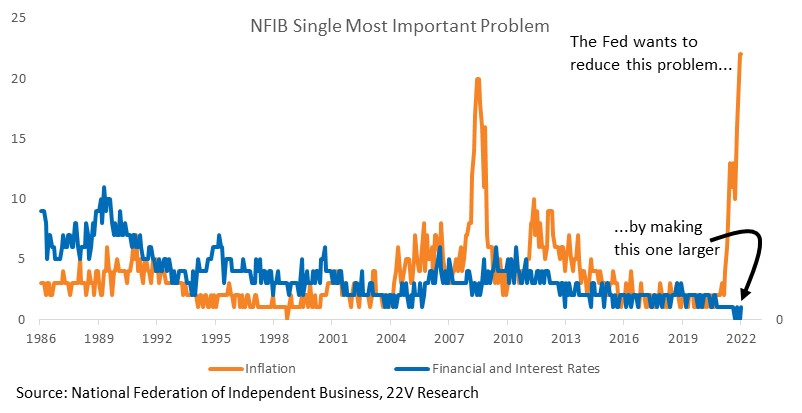
The January NFIB small business optimism survey was released this morning and missed expectations (97.1 vs est 97.5, last 98.9). Capex intentions remain high though as do hiring plans. Quality of Labor is still the largest small businesses issue, but inflation concerns are rising quickly and are the largest source of tightening relative to pre-pandemic levels. Financing costs remain of little concern. That spread illustrates, in an admittedly overly simplistic manner, the shift the Fed is trying to make. They want to reduce inflation by raising the cost of financing.
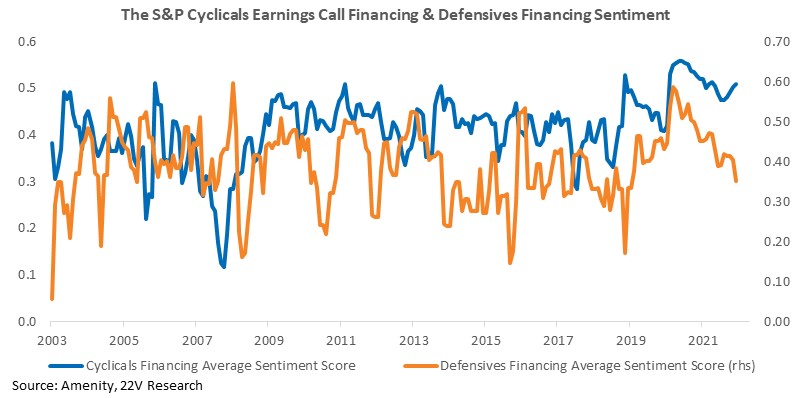
Consistent with the NFIB data, management teams of Cyclical companies are reporting easier access to cash through bonds, equity offerings, bank loans, etc., We collect sentiment data using Amenity’s natural language processing tool. So far in 4Q, financing sentiment of Cyclical companies has improved. which runs contrary to the Fed’s goals. On the other hand, Defensives’ financing sentiment is deteriorating, right in-line with what the Fed wants. Keep in mind, Cyclicals are 3.5x the market cap of Defensives. Most of index market cap is moving in the wrong direction in terms of Financing sentiment.
Those readings are broadly consistent with financial conditions internals, which eased over the past week. Money/bond market conditions easing more than offset increased volatility and lower equity market conditions. That might sound like a soft-landing scenario (modest market declines, still easy financing), but given the level of inflation, the outlook for core PCE and recent Fed rhetoric, there is no patience for organic slowing.
Gerard noted yesterday the level of financial conditions is less important than their relationship with rate hike expectations. Eurodollar futures are now pricing in a 2.1% fed funds rate at the end of 2023. Based on OIS, the odds of a 50bp rate hike at the March FOMC meeting are around 25%. The Fed wants growth to slow by tightening financial conditions. If certainty of a rate hike in March, musings about a 50bp rate hike, and 8 hikes by the end of 2023 are not enough to tighten financial conditions, the Fed may need to signal MORE hikes.
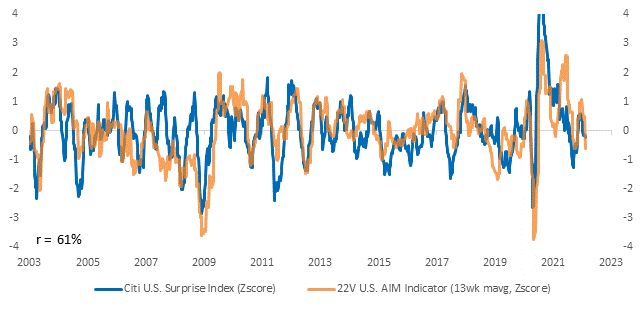
Growth Slowing, Not Slow: Our AIM indicator, which measures whether every economic data point is better or worse than its prior reading, has fallen, which makes sense given Omicron. A softer spot is still a soft spot. But the Citi surprise index has fallen too and is negative (the chart below is standardized, but the absolute level is the U.S Citi surprise index is -7.1), indicating more economic data points are missing than beating expectations.
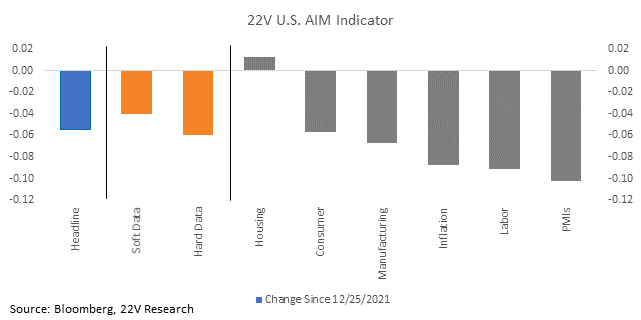
Slower growth doesn’t mean slow growth. Hard data has deteriorated more than soft data during the Omicron soft spot, even though PMIs have deteriorated the most. Housing and consumer trends have been the most resilient, supporting our notion the demand side of the economy is durable. Strong demand necessitates Fed tightening, at least in the eyes of the Fed. Plus the indicators that suffered in the Omicron related soft spot will likely bounce back as that impact fades.
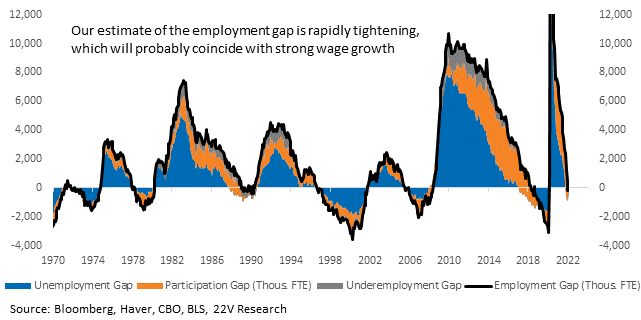
Friday’s employment report was confusing given the massive revisions thanks to the population adjustments. Gerard concluded the report is on the hawkish side. The news (read through the revisions) is that businesses are willing to look through the Omicron shock. COVID is not driving the economy anymore. That means the Fed will have to push back, especially considering broad wage growth. Our employment gap estimate is tightening, and the labor income proxy is still strong. The good news isn’t so good for markets longer-term, given central banks are committing to fighting inflation.