Summary
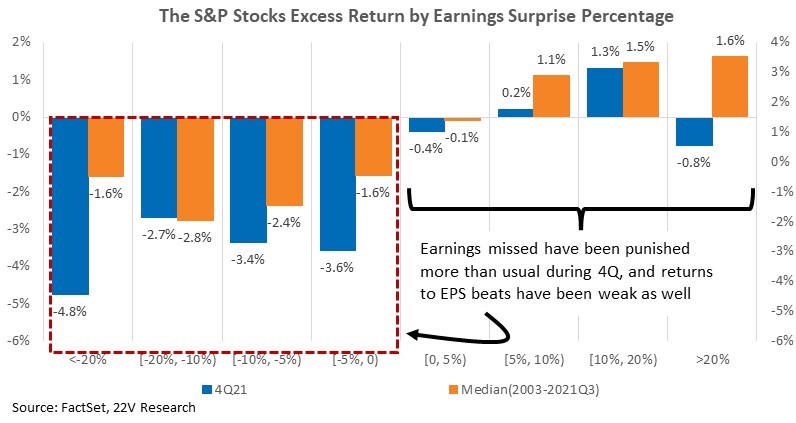
Short Term: Two positives to start. First, FB’s huge drawdown was the latest example of the negative skew to earnings releases. Headline EPS growth has been firm (full year 2021 EPS up to $205 from $203), but companies that miss estimates have seen larger than normal underperformance around reporting and beats have done worse than normal too. Given large drawdown in stocks though, particularly some Tech names, that MIGHT be starting to change. We witnessed sustained positive moves on beats last Friday, so some price discovery COULD be coming into the market in beaten up names.
Second, (positive shorter-term), the reason risk assets held up on Friday (Cyclicals outperformed and Defensives lagged significantly), despite a surge in yields and rate hike expectations, was the prospects of improving economic momentum as Omicron fades ALONG with increasing Fed rate hike expectations. The previous week, equities declined significantly and the story was weakening economic growth AND a 50 bp hike in March (really bad combo). The Fed is on a tightening path and that will slow economic growth, but shorter term (~1mo), Cyclical’s could rebound significantly relative to Defensives as US economic growth stays firm and the Fed does not aggressively offset that strength. That would help Financials, which we were too negative on going into last week.
Longer term: As the payroll report showed, the employment gap continues to rapidly dissipate and upward pressure on rents means Core PCE is going to be well above the Fed’s comfort zone. Economic growth is likely to remain above trend (large section below that supports the positive economic growth thesis), which means financial conditions need to tighten significantly to slow economic growth toward the Fed’s estimate of trend (1.8%). That is what the yields started to reflect Friday as well. Real rates are going higher and that will be a consistent headwind for risk assets. At least until it looks like the Fed is well on its way to accomplishing its goal. It is difficult to see a sustain Cyclical rally until the Fed accomplishes its goal of slowing growth.
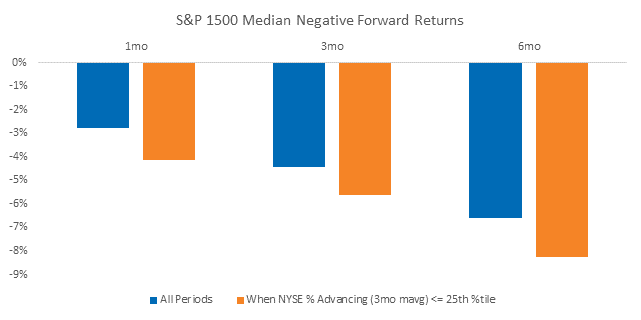
Something to keep in mind longer term. When the percentage of stocks advancing is at or below its 25th percentile (the case today), forward S&P 1500 returns are worse than normal, and the median NEGATIVE forward return is much worse than normal. Hopefully price discovery can offset the decline breadth numbers, but that will take time.
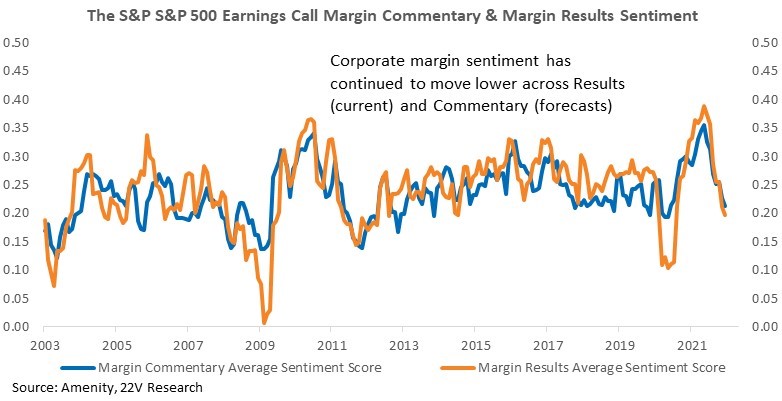
Immaculate Tightening Disagreement Update: We continue to be surprised by how many people think peak and declining headline inflation will lead to a rebound in stocks (fed doesn’t have to tighten much). Core inflation is the issue and pricing power is about to reverse significantly. The Fed’s Job One is to Destroy Pricing Power – and fighting the Fed is tough. As Gerard highlights “the sweet spot for margins seems to be behind us. Whether this turns out to be a proper profit squeeze from the inflation-fighting side or more a soft landing is not something we can’t know in advance.” Think about this way, the 20% increase in prime membership rates that AMZN announced last week is the type of thing the Fed is pushing back against. Management sentiment toward margins has deteriorated, reflecting the increasingly uncertain outlook. Growth will slow, pricing will decline and that will impact forward earnings outlooks significantly. And the Fed wont back off until Core PCE starts to move toward the 2% target (even as headline declines). We are likely to be well above the 3% on Core PCE until the Fed slows growth aggressively.
Bottom Line on Margins/Fair Value: Our base case is that margins flatten and probably narrow a bit in 2022, and the economy slows. Markets will have a tough relative year. Assuming the 2023 inflation outlook looks much better, the longer-term outlook for the economic growth/profits is fine and risk premiums can eventually decline (our base case). If things do not work out, there is a significant decline in economic growth (to well below 2% real) and margin weaken. That scenario cannot be ruled out, particularly as no one knows how high real rates need to go (still deeply negative) to accomplish the Fed’s goal. Those headwinds will persist.
Once financial conditions have tightened significantly, GDP is obviously moving to ~1.8% and a recession has been avoided, being long the market will be MUCH more interesting. Hopefully late 3Q or 4Q of 2022 presents this opportunity. Equity risk premiums will fall if that happens and Cyclicals will outperform. Investors need to be sure Fed tightening does not produce secular stagnation before equity risk premiums will fall.
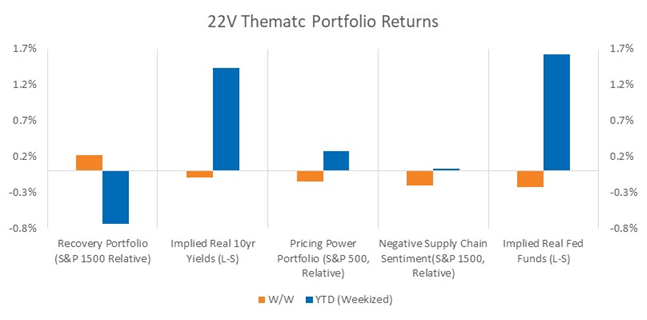
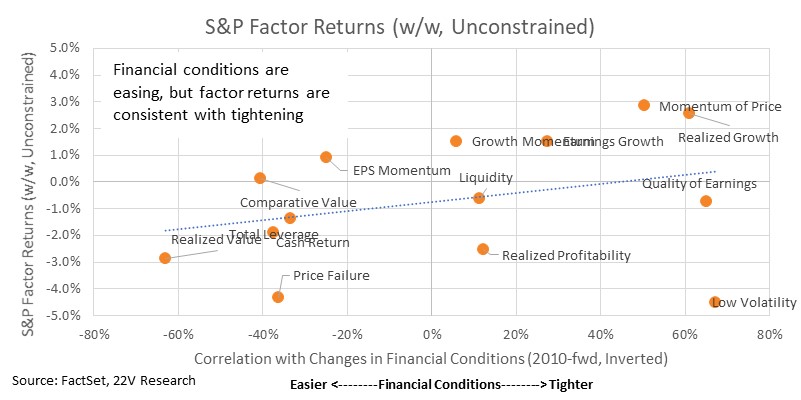
Alpha Opportunities: Play factors that benefit from tightening financial conditions and rising real yields. Despite headline financial conditions easing over the past week, factors returns indicate investors are discounting tighter conditions ahead. As noted in a Quant report Friday, pricing power should be more interesting going forward, and specific themes are important. Happy to send along stocks in the specific baskets.
Full Report
Market Indicators – Earnings & Alpha: FB’s huge drawdown is the latest example of the negative skew to earnings releases. Index level earnings growth remains strong with 4Q estimates rising from $51.29 at the start of reporting to $53.31 today. Full-year ’21 numbers have increased from $203 to $205.20. EPS growth is firm but has slowed, and companies that miss estimates have been seen larger than normal underperformance around reporting. That reinforces the need to focus on companies with higher quality earnings and stronger sentiment. We witnessed sustained positive moves in beats last Friday, so some price discovery COULD be coming into the market in beaten up names.
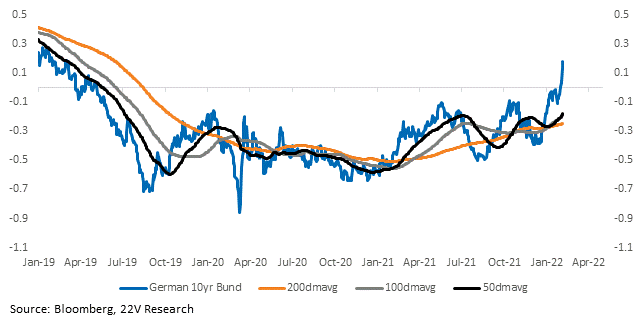
German 10yr yields have moved higher and are now +20bp. On December 15th, the German 10yr was -40bp, so the move has been significant. 22V Technician, John Roque, has been long German 10yr yields and thinks they are going to +50bp. The increase in rest of world interest yields is likely to have an impact on US 10yr yields (helps push them higher).
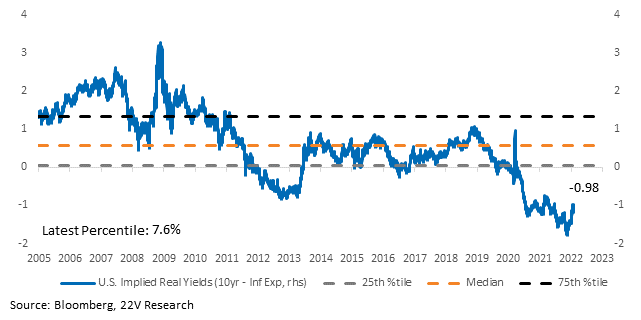
Real yields are a going to move higher as the Fed/other CBs continue inflation fighting. Keep in mind that real rates are still EXTREMELY low. They were just at 1st %tile low a month ago and are now in their 8th %tile. They are going higher…bottom line.
Despite headline financial conditions easing over the past week, unconstrained factors returns indicate investors are discounting conditions ahead.
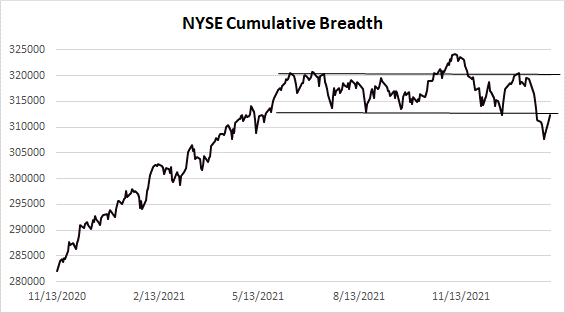
Megacaps have driven indices higher despite shaky market breadth. John Roque, pointed out that NYSE and NASDAQ stocks declining dwarfed stocks rising. Per John, “…in order for the broader market to stabilize and strengthen Cumulative Breadth is going to have to, at least, get back into its former range. Another failure – i.e., a break to a new reaction low beneath the late January 2022 low – would be another negative sign for equities.” FB’s miss puts mega cap leadership at risk though AMZN’s beat and double digit return was a positive sign for market leadership and the state of the consumer.
When the percentage of stocks advancing is at or below its 25th percentile, the forward returns of the S&P 1500 are worse than normal and the median NEGATIVE forward returns are a lot worse than normal. Breadth indicates if the market topples, the fall is more severe.
Longer Term Core Inflation Supports: The employment gap continues to narrow rapidly. Per Gerard, “The abrupt steepening during January was entirely a function of the population control changes. Absent them the gap would actually have eased slightly. But there is no reason to challenge the underlying trend here, which is net hawkish.”
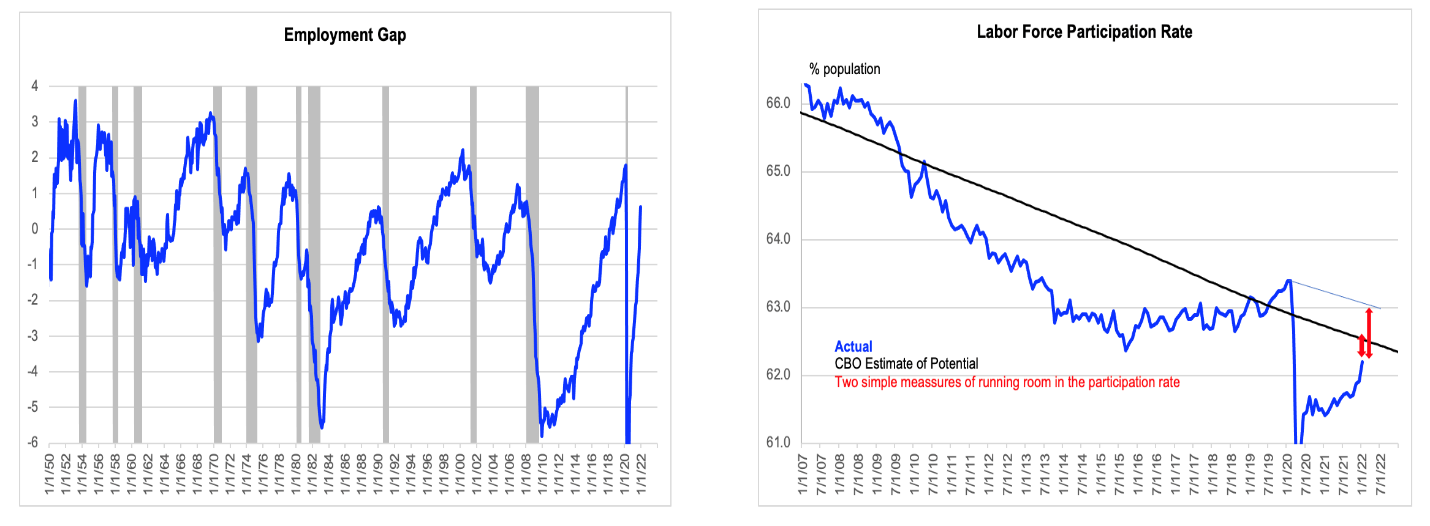
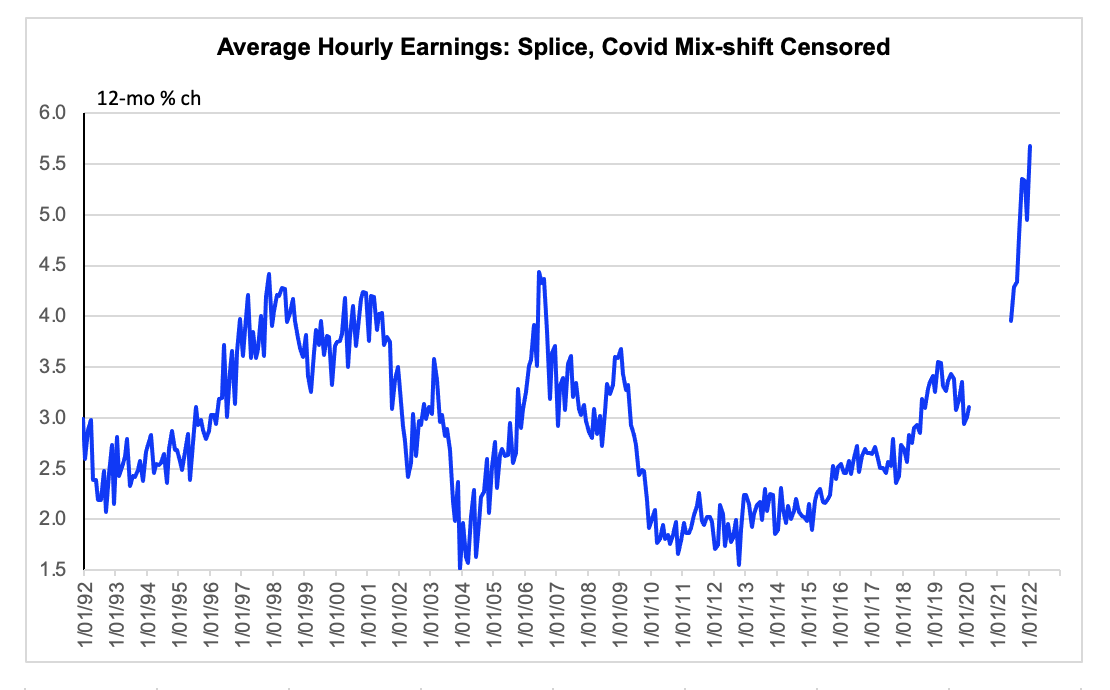
“The 12-month change of average hourly earnings was 50 bps higher than expected, by virtue of the beat during January and upward revisions to the historical data. We will need to wait for the Atlanta Fed Wage Tracker to get a sense of whether mix-shift was a major issue here. But our best guess is that it is not. There was no mix shift evident in the sectoral breakdown, which we can do today. And with the Covid shock fading into the background, our priors should probably be that mix shift is less an issue. In other words, the Wage Tracker will probably be strong.”
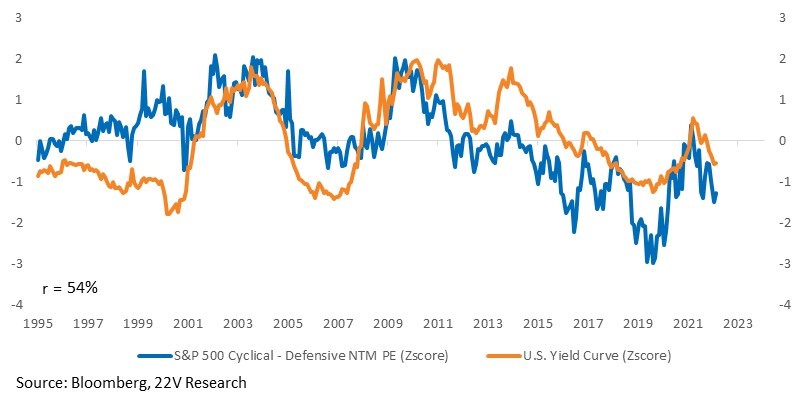
Short Term Cyclical Idea: With US economic growth improving and rest of world 10yr yields moving higher, we would expect some SHORT-TERM re-steepening of the yield curve. Especially since the Fed is unlikely to move 50bp in March. The Fed is on a tightening path and that will slow economic growth, but over a short duration (~1mo), Cyclicals could rebound relative to Defensives as US economic growth stays firm and the Fed is unlikely to aggressively offset that near term strength.
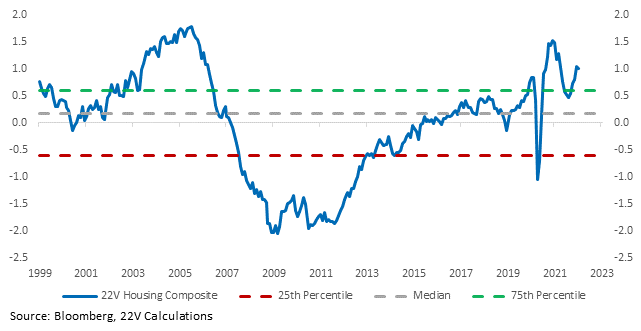
Economic Data is Firm on A longer Term Basis: Housing is a segment of the economy that has remained firm and has good momentum. Our housing composite, which blends the NAHB HMI, existing home sales, new home sales, housing starts, permits, Umich buying conditions, construction, and Case-Shiller, is at its 84th percentile.
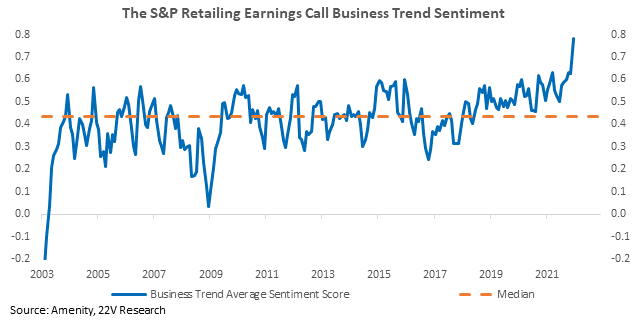
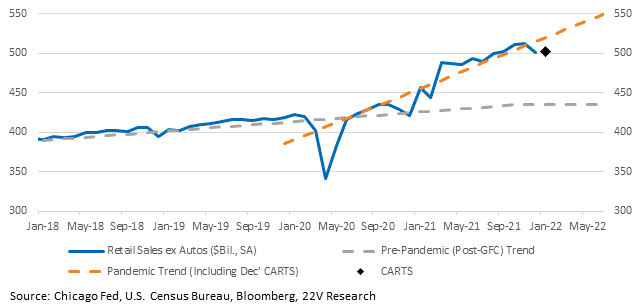
And higher frequency consumer data has improved. Although very few consumer companies have reported, the ones that have are reporting strong business sentiment trends according to the Amenity natural language processing tool. That is consistent with the MoM increase in retail spending estimated by the Chicago Fed’s CARTS index.
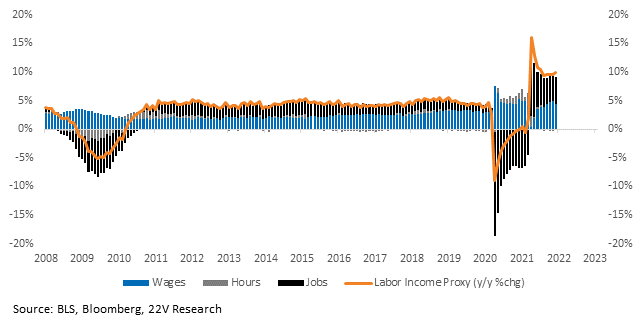
The labor income proxy has surged post-COVID and never turned lower as fiscal stimulus rolled off. As long as the labor income proxy is well above its post-GFC trend, don’t expect “fiscal cliff” concerns to impact spending meaningfully.
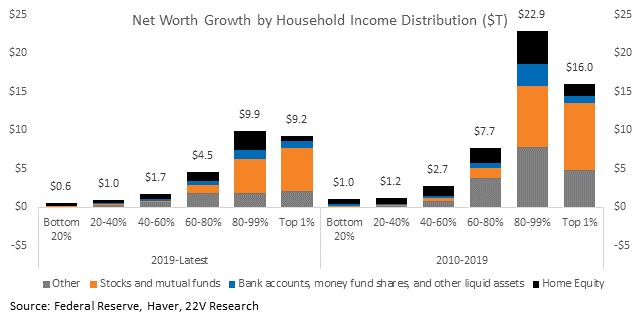
The wealth effect has been massive. In the past two years, low-end wealth has increased by ~60% as much as it did in the nine years following the GFC.
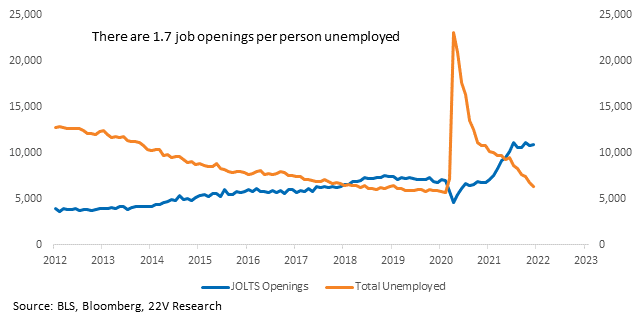
There are more job openings than people unemployed, and the spread is wider than any point in history. At the end of December (last data point) there were 1.7 job openings per unemployed person. The labor market is robust, which will continue to support spending and keep upward pressure on inflation.
Early indications from the Chicago Fed CARTS data are for retail sales to continue well above the post GFC trend. Based on the first two weeks in January, retail sales ex-autos should increase +0.4% m/m.
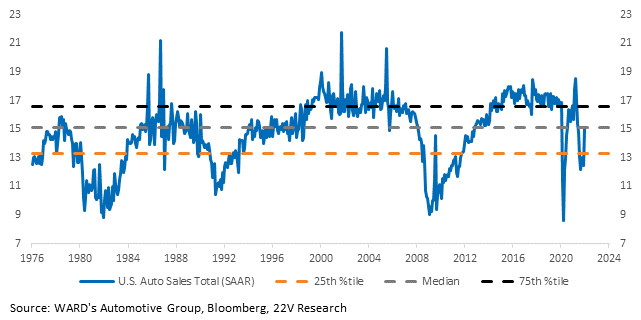
Wards vehicle sales beat expectations by 2 million, rising from 12.5mil to 15mil. The increase is consistent with strong spending growth.
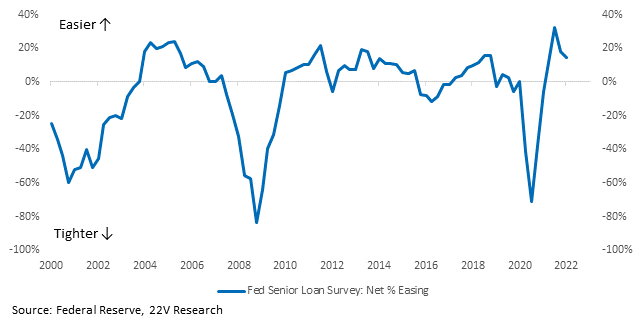
The Fed polls senior loan officers quarterly to gauge bank lending practices (see HERE). In 4Q, banks net eased standards for commercial and industrial loans, citing an improved economic outlook and inter-bank (and non-bank) competition. Same applies to mortgages, auto loans, and credit cards. Banks are reporting a reduction in minimum required credit scores for consumer loans. The Fed ran a one-off survey for expectations for 2022; banks expect to continue to ease lending standards, though they expect loan quality to be mixed. This runs contrary to the Fed’s goal. Once again, another sign that the Fed will need to push harder with policy. Historical data shows the breadth of responses has come in a bit, but above 0 means standards are easing.
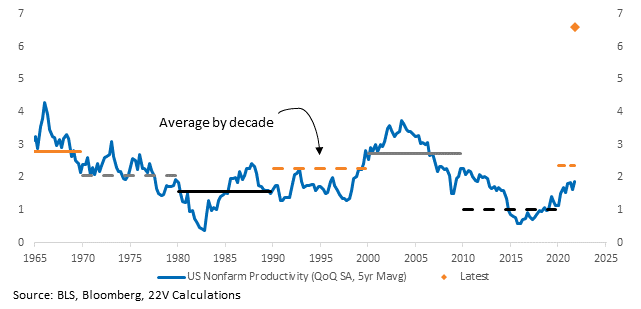
Margin Headwinds: Productivity has improved and that has supported profits, but as Gerard has noted, two things are going to work against profits going forward. As he notes “First, what we have celebrated as “pricing power” during the past year, and quite appropriately, has finally morphed into an inflation problem for the Fed. So, they are going to drive down demand growth to a pace much closer to the economy’s potential of around 2% (real). This will have two effects. First, productivity growth will weaken on a cyclical basis, which will tend to push up unit labor costs, particularly given that labor compensation will be rising in response to the tight labor market and some “catch-up” effects from earlier surprise inflation. (We don’t need inflation expectations to rise to deliver this effect.)
“Second, pricing power – or more precisely, the improvement of pricing power – needs to decline. The Fed’s Job One now is to destroy pricing power. And we ought not fight the Fed. So, the sweet spot for margins seems to be behind us. Whether this turns out to be a proper profit squeeze from the inflation-fighting side or more a soft landing is not something we can know in advance.” Think about the above in these terms, the 20% increase in prime membership rates that AMZN announced Thursday night is something the Fed is pushing back against.