SUMMARY: Fed speakers messaged away from more aggressive policy than is currently priced by futures markets and estimated by sell-side shops. Keep in mind, that messaging was about not raising rates 50bp at the next meeting. Fed tightening is still the path forward, but a short term rebound in equities will continue, led by Growth and Cyclicals, as investor focus on a narrative of “peak tightening” ahead of what is likely to be a weak payroll report. Given the strong trend economic growth backdrop, which will become more obvious in a few weeks as Omicron impacts dissipate, we would fade this asset reflation theme on peak hawkishness and slowing econ growth. Post payroll could be a good time to reengage on the short side for higher earnings risk and low liquidity stocks. High foreign sales stocks and EM are in a better position longer term.
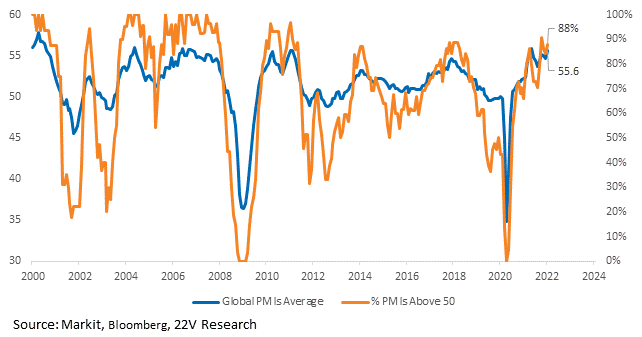
The average global PMI was higher in January than in December, and European firms reported “…the largest production and order book improvements for four months…” In the U.S., regional PMIs indicate the Omicron soft spot wasn’t very soft at all (at least so far – these indices likely don’t capture the entire duration of the soft spot). The Fed’s senior loan officer survey (see HERE) showed banks eased lending standards for commercial and industrial loans, citing an improved economic outlook. strong PMIs and lending activity are another sign the Fed will need to push harder with policy to slow economic activity.
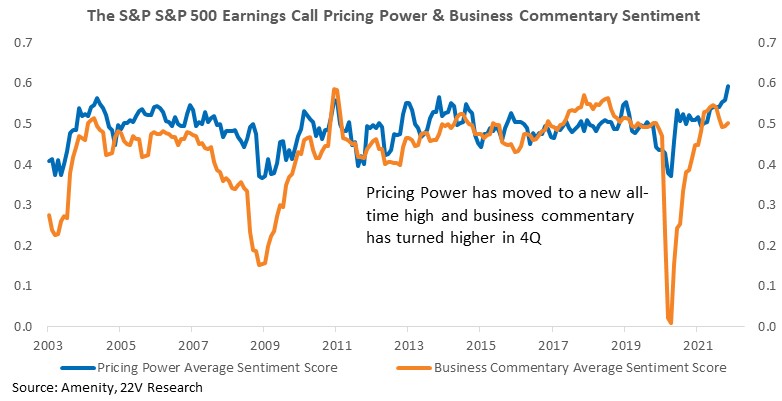
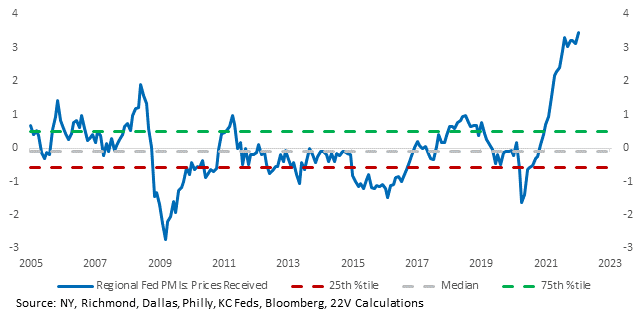
PMI Prices Received hit an all-time high, offering no relief from inflation. That is consistent with management sentiment toward pricing power. Sentiment toward pricing power has increased to a new all-time high so far in 4Q and Business Commentary improved as well. Fundamentals are strong, so more aggressive policy tightening will be needed to slow growth and inflation.
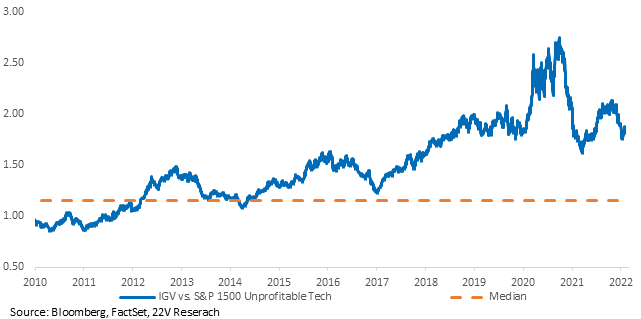
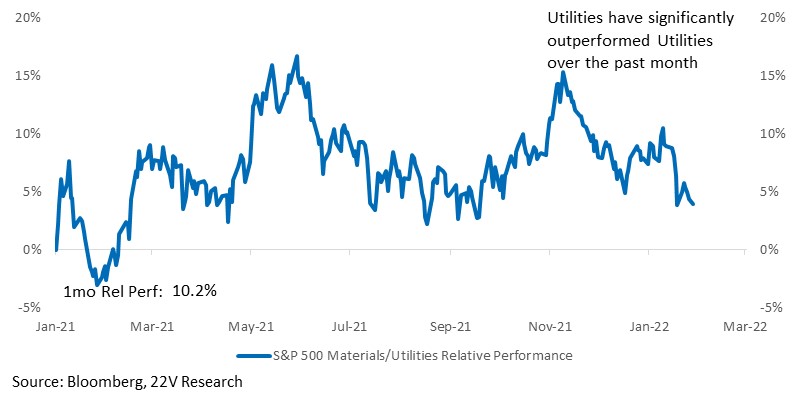
Differentiation between persistent trends and mean reverting groups matters. There are still market segments with strong mean reverting tendencies such as Utilities and Materials. Utilities have significantly outperformed despite rising bond yields, so some reversal should be expected in a short-term relief rally. Rising real rates are a major headwind for lower quality, higher risk market segments. Importantly, Software and Unprofitable Tech are not statistically mean reverting (trends tend to persist). And we have high conviction that higher quality names, like those in IGV, will outperform unprofitable tech as real rates rise.
Full report below…
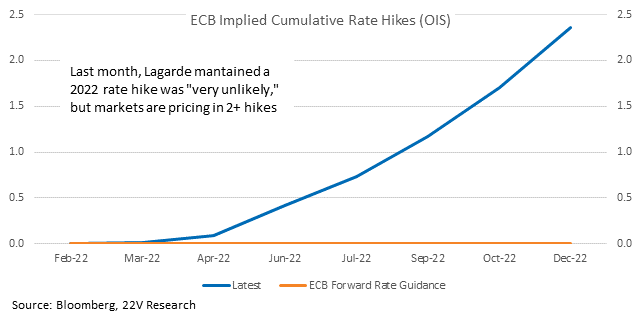
MARKET VIEWS: Global central banks are striking more dovish tones than the Fed. Overnight, the RBA emphasized its dovish stance. The ECB has, so far, maintained its dovish rate outlook, emphasizing the disparity between the EU and US. Markets are pricing in more aggressive rest of world policy than CBs are signaling. That reduces the potential headwind from non-U.S. central bankers policy pivots if inflationary pressures force central banks’ hands. That favors international equities, which are positioned to rebound after a period of relative underperformance.
January Global PMIs are rolling out; so far, the average PMI is higher than in December. In an emblematic note, the chief business economist at IHS Markit observed “Euro zone manufacturers appear to be weathering the Omicron storm better than prior COVID-19 waves so far, with firms reporting the largest production and order book improvements for four months in January.” Leading indicators are not signaling the slowdown in growth that the Fed wants.
The January regional Fed PMIs indicated the Omicron soft spot wasn’t very soft at all (at least so far – these indices likely don’t capture the entire duration of the soft spot). A normalized composition of the regional Fed surveys shows general business conditions are still in their 72nd percentile, employment is at record highs, and capex intentions are robust. Forward expectations actually improved. Fundamentally, that is good news for the economy. Practically, strong PMIs are another sign the Fed will need to push harder with policy to slow economic activity.
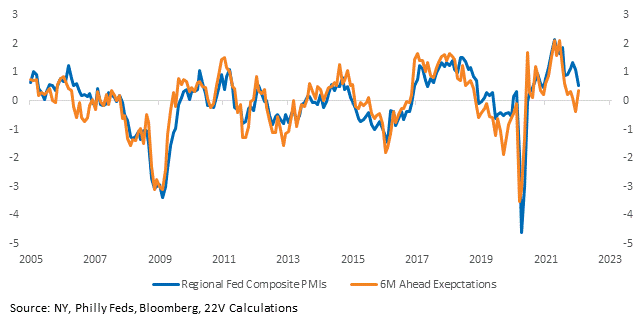
Plus, prices received hit an all-time high, so no relief from inflation. That is consistent with management sentiment toward pricing power. We use the Amenity natural language processing tool to “listen” to every S&P 1500 earnings conference call and gauge management sentiment toward a range of topics. Sentiment toward pricing power has increased to a new all-time high so far in 4Q. Business Commentary sentiment has improved as well. Again, those are strong fundamental signs, but suggest more aggressive policy tightening will be needed to slow growth and inflation.

But, yesterday, Fed speakers messaged away from more aggressive policy than is currently priced by futures markets and estimated by sell-side shops. Daly mentioned Fed policy shouldn’t overreact and the policy shift should be gradual while Bostic spoke out against a 50bp rate hike in March. We can’t be sure how much the Fed wants to slow growth, but our base case is they will act aggressively to combat inflation (which skews to the right), despite yesterday’s relatively dovish comments.
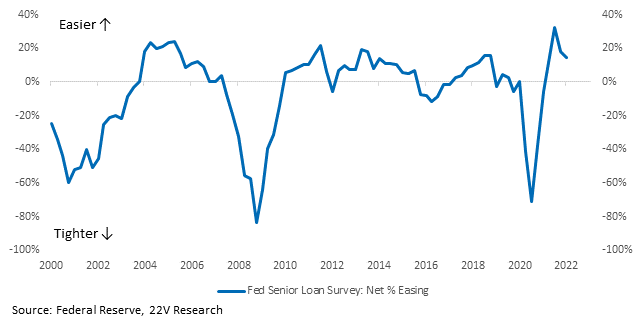
The Fed polls senior loan officers quarterly to gauge bank lending practices (see HERE). In 4Q, banks net eased standards for commercial and industrial loans, citing an improved economic outlook and inter-bank (and non-bank) competition. Same applies to mortgages, auto loans, and credit cards. Banks are reporting a reduction in minimum required credit scores for consumer loans. The Fed ran a one-off survey for expectations for 2022; banks expect to continue to ease lending standards, though they expect loan quality to be mixed. This runs contrary to the Fed’s goal. Once again, another sign that the Fed will need to push harder with policy. Historical data shows that the breadth of responses has come in a bit, but above 0 means standards are easing.
Systematic Mean Reversion: Throughout 2020/21, sector, industry, and factor mean reversion consistently outperformed trend following. The best performing assets in one month tended to be among the worst performing in the following month. Over the past few months though mean reversion has been a losing trade. Easing of concerns about new COVID waves as vaccines and treatments become better and more widespread probably contributed to that shift, but the timing lines up better with the shift in the Fed policy stance. A rate hike cycle started to combat inflation creates a backdrop of consistently rising real rates and slow growth that favors specific industries and factors.
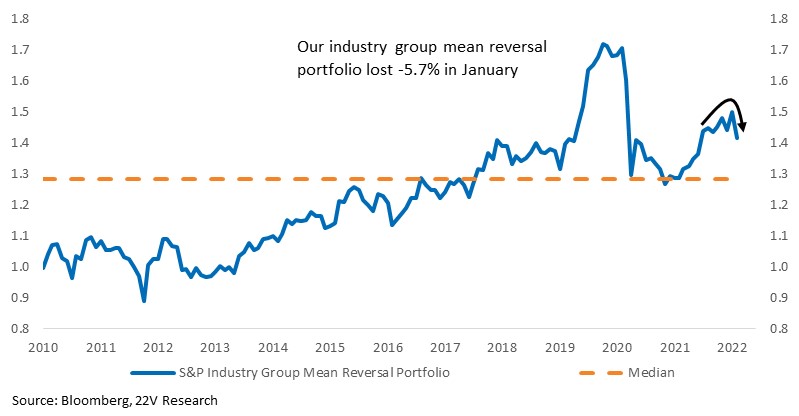
Blind mean reversion that worked well since the COVID market-bottom is, at the least, not likely to generate meaningful gains going forward. But as noted in a recent quant report, there are still market segments with strong mean reverting tendencies such as Utilities and Materials. Utilities tend to work best in recessionary periods as bond yields move lower. Materials are levered to global growth trends that the Fed cannot directly impact (emerging markets). Ultimately, slower growth is a headwind for Materials, but a short-term long Materials short Utilities trade looks attractive today.
Differentiation between persistent trends and mean reverting groups matters. As we noted yesterday, a rising real rates backdrop is a major headwind for lower quality, higher risk market segments, which helps explain the underperformance of spec tech. Importantly, Software and Unprofitable Tech are not statistically mean reverting (trends tend to persist). And we have high conviction that higher quality names, like those in IGV, will outperform unprofitable tech as real rates rise.