SUMMARY: Powell will be asked about the market during his presser, and there could be a bounce on his response. But that doesn’t change the goal – the Fed is tightening financial conditions. The Fed’s goal isn’t a market crash. A bear market would have a large impact on economic activity, working against the Fed’s goals. The Fed is pursuing generally tighter financial conditions, which isn’t achieved through equities exclusively. That doesn’t mean a bear market won’t happen, but Fed jawboning will pursue sustained tightening of general financial conditions, not just equities. Credit conditions normalizing (spreads widening) would help. That’d be a headwind to equities but not necessarily to the tune of a bear market.

As we highlighted yesterday, ROW economic growth is robust. The headwinds from Omicron are fading and businesses are looking past temporary disruptions. That leaves the potential for higher real yields. Rising real yields and wider spreads would help tighten financial conditions, taking downward pressure off stocks, which have been mostly responsible for tightening so far.
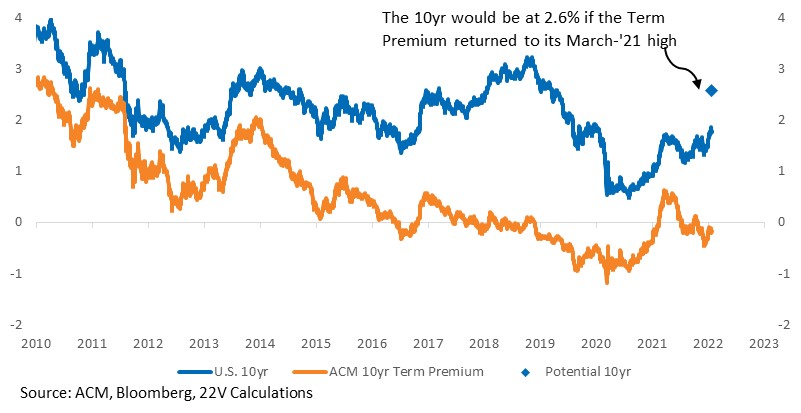
Though there has been a backup in yields, the 10yr term premium remains exceptionally low. That is helping keep a lid on Treasury yields and is something the Fed wants to see unwound. The skew on yields remains higher. Rising yields would help tighten financial conditions and reduce the upward pressure on volatility. Volatility should come down from current levels but not return to its very low post-GFC levels because inflation and growth have moved back above their post-GFC range. That is a good thing in the long run as it allows global central bankers to move off the zero lower bound, reducing downside risk.
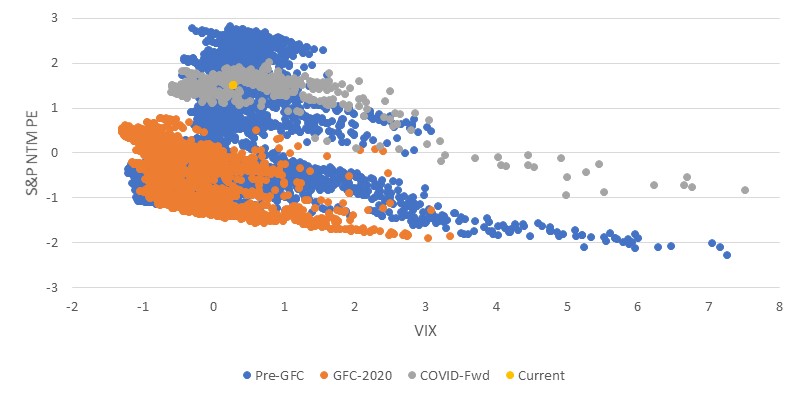
During the COVID era there was a lot of concern that the level of equity PEs was unsustainably high, but remarkably strong earnings growth allowed the S&P to rally 45% run in 2021 even as PEs DECLINED. PEs from 2020 on were consistently higher per unit of volatility than they were during the post-GFC period. Looking ahead, earnings growth will be slower and PEs should be, on average, lower. The distribution of PEs in the pre-GFC era was wide with respect to volatility, and that should be expected again. But the central tendency of PEs relative to vol should be lower.
MARKET VIEWS: Everyone’s waiting on the Fed today. People are talking about 50bp rate hikes, so the bar is set low. Powell will be asked about the market during his presser, and there could be a bounce on his response. But that doesn’t change the goal – the Fed is tightening financial conditions. As we discussed yesterday, the tightening has so far been from volatility. So, if equities recover and volatility normalizes, the Fed will have to push back to tighten again. That being said, the Fed’s goal isn’t a market crash. A bear market would have a large impact on economic activity, working against the Fed’s goals.
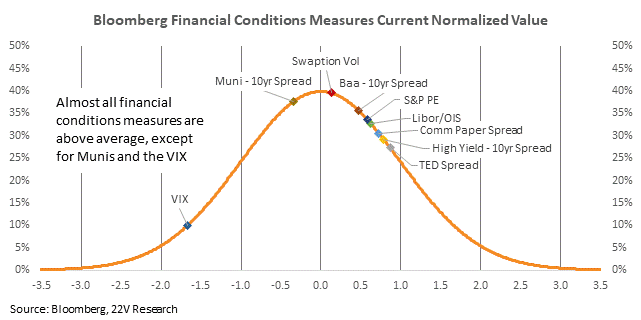
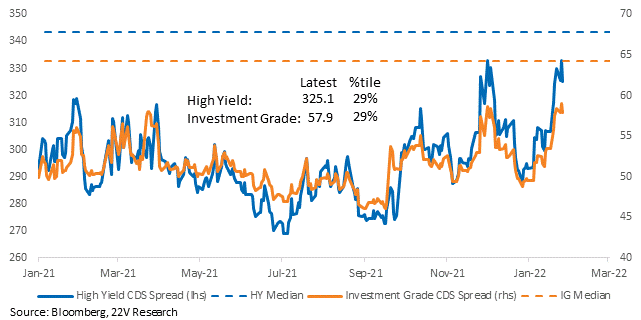
The Fed is pursuing generally tighter financial conditions, which isn’t achieved through equities exclusively. That doesn’t mean a bear market won’t happen, but Fed jawboning will pursue sustained tightening of general financial conditions, not just equities. Credit conditions normalizing (spreads widening) would help. That’d be a headwind to equities (especially unprofitable companies) but not necessarily to the tune of a bear market.
As we highlighted yesterday, ROW economic growth is robust. The headwinds from Omicron are fading and businesses are looking past temporary disruptions. That leaves the potential for higher real yields. 10yr yields are increasing globally and inflation expectations are high while ROW central banks are not confronted with the same challenges as the Fed. Rising real yields and wider spreads would help tighten financial conditions, taking downward pressure off stocks, which have been mostly responsible for tightening so far.
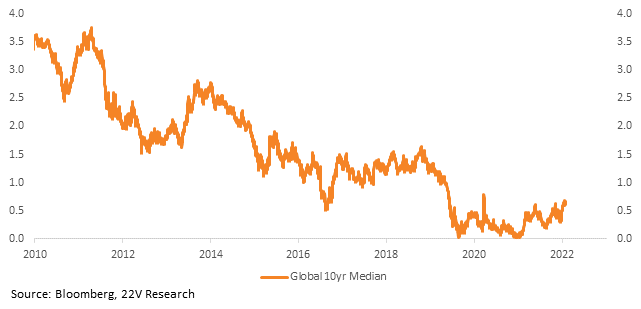
Though there has been a backup in yields, the 10yr term premium remains exceptionally low. That is helping keep a lid on Treasury yields and is something the Fed wants to see unwound. If the term premium rose back to its March of 2021 level, all else equal, the 10yr yield would rise to ~2.6%. We are not calling for that kind of backup, but the point is that the skew on yields remains higher. Rising yields would help tighten financial conditions and reduce the upward pressure on volatility.
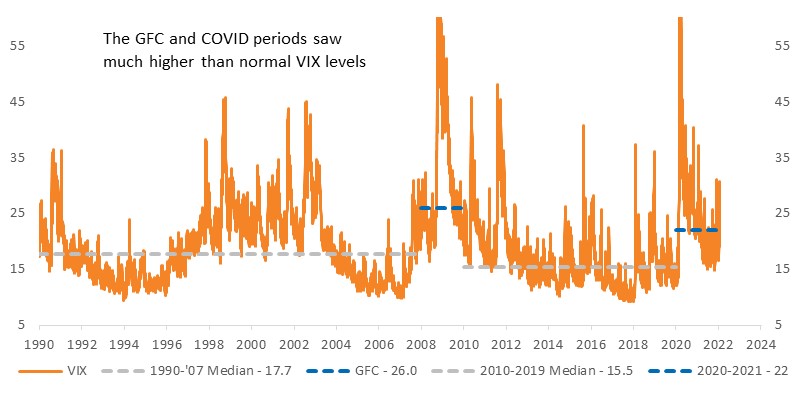
To be clear, volatility should not return to its very low post-GFC levels. During the COVID era, implied vol has generally been higher than its typical long-term level but it fell back to the mid-teens by 2H21. Policy uncertainty is part of the reason for elevated volatility, but it is useful to keep in mind that the reason for heightened uncertainty is that inflation and growth have moved back above their post-GFC range. That is a good thing in the long run as it allows global central bankers to move off the zero lower bound, reducing downside risk. Implied vol is unlikely to remain as high as it is today for an extended period, but the typical level of vol should be higher going forward.
During the COVID era there was a lot of concern that the level of equity PEs was unsustainably high, but remarkably strong earnings growth allowed the S&P to rally 45% run in 2021 even as PEs DECLINED. The elevated PE seen during most of the COVD-era was reasonable given the MASSIVE rebound in earnings from their collapse in 1Q20 as the global economy suddenly ground to a halt. PEs from 2020 on were consistently higher per unit of volatility than they were during the post-GFC period.
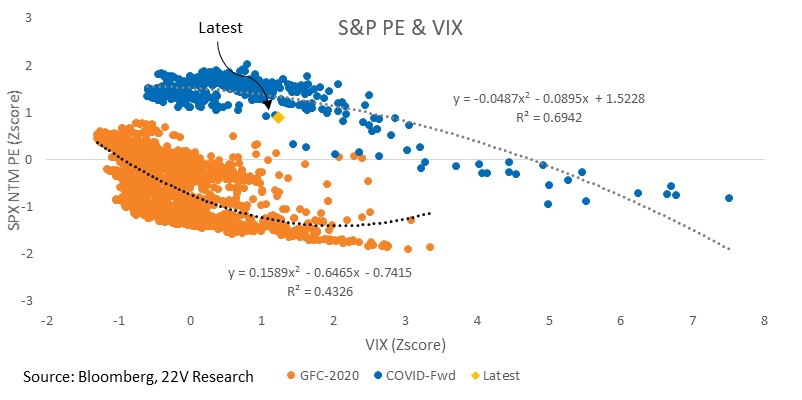
Looking ahead, earnings growth will be slower and PEs should be, on average, lower. The distribution of PEs in the pre-GFC era was wide with respect to volatility, and that should be expected again. But the central tendency of PEs relative to vol should be lower.