Imagine a major league baseball player asking, “Who was Babe Ruth?” Or a boxer, “Who was Muhammad Ali?” Or a football player, “Who was Jim Brown?” Or a basketball player, “Who was Wilt Chamberlain?” Or a golfer, “Who was Jack Nicklaus?” Or an actor, “Who was Marlon Brando?”
To paraphrase Michael Crichton, “…that would be like a leaf not knowing he was part of a tree.” But it happened the other day when our friend told us that one of the traders / PMs in his shop asked, “Who is Jeremy Grantham?” And the question arose because the trader / PM had heard comments made recently by the estimable Mr. Grantham that upset the bequeathed birthrights of homeostasis as it relates to ever higher equities, low bond yields, unbothersome commodities, and the Fed. To make matters more confounding to the uninitiated, it’s likely that this particular Mr. Grantham doesn’t have an Instagram account.
Mr. Grantham is the G in GMO – Grantham, Mayo, & van Otterloo – a Boston-based asset management firm that started one of the first index funds and who specializes in asset allocation. Mr. Grantham has been observing and investing in markets for more than 50 years and his recent commentary – “Let the Wild Rumpus Begin” – was, to many, like hearing fingernails on a chalk board.
Mr. Grantham proceeds delicately, but assuredly, in his essay as he lays out his case for the “popping of the equity superbubble” and in doing so he provides fair warning to those who continue to embrace the “straight out of central casting” playbook. You know the playbook…it goes like this – “Market worries around rates and corporate margins are overdone. The recent pullback in risk assets appears overdone, and a combination of technical indicators approaching oversold territory and sentiment turning bearish suggest we could be in the final stages of this correction. While the market struggles to digest the rotation forced on it by rising rates, we expect the earnings season to reassure, and in a worst-case scenario could see a return of the “Fed put.” That’s the ol’ BTD playbook right there and we don’t agree with it at all. Like Mr. Grantham – and we hope we’ve already made this clear – we think we’re now in a bear market and bear markets upset the status quo because they force investors to do the exact opposite of what they did in a bull market.
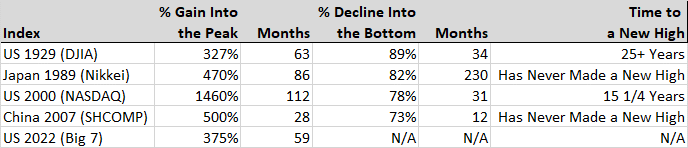
Examples from the “Let the Wild Rumpus Begin” essay include 1929 in the US, 1989 in Japan, 2000 in the US and 2022 in the US. Of course, there have been other “superbubbles” like the China version that saw the Shanghai Composite gain 500% (not a typo) in 28 months from June ’05 – Oct ’07. While the popping of the bubbles is always a cataclysm, it’s the ensuing aftermath that really chops up the investors – i.e., the SHCOMP had two big echo rallies of +100% from Oct ’08 – Aug ’09 and +160% from Jan ’14 – June ’15 but the index is now 40% below its all-time high from 2007 and, we expect, it will work lower.
This table should provide some historical context. We’re not offering it to be salacious. But if Mr. Grantham is right then we’re in for a long slog.
Mr. Grantham’s historically grounded approach has always appealed to us and, to be sure, we’re simpatico because he also detests the Fed. He says as much right here – “One of the main reasons I deplore superbubbles – and resent the Fed and other financial authorities for allowing and facilitating them – is the under-recognized damage that bubbles cause as they deflate and mark down our wealth. As bubbles form, they give us a ludicrously overstated view of our real wealth, which encourages us to spend accordingly. Then, as bubbles break, they crush most of those dreams and accelerate the negative economic forces on the way down. To allow bubbles, let alone help them along, is simply bad economic policy.”
And how can you not detest the Fed? In a new book entitled, “The Lords of Easy Money – How the Federal Reserve Broke the American Economy” we learn that Former Fed Chairman Ben Bernanke held the proletariat in deep disdain. The author, Christopher Leonard, writes, “The joke comes when he recounts an exchange among policy makers during a 2012 meeting of the Federal Open Market Committee (FOMC). The committee was in the throes of a monthslong argument about whether and how to expand the Fed’s easy-money policies.
Richard Fisher, president of the Dallas Fed, chimed in with a warning. Texas Instruments, a major employer in his district, wasn’t treating existing Fed policies such as near-zero interest rates as a spur to investment and job creation. The company was merely reconfiguring its balance sheet toward cheaper debt financing and away from equity funding. This ran counter to the Fed’s theories about how its decisions filter through to the Main Street economy. To which Chairman Ben Bernanke replied: “President Fisher . . . I do want to urge you not to overweight the macroeconomic opinions of private-sector people who are not trained in economics.”
Not only did Bernanke’s bourgeoisie comments drip with condescension but he also ridiculously referred to Richard Fisher as “President Fisher.” Were they not on a first name basis? Who knew the sanctum sanctorum of the Eccles Building was so pompous, priggish, and square?
We believe rallies should be sold and that yesterday’s intra-day lows for the major indexes will be broken. To be sure, we’re not sure if any rallies will get up to our “sell points” but we are sure that if the indexes don’t rally now / shortly the equity markets will get uglier faster. Please remember that while each of the major indexes are oversold on a daily basis, only weekly momentum for the NASDAQ and RTY are in oversold territory (not necessarily oversold, though) on a weekly basis. More importantly, not one of these indexes are oversold on a monthly basis. In fact, they’re all still historically overbought.

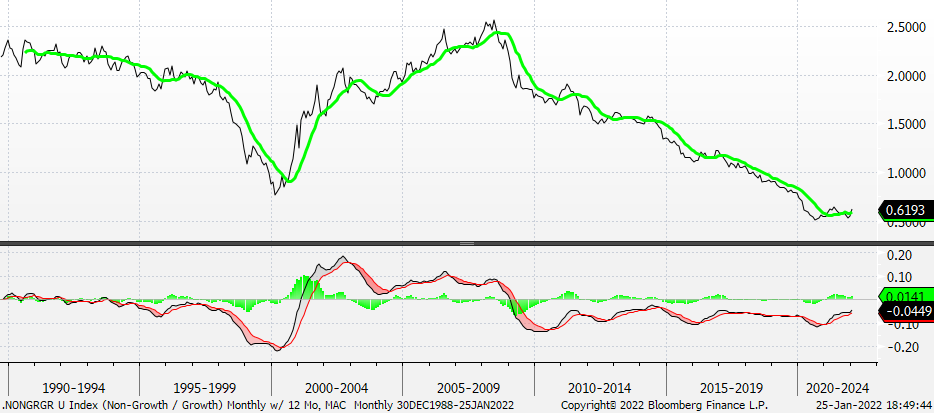
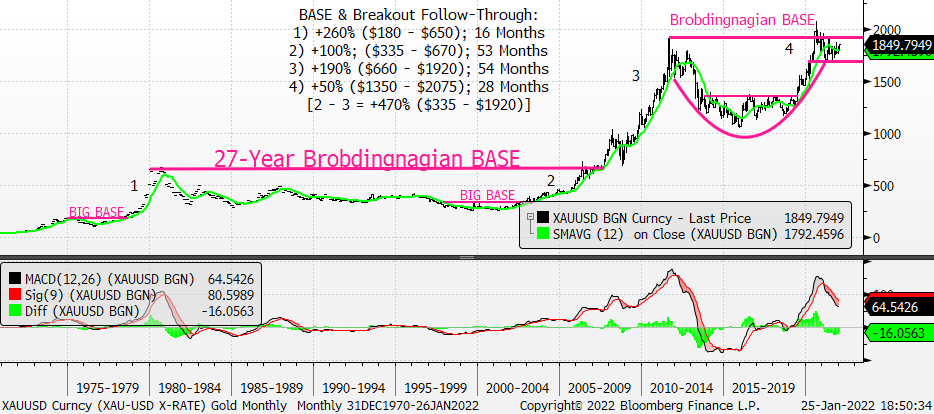
We also believe that Non-Growth will beat Growth and gold (below) is a buy.