Almost nobody wants to label what we’re all seeing – and what we’ve seen for a few months now – as a bear market. Investors don’t want to say it because nobody wants to admit the “everything bull market” is over and who wants to change the “BTD” approach that worked exceedingly well for so long?
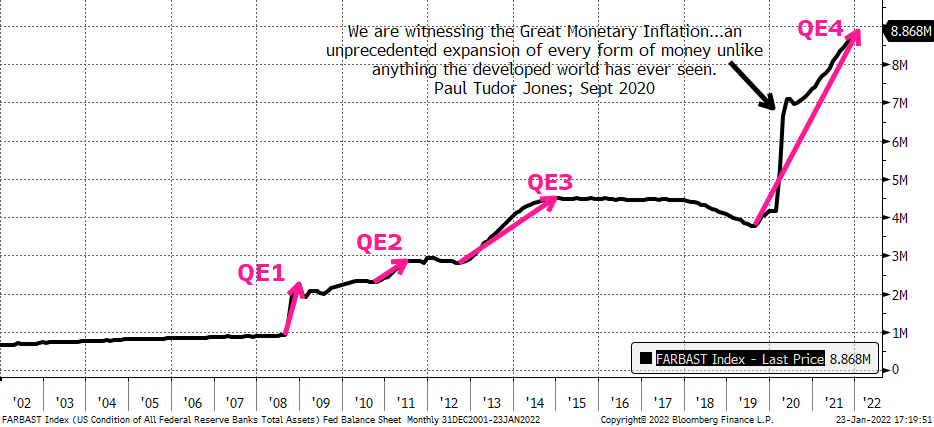
The “everything bull market” that carried nearly all assets to unthinkable heights and created bull markets out of thin air [MEME stocks including AMC and GME, ARKK, a FOMO ETF, SPACs, NFT’s, cryptos (at least one of which, Dogecoin, was created as a joke to make fun of the frenzy in cryptos; and, to make this creation even more wild, the Dogecoin crypto phenomenon sparked a mini-mania of its own as potential dog owners rushed to buy the Dogecoin’s symbol, a Shiba Inu puppy), 1000 IPOs that raised $315B in 2021 (the prior high total was $200B), 1500+ IPOs in 2020 and 2021 vs. a total of 1700 in the prior 10 years, US home prices rising 18% annually in Nov 2021 for the largest gain since the end of WII and faster than in any year during the real estate bubble years of 2004 – 2007, etc.] was borne aloft by a Fed Balance Sheet that rose from $4.2T in Feb 2020 to $8.8T as of Jan 21, 2022. For years investors have sung the Bette Midler song, “You are the wind beneath my wings” as an homage to the Fed’s asymmetric response to every crisis (money in ≠ money out, if any comes out at all).
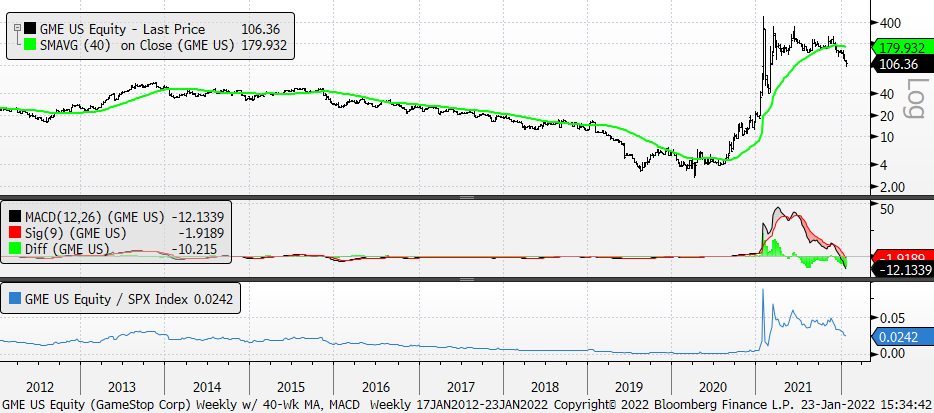
It’s going to take time for investors to change their thinking. For example, it was reported last week that the Swiss Central Bank “increased stakes in some of the US stock market’s most volatile names.” The Swiss Central Bank “more than doubled its stake in AMC Entertainment (AMC), bought more GameStop (GME), and increased their holdings in Palantir Technologies (PTR), and Snowflake (SNOW).” Perhaps we’re a bit too old school for such a progressive /aggressive Central Bank approach, but this is not the kind of stuff you see at bottoms…rather, it’s the stuff you see at tops. Besides, aren’t Central Banks supposed to take their fiduciary responsibilities seriously? After reading about the Swiss C.B. we concluded there’s not much difference between Central Bankers of this era and the r/wallstreetbets crowd. And this was reinforced over the last few months with the revelations that some members of the Fed and US Congress traded their accounts – while in possession of restricted information – as actively as day-trading Visigoths. Incidentally, we believe both AMC and GME should be sold here and on any bounce as it’s our take both stocks have risk to the single digits.
Last week we heard, “But it’s cheap now” as investors were trying to convince themselves that formerly egregiously expensive stocks were now just merely expensive. While it’s understandable that investors are trying to justify lower multiples (P/E or P/S), it’s hard for us to embrace such thinking because these same investors were also justifying high and higher multiples all the way up. If P/E or P/S multiples didn’t matter on the way up, should P/E or P/S multiples matter on the way down?
Because we’re all so well-conditioned to expect the Fed to imitate Mighty Mouse and sing his theme song, “Here I come to save the day…” many investors we’ve spoken with are now anticipating the Fed put to arrive any day now. Who knows, maybe they’re right and the Fed will save the day once again? It just seems a bit premature with the S&P not even down 10% from its Jan 4, 2022, high (14 days ago). Besides, for all the consternation regarding tapering, which hasn’t yet started, [the Fed’s Balance Sheet is nearly $9T, is up in three consecutive weeks in 2022, and has grown for 18 consecutive months] and raising rates, which hasn’t yet started, [the Fed Funds rate remains at .25% for nearly two straight years] it’s a mystery just what tools the Fed will employ to rescue their trading members, the traders in Congress, the Swiss C.B. and, of course, the American investing public, too.
After serving as a combat bombardier in WWII, the great Richard Russell, the Dean of financial newsletter writers, began publishing the Dow Theory Newsletter in 1958 and did so continuously until his death in 2015. He once said, “The hardest thing to do in our business is to stay invested in a bull market from beginning to end. The second hardest thing to do is to stay out of a bear market from beginning to end.”
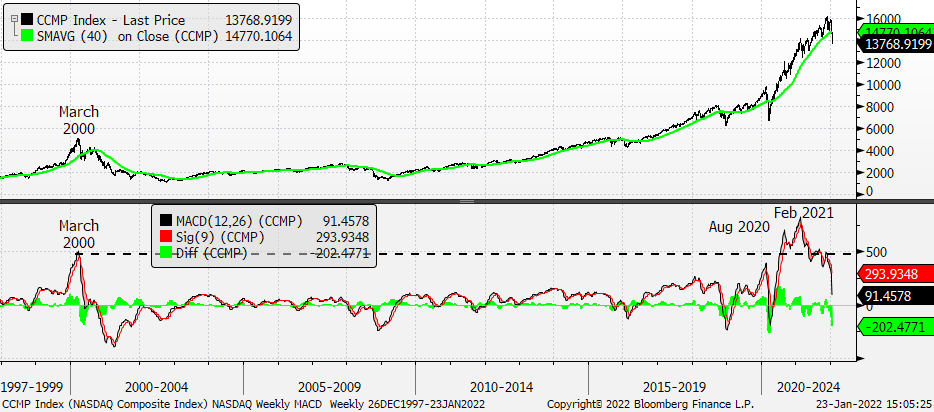
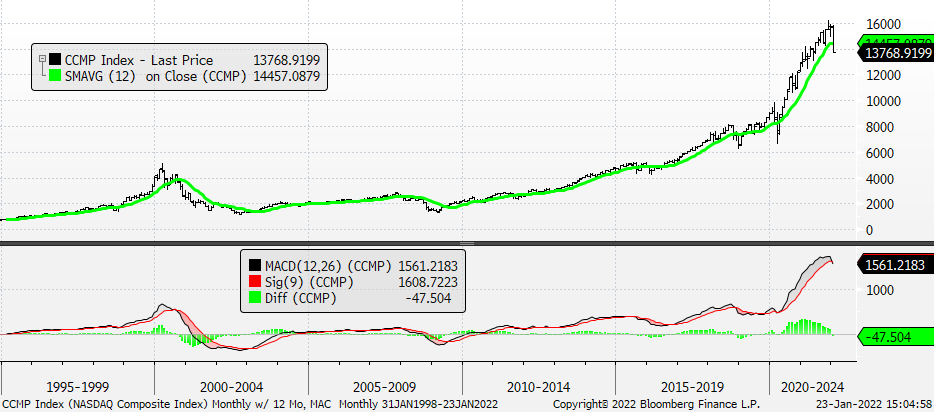
NASDAQ – Weekly w/ 40-Week Mov Avg and Weekly MACD: Despite being down 15% from its late November high and having fallen in 7 of the last 9 weeks, with its worst drop (-7 ½%) coming last week, NASDAQ is still NOT oversold on a weekly basis. More amazingly, it’s still historically overbought on a monthly basis (next chart).
NASDAQ – Monthly w/-12-Month Mov Avg and Monthly MACD:
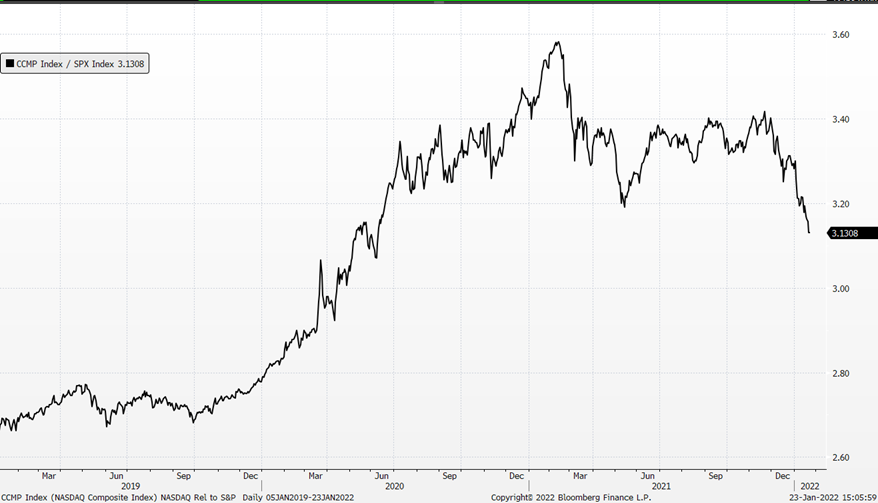
NASDAQ Relative to S&P 500: After “dancing on the ceiling” for a long time, this ratio has topped in favor of the S&P.
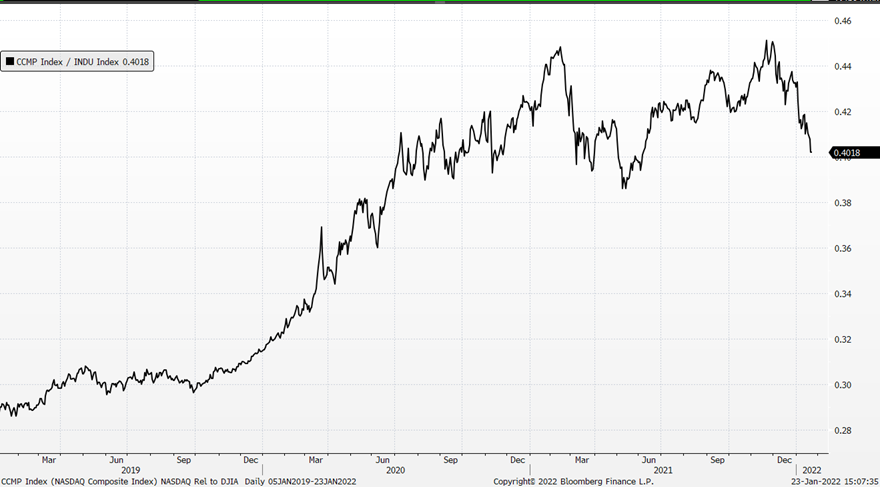
NASDAQ Relative to DJIA: Big top here in favor of the DJIA and out of NASDAQ.
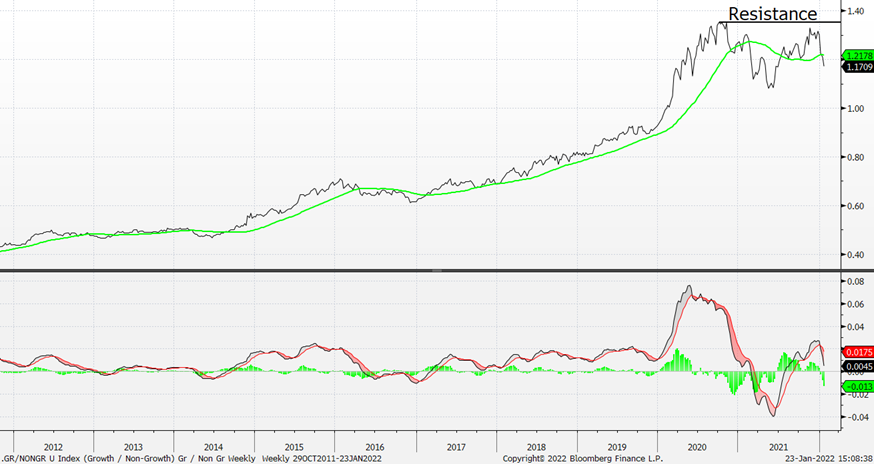
Growth Relative to Non-Growth: Another top in place where the denominator (Non-Growth) is going to beat the numerator (Growth).
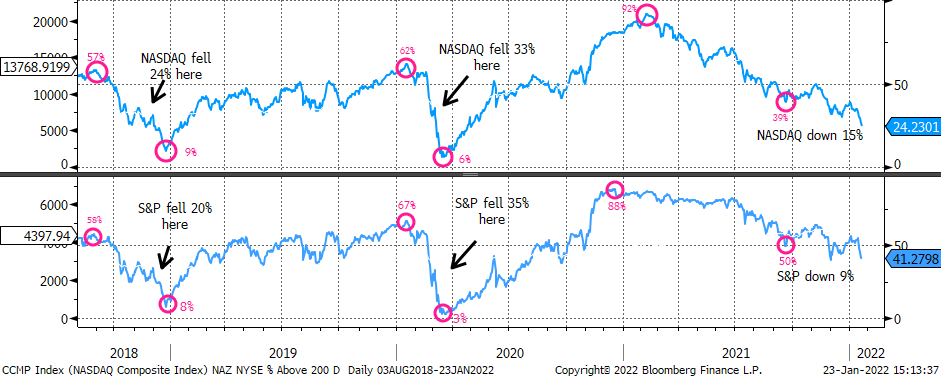
Based on the indicators here – % of NASDAQ Stocks > 200-Day Mov Avgs (top) and % of NYSE Stocks > 200-Day Mov Avgs (bottom) – both NASDAQ and the S&P should already be much lower.
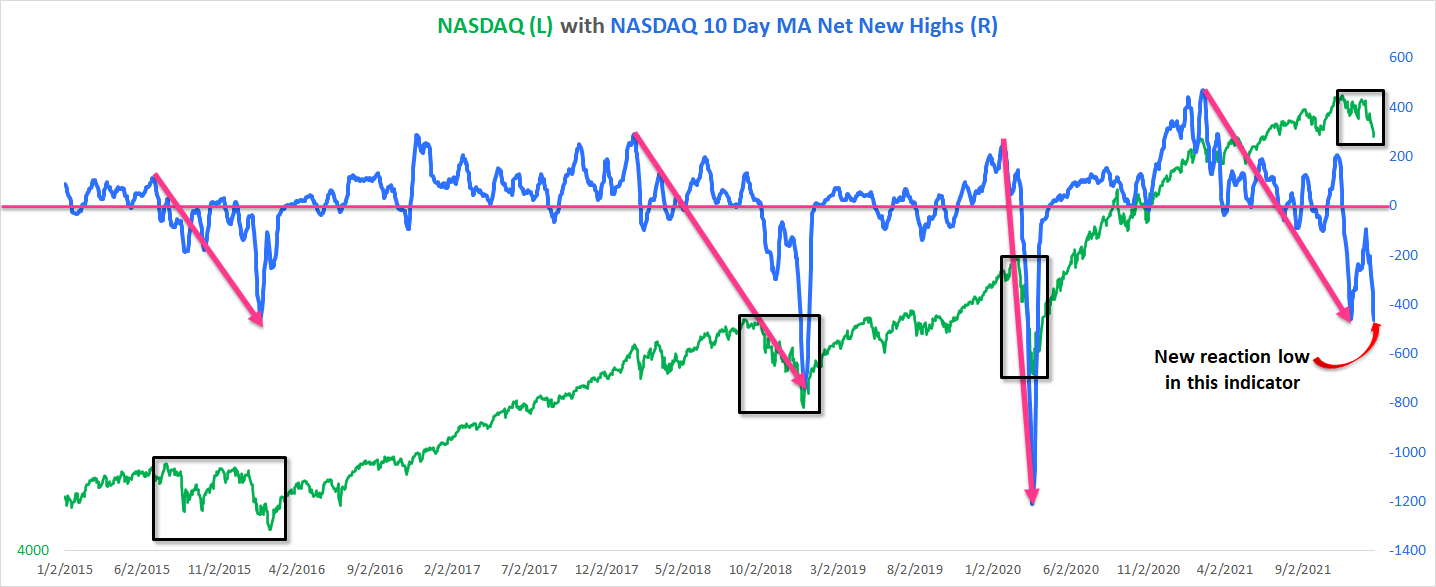
In 2015, 2018, and 2020 NASDAQ Net New Highs collapsed, and NASDAQ fell -20%, -24%, and -33%. Net New Highs have also collapsed this time, yet NASDAQ is only -15% from its late November high. We continue to think this historic anomaly cannot continue, NASDAQ has further to go on the downside. The number of Net New Highs for NASDAQ has been weakening since Feb 2021
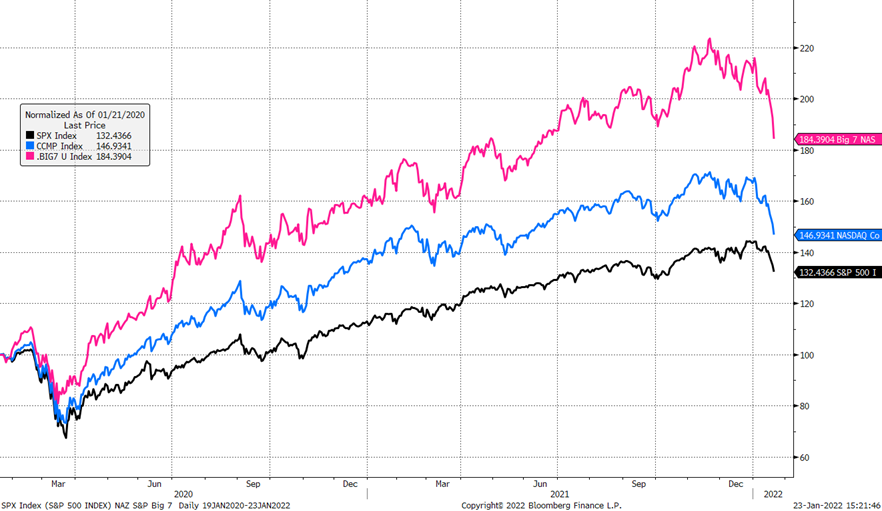
The Big 7 (in pink, AAPL, MSFT, GOOGL, AMZN, TSLA, FB, & NVDA) are now under pressure as our index is down 18% from its Nov 19 high. These 7 stocks are 25% of S&P (this figure is slowly declining from a high of 26%) and 40% of NASDAQ. AMZN is the worst of the group followed by FB and GOOGL. We continue to be sellers.
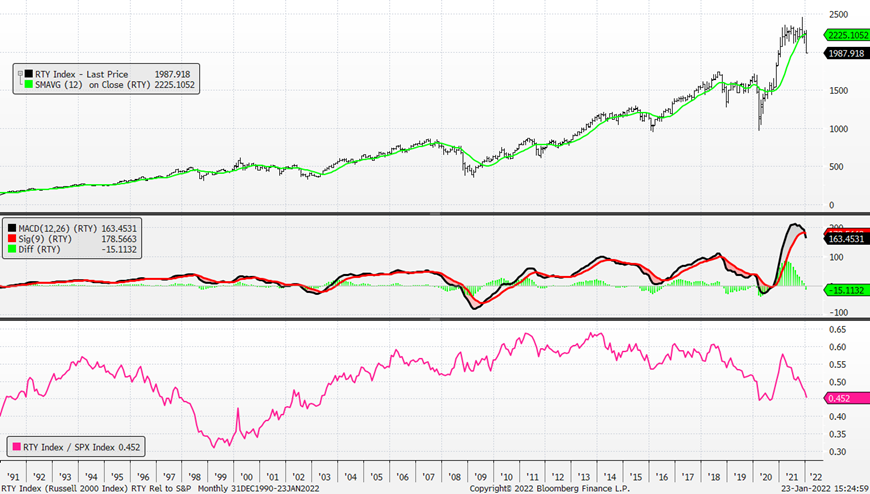
And the Russell 2000 has topped, too.
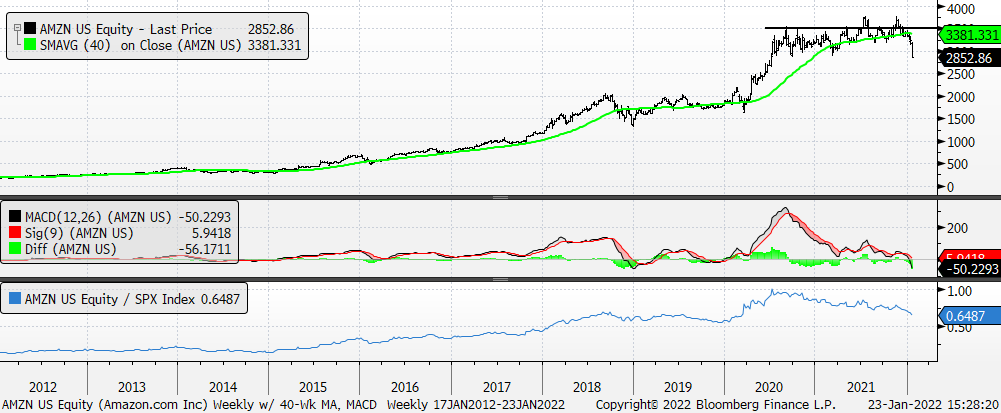
Amazon – Weekly w/ 40-Week Mov Avg, Weekly MACD and Rel. to S&P: risk to 2000
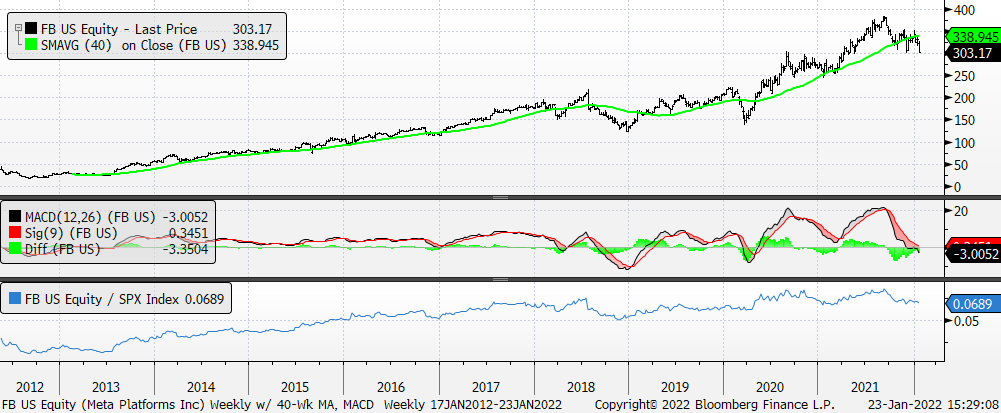
Meta Platforms – Weekly w/ 40-Week Mov Avg, Weekly MACD and Rel. to S&P: risk to 225
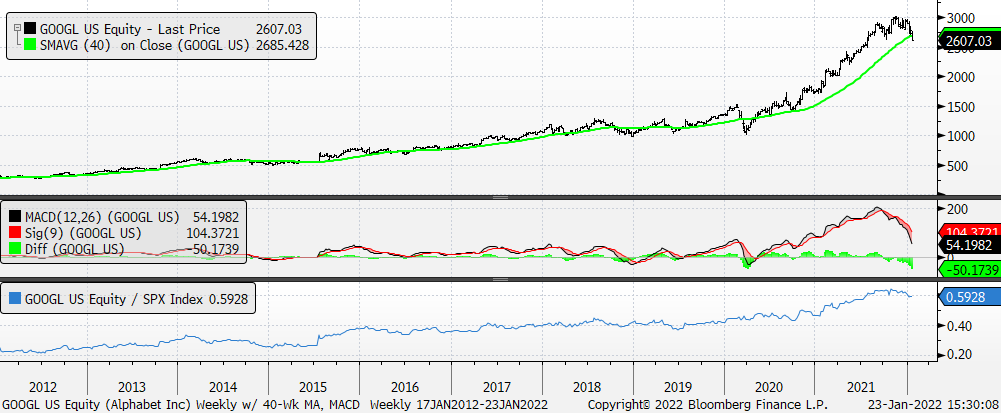
Alphabet – Weekly w/ 40-Week Mov Avg, Weekly MACD and Rel. to S&P: risk to 2000
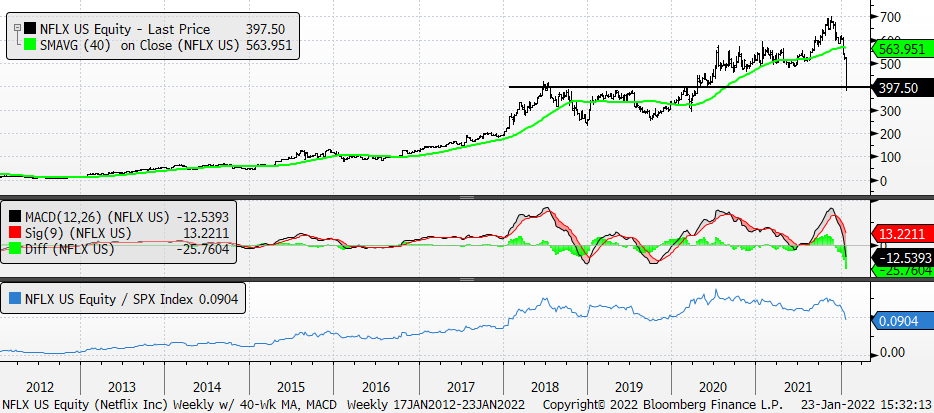
Netflix – Weekly w/ 40-Week Mov Avg, Weekly MACD and Rel. to S&P: What if Netflix is the poster child for Tech / growth for this bear market in that is has erased its gains from its spring 2020 breakout and this is what we should expect for most of Tech / growth?
GameStop – Weekly w/ 40-Week Mov Avg, Weekly MACD and Rel. to S&P: risk to single-digits
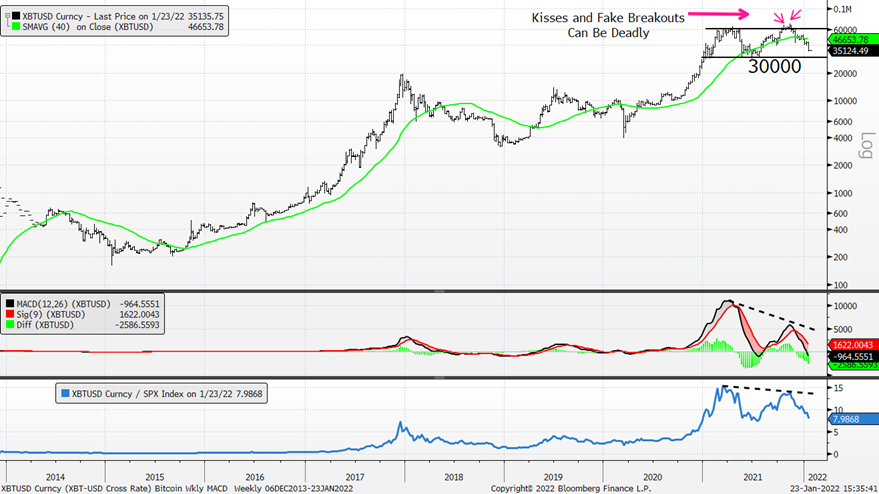
Bitcoin – Weekly w/ 40-Week Mov Avg, Weekly MACD and Rel. to S&P: we’ve been going with a target of 30,000. What follows is not hyperbole, but the median historical bear market for Bitcoin is -78% and we think it’s a decent idea to understand what such a down move would mean this time: a 78% decline from the Bitcoin high of nearly 69,000 (November 10, 2021) would imply a potential downside figure of about 15,000. It’s probably safe to say that not one Bitcoin bull has that figure in their model. To be sure, we don’t either…but we think it’s worth keeping in our back pocket in case we need it.
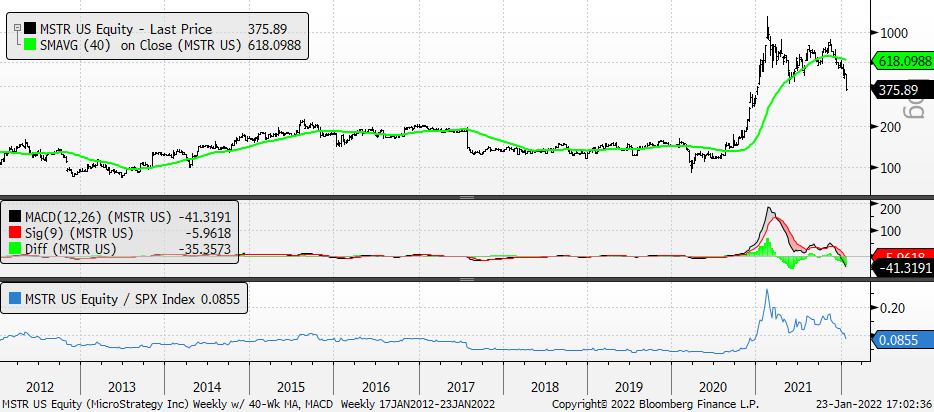
And if Bitcoin has that kind of risk, what does it say about MicroStrategy? Sell here and sell all bounces. Looks like it has risk to 200.
Fed Balance Sheet – “You are the wind beneath my wings.”
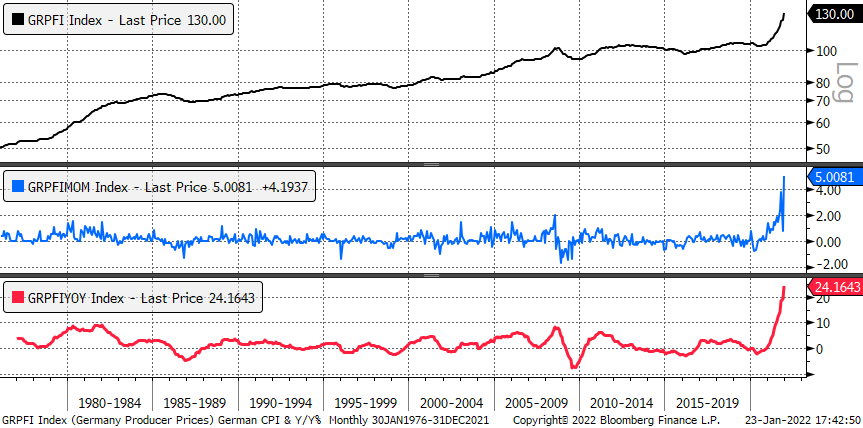
German PPI for December was +5% M/M and +24% Y/Y (that is not a typo)
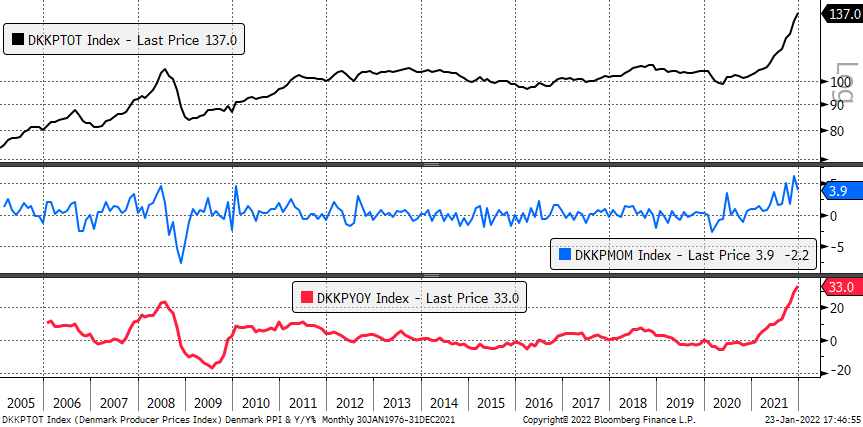
Denmark PPI for December was +4% M/M and +33% Y/Y (that is not a typo)