Summary: Two obvious paths could usher in slower inflation and get investors more comfortable being long risk assets again; 1) The Easy Way: the economy slows naturally and supply chains clear up or 2) The Hard Way: activity slows at the insistence of the Fed. The latter scenario seems most likely, which makes mean reversion harder than normal to play (we have made some poor bounce calls). Bottom line: Market headwinds will remain in place while the Fed is in “inflation containment” mode.
The fed will likely reinforce that idea this week and our call remains that core inflation trends are too hot (Rents/Wages suggest stubbornly high Core PCE) and supply chain issues are lasting much longer than expected (goods deflation not setting in yet, see recent Manheim used car prices). The above means the Fed is likely to stay in inflation containment mode, even if economic growth slows, as it focuses on bringing inflation down. The problem is we don’t know how much growth needs to slow for the Fed to accomplish its goal. That will depend on productivity trends. That makes buying stocks on weaker data points a potential value trap trade.
January economic data is soft and there is significant downside risk to payroll growth estimates. But barring a high conviction call that growth is weak enough for the Fed to change its policy stance, don’t expect the backdrop to change much. The market is deeply oversold (NDX in particular) and we heard several comments that the bar for Powell is extremely low this week. A vicious bounce is inevitable, but we will be cautious in trading that if the fed continues to talk about inflation containment despite weak economic growth. Should we expect a change in market trends with that framework?
Side note on bounces. They are always easier for sell side hacks (we get it…we are hacks) to write about then they are for investors to actually trade. We are more focused on the conditions that need to change to get long again. Hopefully those conditions will come in 3Q/4Q of 2022.
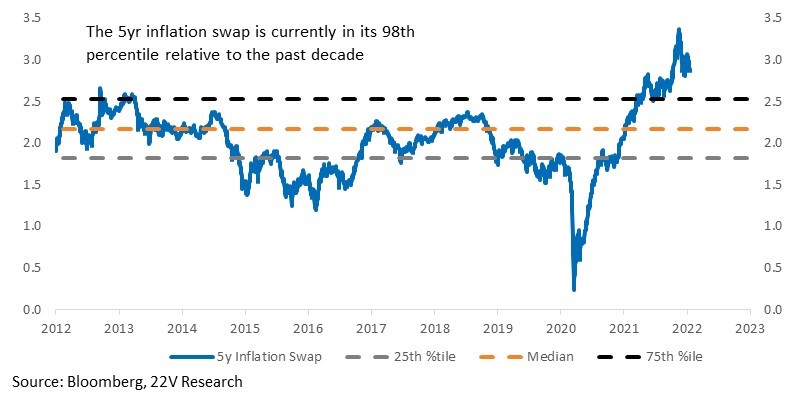
Trend Spending Debate: 22V’s economist, Gerard MacDonell, thinks consumer spending trends will remain firm after the January soft patch (he has been correct and the reasons he has been still apply today. See the labor income proxy and $40 trillion positive wealth shock since 2019). That is not a good thing though as it reinforces the idea the Fed needs to be more aggressive to slow growth. Which gets to how we think about a bottom forming in risk assets and Tech in particular. Proxies for the demand outlook (inflation expectations in this case) rolling over will signal the Fed is succeeding in slowing demand. The 5yr inflation swap is in its 98th %tile relative to the past decade and remained stubbornly high last week.
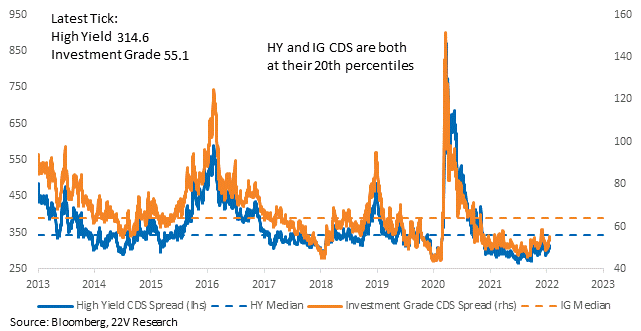
Financial Conditions Still Too Easy: Financial conditions in aggregate are still extremely tight historically, CDX spreads are near their 30th %tile historically (CCC outperformed last week), Asset reflation will resume after credit spreads widen, which will happen if stocks keep falling or inflation expectations collapse, and the Fed changes its tone. Unfortunately for Value and deeper Cyclicals, to the extent the Fed is successful in driving inflation and inflation expectations lower, deeper Cyclicals should give back recent gains. Also, when investors are in cash preservation mode, trying to pick the between growth and value becomes much harder. Also, QQQ moving lower help the Fed accomplish its goal of weaker demand. Tech has been the single biggest driver of the stock market wealth effect. It just a very hard backdrop and focus on other alpha opportunities (below).
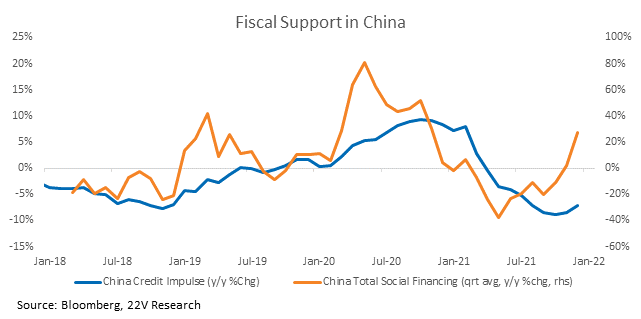
Focus on EM: Emerging markets have underperformed developed markets by -21% over the past year, an 88th percentile 1yr underperformance. EM is especially attractive if China is forced to add stimulus as some are calling for (the EEM is 30% China). China still has COVID headwinds that will limit growth, but China’s credit impulse has bottomed and China seems to be moving back to the old stimulus playbooks (infrastructure/lending).
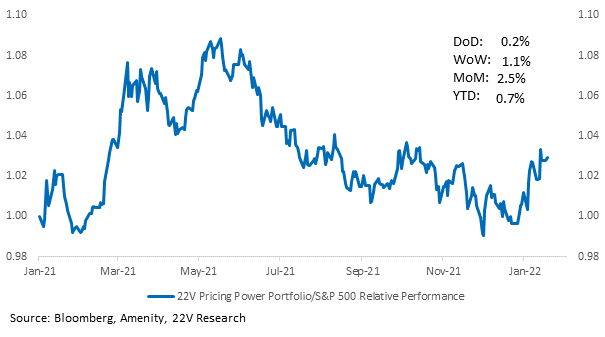
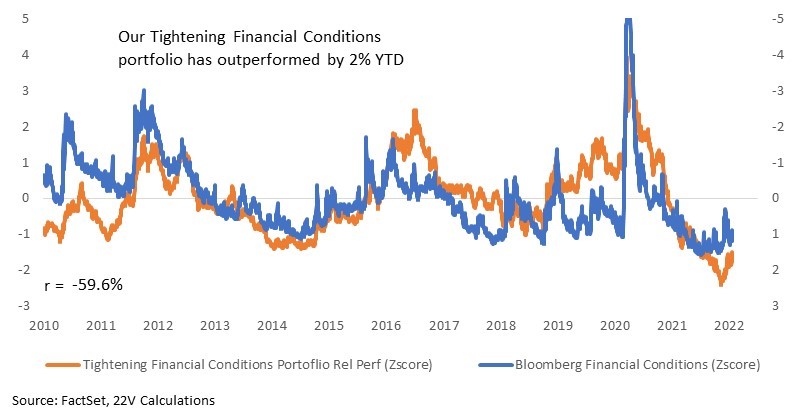
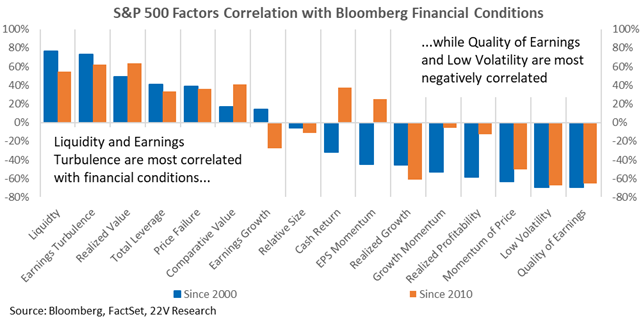
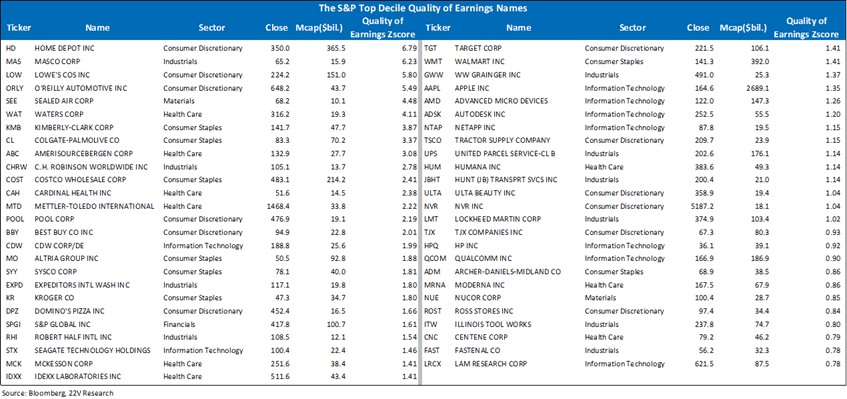
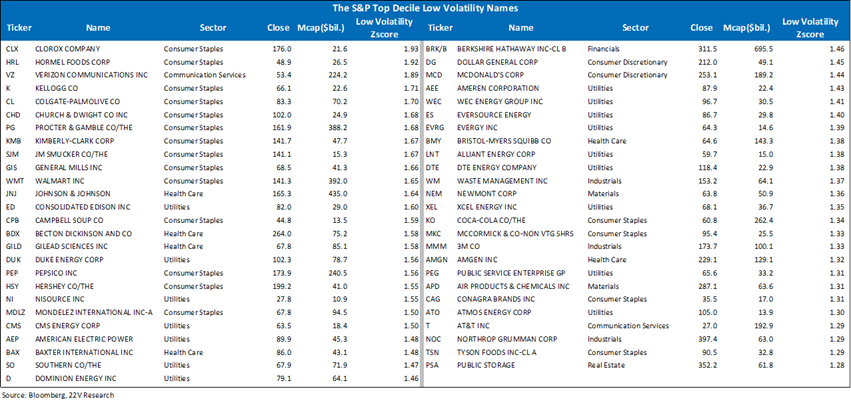
Alpha Opportunities: Stocks benefiting from tightening financial conditions (most negatively correlated with the Bloomberg Financial Conditions Index) rebound recently and have outperformed the SPX by 2% YTD. Quality of Earnings and Low Volatility factors benefit the most from tighter financial conditions. We have the list of stocks in the report. Pricing power has done very well recently, and it is a factor that should outperform as inflation expectations fall. Pricing power was not as beneficial for companies when inflation was surging (all companies passing along higher input costs). This is a factor we would be long over the coming months.
Financial Conditions: Given stubbornly high inflation expectations, higher UST yields, firm commodity prices, and credit spreads being in their 20th %tile, investors are still discounting a relatively firm longer-term economic backdrop.
22V’s economist, Gerard Macdonell, agrees consumer spending trends will remain firm (he has been correct). But that would reinforce that the Fed must slow growth the hard way. Which gets to how we think about a bottom forming in risk assets and Tech in particular. Proxies for the demand outlook (inflation expectations in this case) rolling over will signal the Fed is succeeding in slowing demand. The 5yr inflation swap is in its 98th %tile relative to the past decade.
The Fed slowing demand growth should push inflation expectations lower. Put differently, for investors to get comfortable that risk assets are bottoming, real yields, credit spreads, UST yields etc., need to move to level that indicate a significant change in the demand outlook and lower inflation expectations. As that happens, Energy and Financials will struggle and the yield curve will flatten.
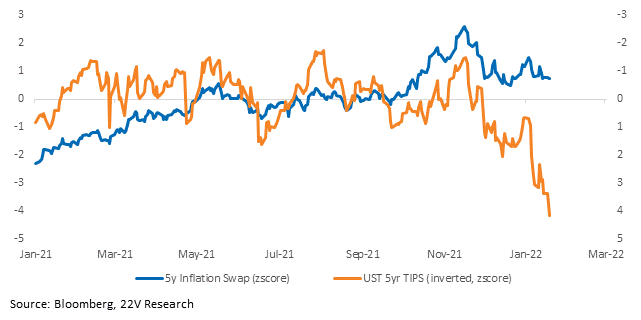
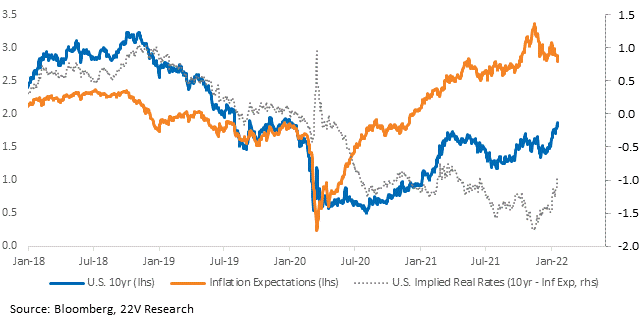
Implied real yields have gone up despite 10yr yields consolidating the past few week. That is a result of inflation expectations coming down. Inflation expectations are still in their 98th %tile historically and likely headed much lower if the Fed is going to slow growth. That means real rates are still biased higher EVEN if 10yr yields consolidate.
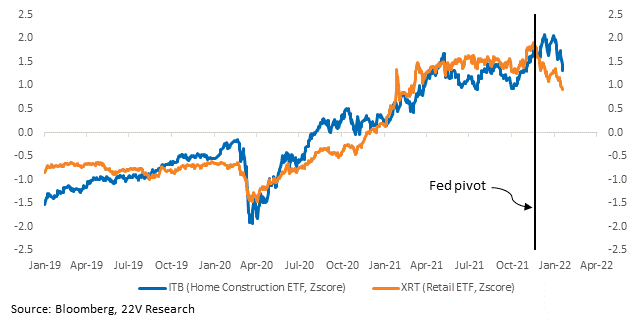
The two main areas driving above trend demand for the US economy have been the consumer and housing. When the Fed pivoted to a more hawkish tone in late November, retail stocks immediately turned lower, and homebuilders followed a few weeks after. If the Fed is successful in slowing economic growth, it stands to reason that the consumer and housing will slow some (consumer and housing slowing will go a long way in helping the fed accomplish its goal). That is a headwind for both groups.
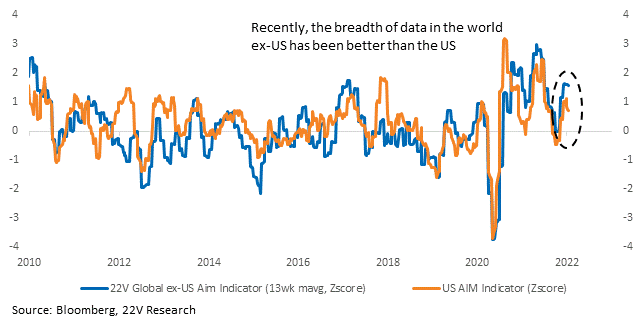
Focus On EM: As the US economy slows, which the Fed wants (the question is HOW MUCH), international equities begin to look more attractive on a relative basis. Last week, Lagarde said the ECB does not need to act as quickly as the Fed. Recently, the breadth of economic data points in the world ex-US has been better than the breadth of economic data points in the US.
Emerging markets have underperformed developed markets by -21% over the past year, an 88th percentile 1yr underperformance. EM is especially attractive if China is forced to be as stimulative as some are calling for (the EEM is 30% China). We hosted an expert webinar on China last week (replay link HERE). Victor Shih, our expert guest, talked about China’s potential fiscal response and emerging problem with zero-COVID, which impacts fiscal policy. China’s credit impulse and total social financing have both bottomed. The PBOC pledged stimulative policy in the press conference following a rate cut.
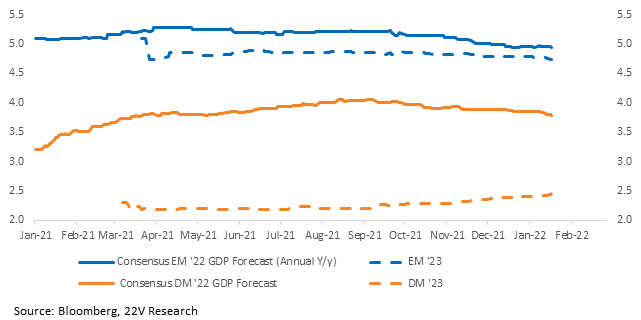
Keep in mind that as US growth slows, pushed along by tighter financial conditions, the USD is unlikely to move much higher. That is preemptive pushback on questions about the USD surging as the Fed acts more aggressively than other central banks. Financial conditions can tighten well before rates actually move, so growth slows while the USD is not necessarily super strong. Estimates for growth in emerging markets are better than developed, especially into 2023.
Focus On the Stocks That Benefit from Tighter Financial Conditions: Stocks benefiting from tightening financial conditions (bottom decile names correlated with Bloomberg Financial Conditions) rebound recently and have outperformed the SPX by 2% YTD.
Quality of Earnings and Low Volatility are factors most negatively correlated with Bloomberg Financial Conditions (benefit from a tightening of financial conditions). Liquidity and Earnings Turbulence are the factor most positively correlated with changes in financial conditions and should struggle as the fed pursues its tightening goal.
Quality of Earnings basket and Low Volatility basket.
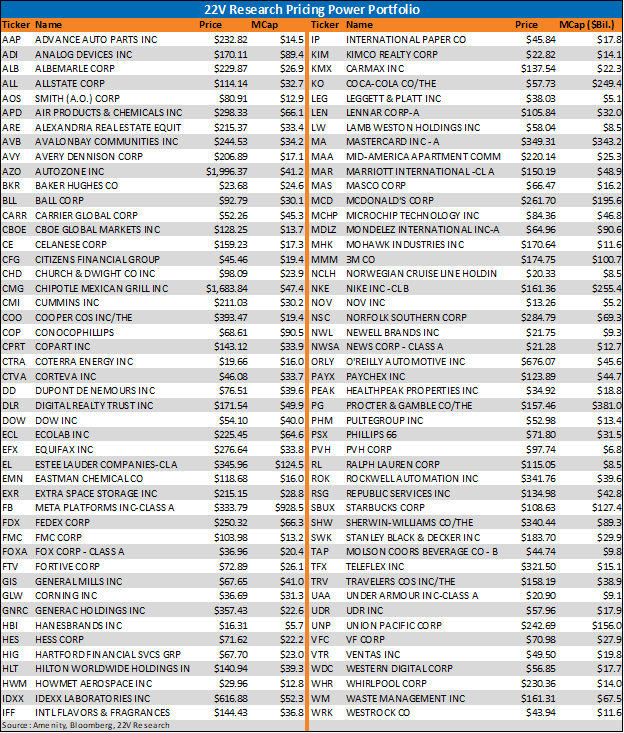
Focus On Pricing Power: pricing power has done very well recently, and it is a factor that should do well as durable goods prices deflate AND if inflation expectations fall. Pricing power was not as beneficial for companies when inflation was surging (all companies passing along higher input costs). This is a factor we would be long over the coming months. List of stocks below.