
President Biden’s post-election pledge of a return to normalcy was always going to be judged subjectively in every beholder’s eyes. The nature of US executive branch governance means exogenous events and internal White House developments inescapably influence policymaking as well as public opinion. That process shapes views – fairly or otherwise – about presidential performance.
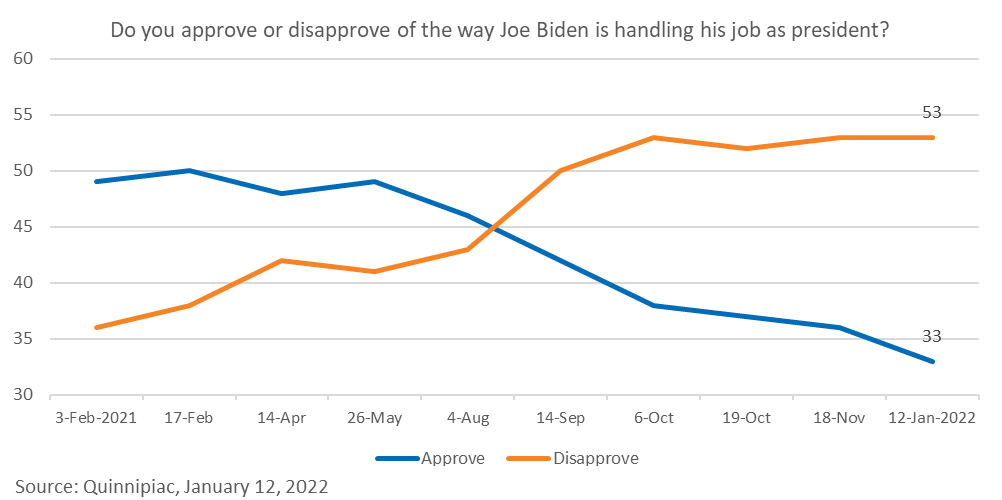
Amid calls to reshape his staff and concerns about the administration’s execution of a range of policies including macroeconomic, COVID, and geopolitics, it is clear Americans no longer give this once popular president much benefit of doubt. This loss of support is reflected in most public opinion surveys at the end of Biden’s first year in office. In a Quinnipiac University poll we showed you last week and reprint here for effect, the president’s disapproval rating has been steady since early October last year. His netted job performance numbers are dropping because his approval rating is falling, furthering a trend that started last summer.
Governance
March 1 is the next important policy agenda date for President Biden as the State of the Union address was rescheduled to come closer to the release of his FY23 budget. If the Wednesday presidential press conference marking his first year in office was a practice run, the White House has time to tighten the SOTU message. His misstatements on Russia/Ukraine illustrate the importance of tighter, crisper messaging. The selloff of US equities markets yesterday was linked to Ukraine’s pro-western neighbors agreeing to send Kyiv large-scale defensive weapons. The move came less than 24 hours after many perceived Biden waffling on what type of Russian aggression would trigger US/NATO support. Geopolitics now vie with macroeconomics as major elements of Washington’s ramping risk profile.
Hopes, Dreams, and Taxes
The House and Senate will not be in formal session next week. Efforts to revive a version of Build Back Better continue and much of the discussion involves tax credits. Senator Joe Manchin’s openness to a restructured childcare tax credit has others suggesting that this provision coupled with Biden’s green/clean energy investment and production tax credits proposal could be the basis of BBB2. Manchin reiterated support for lowering prescription drug costs. These three “chunks” are part of what the senator termed a blank slate negotiation. Our sense hasn’t changed that BBB2 would have to be consummated first within the Senate and then a bicameral Congress.
Financial Services
Digital assets will continue to be a priority for Congress this year albeit from a regulation-building perspective rather than legislative. The Federal Reserve System announced two developments important to the accelerating discussion of nonbank financial risks, fintech regulation and cryptocurrency. The Board yesterday released a research study and request for comment on central bank digital currency: Money and Payments: The U.S. Dollar in the Age of Digital Transformation. Relatedly, The Federal Reserve Bank of New York announced a blockchain trading practitioner, Michelle Neal, as the new head of the Markets Group.
The administration reportedly is soon to follow up on discussions last year about regulation of digital money to protect investors and taxpayers. We’ve heard but have not verified that White House may release an executive order this quarter that would cover four areas of the broad digital money space including:
Outlook
The midterm elections continue to narrow opportunities for legislation this year. Congressional staff believe their bosses will need more time than the current February 18 continuing resolution deadline affords to complete an FY22 omnibus bill that could unleash new programs and above baseline spending for some budget functions, including defense. Democrats’ fret over the looming November 8 date were validated by yet another data point. The latest NBC News polling survey demonstrates Republicans are more interested in their party than former President Trump. He might yet prove a get-out-the-vote draw for disgruntled Democrats but if the following trend continues, Trump will be less of an impediment to a Republican unified Congress next year than thought a few months ago.


