SUMMARY: Overnight headlines continue the monetary policy tightening pile on. From the fed, Brainard is set to tell congress that “inflation is too high”, which follows Daly and Bullard remarking yesterday that the fed should lift rates in March, and Philly fed President Harker noting that more than three hikes would be appropriate if inflation remains high.
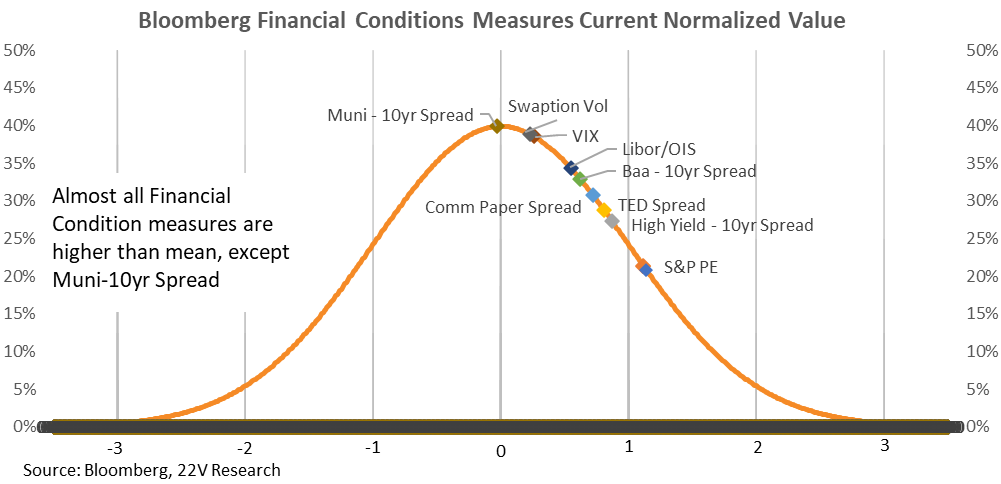
Bottom line, the Fed wants financial conditions to tighten to the point that they affect the economy (that’s the point). It’s reasonable to assume (not guaranteed) that the components of financial conditions that are furthest from “normal” will tighten the most to help the Fed accomplish its goal. The below illustrates components of financial conditions and the distance from their long-term medians. We do not look at the chart and assume the Fed wants stock prices to fall significantly though. The point is illustrate where the outliers are relative to history (bitcoin is not in the measure) and of course, inflation can fall without a significant tightening of financial conditions if productivity and participation pick up.
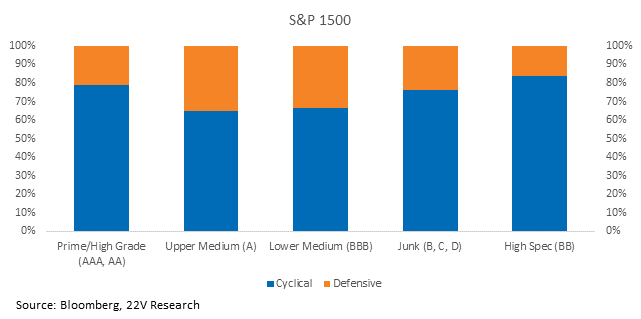
The above does suggest it is likely credit widens out and the corporate credit curve steepens. Equities with the lowest credit ratings underperformed those with higher credit ratings when the S&P fell from 1/4 to 1/10 the Fed’s intent to tighten financial conditions became clearer. The underperformance of lower rated stocks is a trend that can persist as investors digest the Fed’s intent to tighten financial conditions to the point the economy is affected.
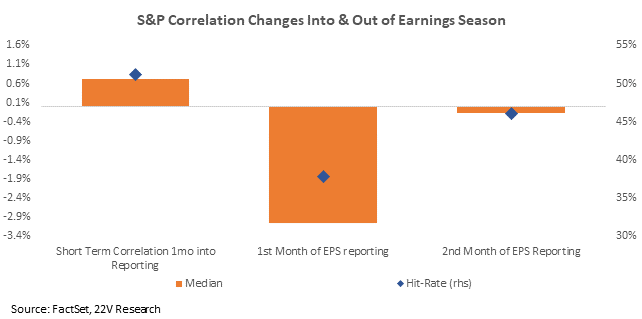
Alpha Over Beta Short Term: Monetary policy headlines/comments will continue adding to market/factor volatility, but with major economic release behind us and earnings reporting season in front, market movements will be more alpha and less beta drive. As new earnings data are released, S&P correlations tend to dip and market return dispersion increases.
Major financial earnings are due tomorrow (JPM, C, WFC, BLK, FRC), kicking off the unofficial start of reporting season. The pace of reporting picks up after that with 39 companies (8% of index market cap) reporting next week and 109 names (34% of market cap) reporting the following week. Earnings revisions have been strong leading into the start of reporting with S&P revenue growth estimates revised up from 11.7% at the end of last year to 12.3% today. Investors are laser focused on margins and margin commentary this earnings season.
Full report below…
MARKET VIEWS: There wasn’t much overnight market news and we are through the most relevant macro prints (see CPI commentary later in this report). Monetary policy headlines/comments will continue adding volatility to the short rates and real yield forecast, influencing facto and industry trends, but with major economic release behind us and earnings reporting season in front, market movements will be more alpha and less beta drive. Despite the recent tightening of financial conditions, the overall level of market correlations remains lower than it has been over the past several years. Recent, short-term correlations have rolled over.
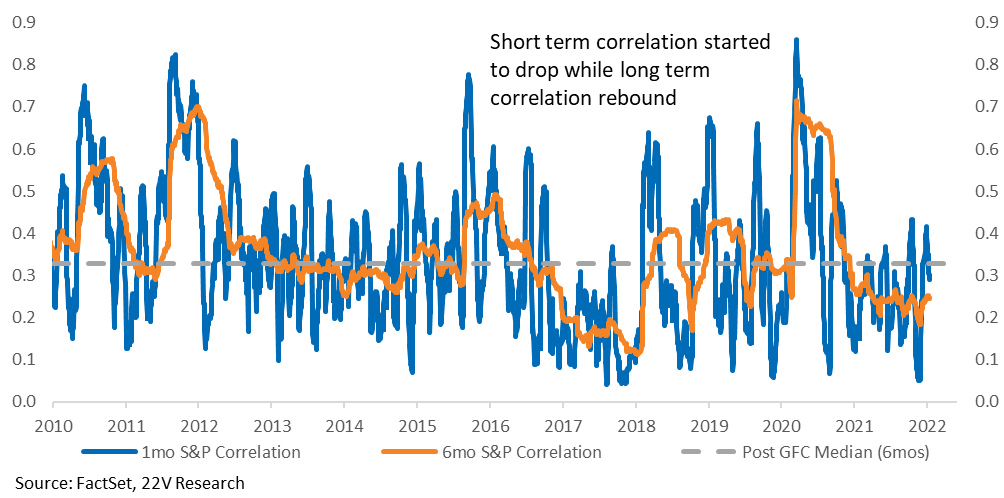
About 7% of the S&P has reported earning so far, but major financial earnings are due tomorrow (JPM, C, WFC, BLK, FRC), kicking off the unofficial start of reporting season.

The pace of reporting picks up after that with 39 companies (8% of index market cap) reporting next week and 109 names (34% of market cap) reporting the following week. As new earnings data are released, S&P correlations tend to dip and market return dispersion increases.
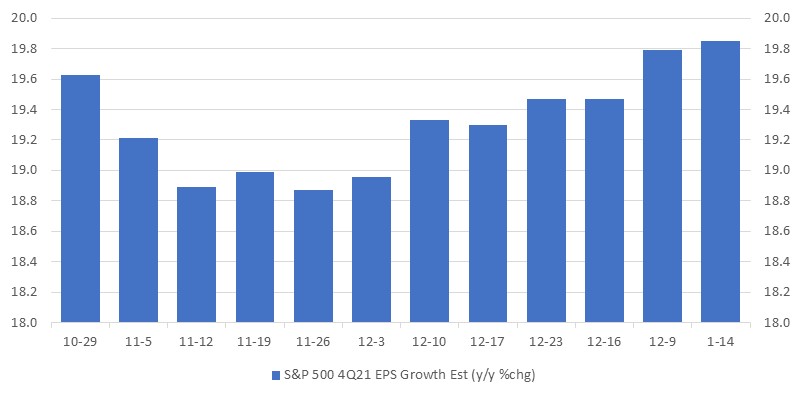
Earnings revisions have been strong leading into the start of reporting with S&P revenue growth estimates revised up from 11.7% at the end of last year to 12.3% today, and EPS growth estimates rising from 19% to 19.9%. S&P EPS growth has beat start of reporting season estimates by at least 10pp over the past six quarters. Though we do not anticipate that level of upside surprises, index EPS are likely to end the year around $207, up from current estimates of $203.
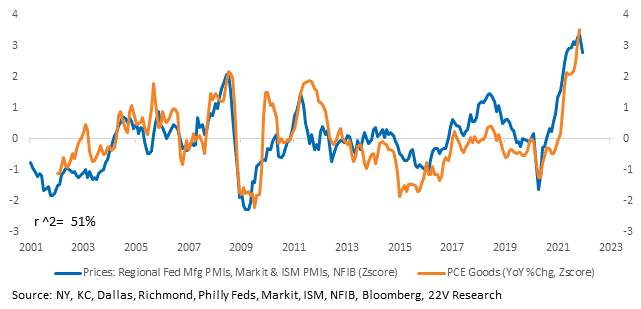
CPI: Rent inflation, which is hard to predict but should trend persistently higher soon, did not surface in December’s CPI. That was beneficial since goods deflation did not surface either. The report was positive relative to fears, providing a boost to Growth after a period of 99th percentile underperformance, but is not a market clearing print. The Fed is STILL going to tighten financial conditions, but short-term policy does not need to be more aggressive if goods deflation happens as rent inflation kicks in. Interestingly, we saw some moderation in prices received reported by respondents to the regional fed, ISM, and Markit manufacturing PMIs and the NFIB surveys. The prices received component is still exceptionally high, but this could be a sign of some goods deflation on the horizon. The relentless upward trend has been broken.
FINANCIAL CONDITIONS: Financial conditions need to tighten to the point that they affect the economy (that’s the point). It’s safe to assume the components of financial conditions that are furthest from “normal” will tighten the most. The below illustrates components of financial conditions and the distance from their long-term medians. We do not look at the chart and assume the Fed wants stock prices to fall though. Messing with a large source of consumer wealth does not seem like the safest way to tighten conditions without also breaking the economy. Tightening money/bond market conditions seems like a safer approach, with the fed letting stocks take care of themselves.

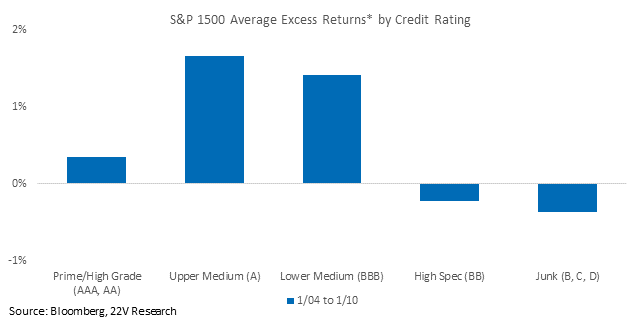
That means it is likely that credit widens out and the corporate credit curve steepens. Equities with the lowest credit ratings underperformed those with higher credit ratings when the S&P fell from 1/4 to 1/10 as the narrative that the Fed would tighten more aggressively took hold. The underperformance of lower rated stocks is a trend that can persist as investors digest the Fed’s intent to tighten financial conditions to the point the economy is affected.
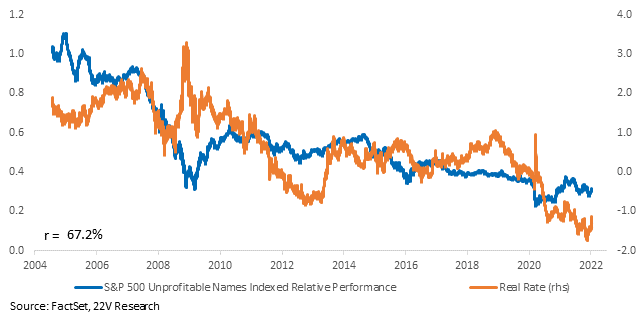
Megacap tech has some of the highest credit ratings but has underperformed recently. It’s tough for the NASDAQ to keep underperforming under a regime that supports high quality, cash returning equities. It’s important to differentiate between unprofitable and profitable tech. Cash returning giants are not going to be hit the same as the unprofitable names that benefitted from ultra-low implied real rates. Implied real rates are going to keep increasing, a headwind to unprofitable companies, but not all of Tech.
Better rated groups have a higher ratio of Defensives to Cyclicals than worse ratings. That’s a headwind to Cyclicals relative to Defensives all else equal, but note there are plenty of highly-rated Cyclicals. Plus, the highest rated names are mostly Cyclical (tech is Cyclical).