It was a long time ago, but we once had lunch with Peter Bernstein who was at various times in his life a Fed Economist, an employee of the Office of Strategic Services (forerunner of the CIA), an Air Force captain, a money manager, the first editor of The Journal of Portfolio Management, and author of books such as Against the Gods: The Remarkable Story of Risk and The Power of Gold: The History of an Obsession. At the time of our lunch with Mr. Bernstein, and his wife Barbara, we had been lucky to have been carrying a thematically bullish call for gold (“Totally and Unequivocally Bullish,” Oct 31, 2001) and we wanted to talk to Mr. Bernstein about his book, The Power of Gold, which was published in 2004.
Mr. Bernstein revealed to us that he wrote the book, not because he was a fan of gold, but because he hated it. “You’ll have to explain that one,” we said. And this is how he did it. He said, “John, were you a student of statistics?” We said, “Yes, but should’ve done better.” He said, “Very well. Tomorrow I will come to your apartment and ask you to join me for a walk around our fair city. I’ll tell you that we’ll be out all day for our brisk walk. I will also tell you that there is a 5% chance that you will be hit by a car. You, as a student of statistics, make the quick calculation that…” And we quickly said, “There’s a 95% chance of not getting hit by a car.” He said, “Jolly good [he actually said it] …that is the correct way to think about it statistically. However, the ramifications of that 5% – where you are hit by a car – are so grave and dangerous that you must have insurance on yourself. And that, John, is the way I think about gold with respect to a portfolio – it is a portfolio’s insurance.” He didn’t reference it at the time, but it’s likely Mr. Bernstein would’ve agreed with the old English proverb, “When we have gold we are in fear, when we have none, we are in danger.”
Mr. Bernstein’s lesson notwithstanding, as a “trender” and not as a “trader,” we think about gold in two ways – (1) We want to be long when it’s in an uptrend and (2) We want to be short when it’s in a downtrend. And when it’s in an uptrend we’re firm believers of King Ferdinand’s 1511 admonition – which Mr. Bernstein included in his book twice to, “Get gold, humanely, if possible, but at all hazards – get gold.” We don’t believe, not even for one second, that gold should be avoided when it’s in an uptrend because it might underperform the S&P or might underperform NASDAQ.
First off, almost nothing outperforms the S&P (it’s a Tech Index) or NASDAQ (self-evident) but that doesn’t mean you shouldn’t own anything else. For example, it is thought that Michael Jordan is the greatest player in NBA history but we’re pretty sure he had teammates and since we’ve been there, we can say with great certainty that Michael Jordan is not the only player in the Naismith Memorial Basketball Hall of Fame – and one of them is named Dave Debusschere.
Secondly, it might be forgotten but there have been two long stretches where gold did outperform the S&P: (a) From April ’71 – Jan ’80 gold outperformed the S&P by 1400% and (b) From July ’00 – Aug ’11 gold outperformed the S&P by 670%.
We’ve thought for some time that gold has been basing and we got a bit more aggressive in late November with a note entitled, “Golden Ticket” in which we said we believe “gold will make a new all-time high above its August 2020 peak of 1862.85.” Gold had a nice little pop on Friday, December 31, 2021, rising 80bps (remember, this is not a tech stock) and it’s been up for three weeks in a row rising a modest 2.6% (again, please remember that it is not a tech stock). We monitor or follow 23 commodities and 91% were up in 2021 with only gold (-4%) and silver (-12%) down on the year. It was a bit odd to see both gold and silver sit out last year’s commodity advance, but gold was the first soldier over the wall to lead the other commodities into battle when it broke out in June of 2019 by working above $1350 – $1375 so perhaps gold has been, as we believe, BASING, consolidating, and building for its next advance.
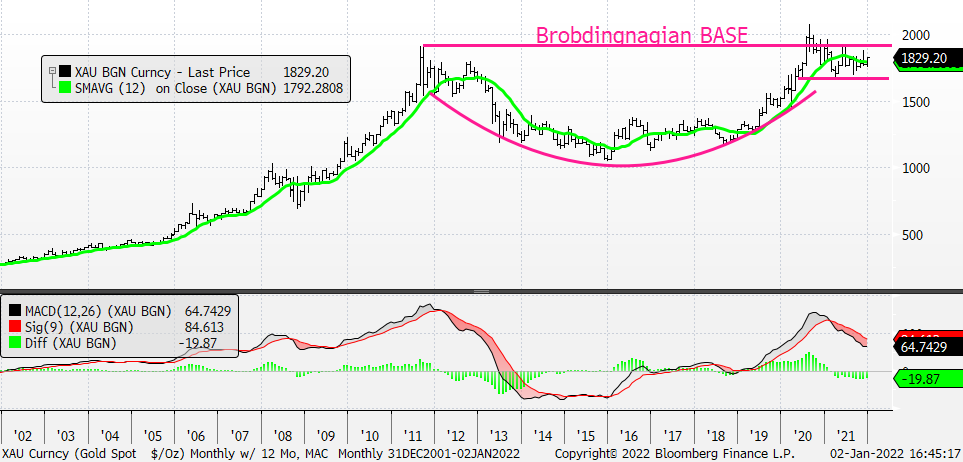
The metal is not in the clear, however, in that it must get above its November 2021 peak of 1877 to clear a near-term hurdle, but we believe it is in a good spot to do some buying or to add to an already existing position. On our Scoring System gold has a good Technical Score of 3, is above its upward-sloping 50- and 200-day moving averages, possesses modest daily and weekly momentum, and is the proud owner of a monthly Brobdingnagian BASE.
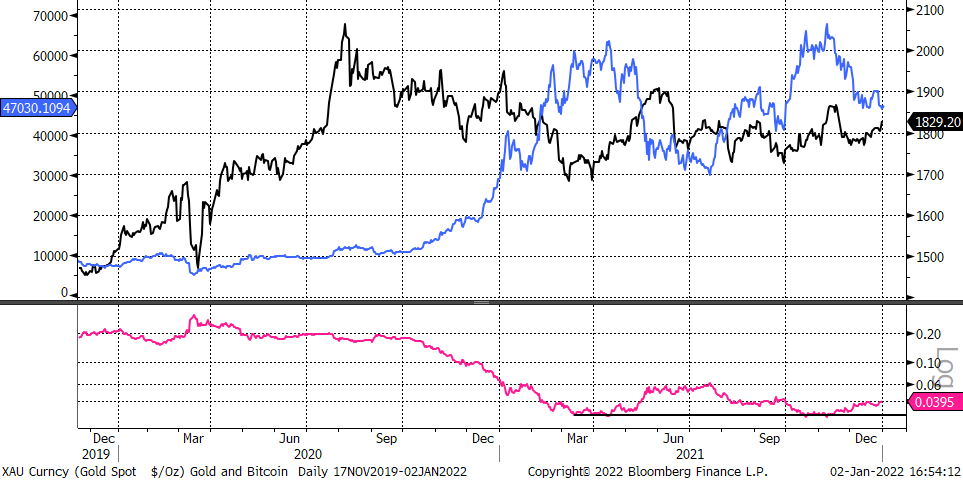
We also like gold here versus Bitcoin as momentum work is picking up for gold and deteriorating for Bitcoin (gold = black, Bitcoin = blue, and the pink line = relative ratio gold / Bitcoin). Bitcoin behaved more spectacularly when it won in 2021 but the relative ratio for gold / Bitcoin is at levels first seen in early February 2021. And it might be said that this relative ratio has double bottomed for gold vs. Bitcoin.
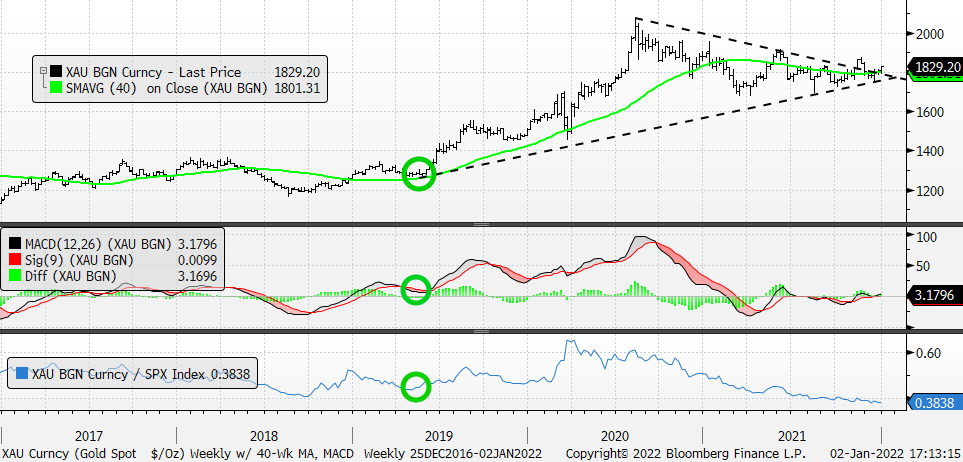
The last chart below shows gold on a weekly basis with its now inflecting upward 40-week moving average, its modestly positive weekly MACD and its still weak trend versus the S&P 500 (bottom panel). Indulge us for one minute here and notice the higher low in relative performance for gold versus the S&P in spring 2019. If you had been open to seeing that higher low for gold versus the S&P and bought some gold – it also had a higher low in its weekly MACD and in its absolute price, too – and held gold until it peaked relative to the S&P in April 2020 you’d have seen the metal outperform the mighty S&P by 50%. We know…we know…a lot of that outperformance came during the COVID-induced equity drawdown, but gold had started to do better relative to the S&P a full eight months prior to COVID.
We’re certain of at least one thing for gold – if it works, as we suspect, then its narrative or reason for working will form after price has already turned importantly. Paul Tudor Jones just might agree with that.