
Plenty of attention this month on payment systems of all kinds allows for a quick update on those policy developments and our view on President Biden’s efforts to restructure the Federal Reserve Board. This bank and broader financial services policy focus is certain to remain high next year, even if there are episodic changes to intensity.
We continue to see more opportunities than risks for regulated financial institutions and products despite what will be an active 2022 for bank regulation. US bank policy next year will be influenced by a pro-growth White House nominating three new Federal Reserve governors. The Treasury Department supports broadly inclusive growth as it leads the administration’s plans to address nonbank financial institution risks. National private and public payment systems, to varying degrees, stand to benefit from innovations designed to increase choice, mitigate deficiencies, and enhance competition.
Payments
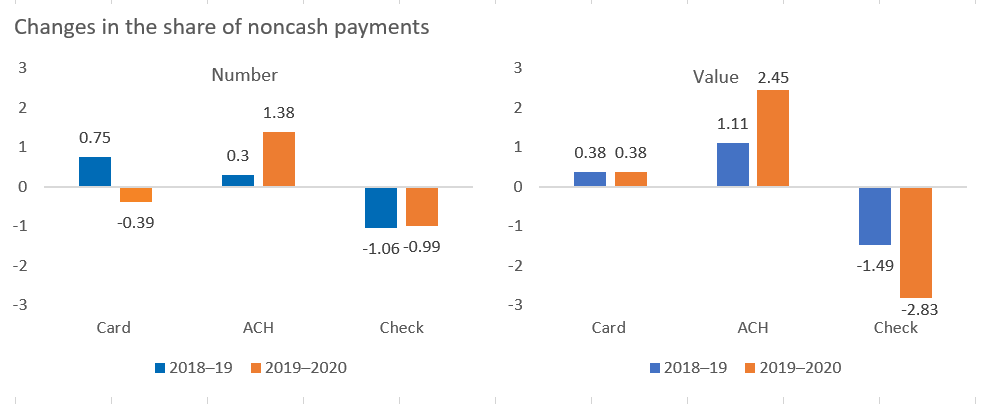
The Federal Reserve Board on December 22 published its payments study for the first time in three years. The report contains important findings from pre-pandemic as well as 2020 events, including quarterly data for that year. Technology as an enabler or accelerant of trends is the standout, if unsurprising, theme. Usage of checks declined in each year 2018–2020, and contactless payments rose in value and number in the same period. These trends did not hurt the 2021 YTD performance of institutions in the popular KBW Bank Index, which rose 35% through midday yesterday.
By Number, Card Payments Most Used of Noncash Payments
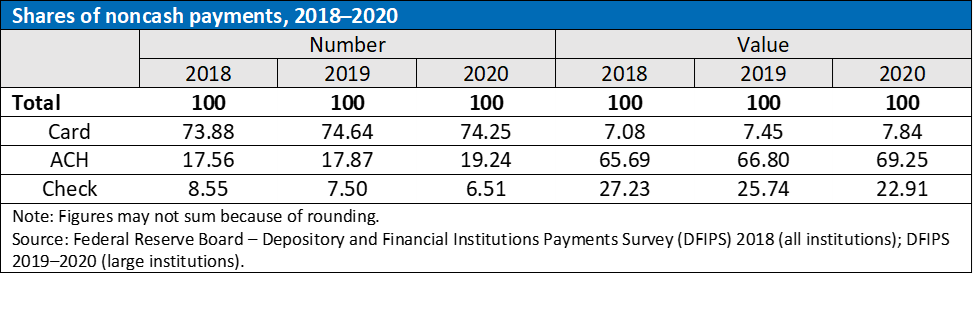
The three horses of noncash payment transactions are cards, automated clearinghouse transfer systems (ACH) and checks. ACH is the king of payments for the study period 2018–2020 in terms of number of transactions and value of those payments. The study implies these trends continued into this year, again, enabled by technology deployment and acceptance.
Digital wallets are a clear indication of tech deployment and acceptance (even if the tech facilitates or forces acceptance among some consumers). Digital wallet activity rose throughout last year and really accelerated in 2H20 as the pandemic encouraged more Americans to seek contactless payments. Here too the 4Q20 leveling off makes sense but convenience and industry marketing are two factors we believe support the trend.

Board Restructuring
Senate Banking Committee Chairman Sherrod Brown reportedly wants to hold Chair Jerome Powell’s re-nomination hearing the week of January 10. Brown intends to follow shortly thereafter with Governor Lael Brainard’s board vice chair nomination hearing. The vice chair for supervisions nomination remains a topic of interest especially among bank managers and their investor base.
The White House has floated a few names for the VC Supervision slot, but none has received as much attention as Richard Cordray. He is a lawyer, former Ohio state regulator, and the first confirmed director of the Consumer Financial Protection Bureau (CFBP). The second point is a positive for Chairman Brown (D-OH). The third point is important to Democrat left-wingers, especially Senator Elizabeth Warren (D-MA), the architect of the CFPB who personally and successfully lobbied former President Obama to nominate Cordray. Atlanta Fed Bank President Raphael Bostic and former Treasury Deputy Secretary Sarah Bloom Raskin are among the other possible candidates often mentioned.
Policy qualifications stipulated, the president’s inclination to appease Brown and his committee colleague Warren as well as the political factions they represent could compel this decision. We have Bostic getting one of the two remaining seats. Brown’s language immediately before and after Powell’s hearing will provide meaningful clues about his White House relationship. He will be doing heavier lifting for Biden than any other Democrat next quarter, including Vice President Kamala Harris, House Speaker Nancy Pelosi, and Majority Leader Chuck Schumer, in our view.
The financial services lobby surely won’t like each Fed Board pick, and Biden is sensitive to not having those institutions fight him on any one nomination. Our sense is that relevant administration staff and Secretary Janet Yellen think there’s a Goldilocks slate that, while not appeasing every important stakeholder group, won’t induce any to engage in confirmation war.
On the crucial subject of bank and nonbank rules we believe Federal Reserve/Biden administration commonality exists within the incentives for protecting systemic risk controls as the core macroprudential task. This umbrella covers all aspects of payments and intermediation functions. Second tier issues include how most effectively to work climate effects disclosure into annual stress tests and refining the Community Reinvestment Act.
Easy financial conditions and a well-established rulebook most burdensome to banks with assets greater than $10 billion continue to preclude policy-driven downsides for most banks (M&A could be an exception). We maintain the view that US banks on whole enjoy global competitive advantages that could be underpinned by London’s Brexit troubles and Beijing’s financial nationalism, at minimum creating challenges for other banks in the region outside China.
Relative to other sovereign large, globally connected systems, US banks do not face a realistic prospect of new, onerous rules sapping bottom lines. In terms of expectations, it’s possible if not likely that bank regulation under Biden will not ease significantly and therefore could disappoint banks and investors hoping for a thinner, lighter rulebook. This prospect is sufficient to test, if not disintegrate our Goldilocks Fed slate notion.

