
A productive bipartisan December on Capitol Hill recedes quickly from short-term memory crowded out by questions of why the Senate did not pass BBB and if it can next year. Geopolitics is the other policy-driven subject investors have turned to as the remaining December calendar offers more opportunities to gauge relations among economic and military superpowers.
The policy trend in place adds bite to existing US actions to deter financial transactions and technology transfer among US companies and foreign military and civilian organizations. Presidents Biden and Trump rolled back the tradeoffs of their predecessors that gave greater weight to economic considerations while balancing national security concerns. The Department of Commerce’s Bureau of Industry and Security three weeks ago issued a final rule augmenting the so-called Entities List to prohibit commercial and financial interactions with 27 people or organizations considered threats to US national security.

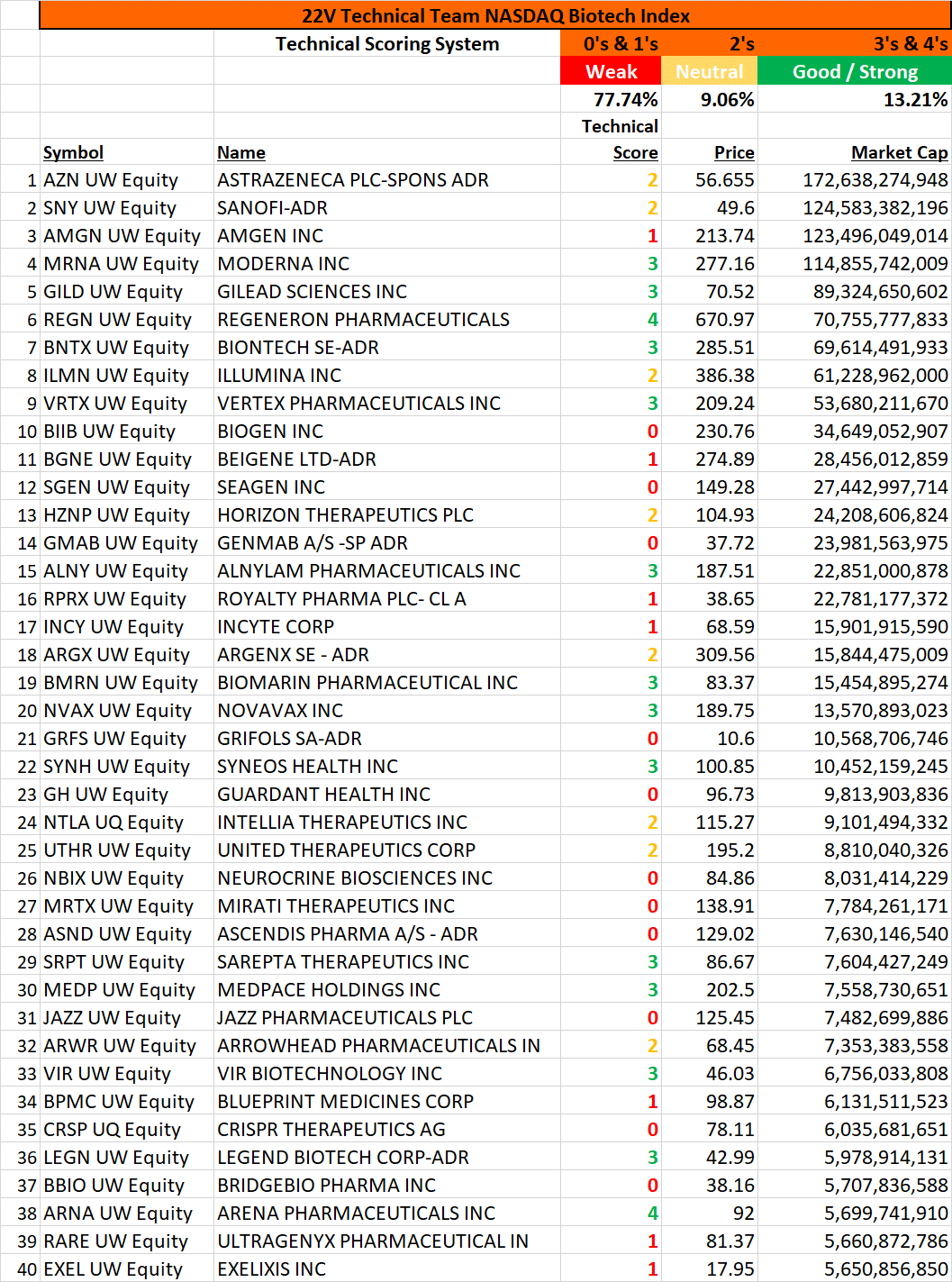
The news caused pain for biotech stocks already under pressure since late summer as some of those companies had been providing surveillance and other technologies to countries including China, Russia, Pakistan, and even allies such as Japan and Singapore. John Roque scored the NASDAQ Biotech Index (NBI) for us but rather than the entire 265 index members, we asked John to show us the top 40 by market weight. The scores relate to the entire index. We were a bit stunned to see 78% of the NBI showed up as weak 0’s or 1’s; when asked, John observed that sometimes a “group out of favor falls really out of favor.” Part of our uninitiated surprise at the scores was it comes during a pandemic with heightened awareness of a highly transmissible variant.
Sugar plums dancing in some hopefuls’ heads doesn’t slow the geopolitical west vs. east escalating scrum. Germany’s naval chief speaks on Tuesday at the International Institute for Strategic Studies on his country’s re-engagement with the Indo-Pacific region. Germany plans to send military vessels to Asian regional ports of call every other year beginning this year with the arrival last week of the frigate Bayern in Tokyo.
President Biden has explicitly called his approach to China as one seeking “competition, not conflict” and “strategic stability.” Step-by-step implementation of commercial sanctions is a key defensive element for maintaining strategic stability, along with complementary steps to improve US competitiveness. Sanctions should be expected to increase. China will react by retracting from its commercial relationships with the outside world, work relentlessly toward self-reliance and self-sufficiency, but continue its external engagement with subsidized exports and use of all means to acquire technology from abroad.
President Putin’s annual news conference is set for December 23. Always rich in headline and risk assessment material, it is hard to top the March 2014 speech in which he evoked imagery of Prince Vladimir of Kiev. The sweep of his comments then is matched by Putin’s apparently unyielding geographic security ambitions and risk perceptions. Here too, EU/UK/US cooperation has made plain it is planning to punish Russia’s possible expansion west. Market risk would arise most if conflict(s) cause the US to ban Americans from participating in Russia’s secondary markets, and if Russia is cutoff from the international clearing house SWIFT (Society for Worldwide Interbank Financial Telecommunications).
A growing risk from Biden’s signature fiscal policy is that it meaningfully overshadows an otherwise largely bipartisan productive December. Now and for any reasonable horizon, geopolitics will require persistent multi-tasking by the White House. Not only are Democrats publicly asserting the will and ability to pass BBB next month, but Biden, in concert with others, obviously is taking the fight to global competitors as the administration attempts to manage consequential international economic and military competition.

