
Overview
Senate consideration of President Biden’s signature economic agenda legislation – Build Back Better – remains challenged by the calendar. It won’t be on the Senate floor today, a milestone we said would indicate whether December enactment was likely. The question now is whether we correctly valued the indicator. While risks are rising BBB won’t make it to the White House for Christmas, progress over the weekend could suggest we were wrong about our floor timing threshold as the compelling outcome signal. We hold on to the call that BBB is finished this year, despite possibly misplaced emphasis on floor timing, largely due to the leeway built into calendar that clearly will be used on the front rather than the backend.
Senate Negotiations
The Senate Finance Committee 1,200-page reconciliation chapter is the negotiating document for Senate work and outlook on Build Back Better. It’s mostly a barbell exercise: focus on provisions that would affect the top and bottom deciles of income distribution. Senator Joe Manchin worries social safety net programs might fuel inflation, and there isn’t yet agreement on how to include SALT modifications without losing votes in the Senate or possibly the House on a concurring vote should the Senate pass something. None of these hurdles are new to making fiscal policy but they do, as is usual, crystallize risks.
Clean Energy Proxies
Biden’s cleaner energy proposals are the policy jewels of BBB along with fiscal realignment which he hopes will tax corporations and higher incomes to provide tax benefits to lower income Americans. The so-called green provisions therefore are indicators of both overall and provisional legislative risk. Part of the latter is an acknowledgement last month by the Office of Management and Budget (OMB) that the original 1985 sequestration provision of the Congressional Budget Act applies to many green programs.
A few thoughts about these legislative risks. The deficit “control” law set up a scorecard through which the Congressional Budget Office and the OMB play a role in determining triggers and assessments. Congress retains control of sequestration impact in any year for all programs by deciding annually whether the pain, if prescribed, is administered. Finally, it would be better to be a new program that got created and then suffered a low single-digit cut in some future year than not to have been created at all. Nonetheless, since November 1, many green energy stocks have imploded.
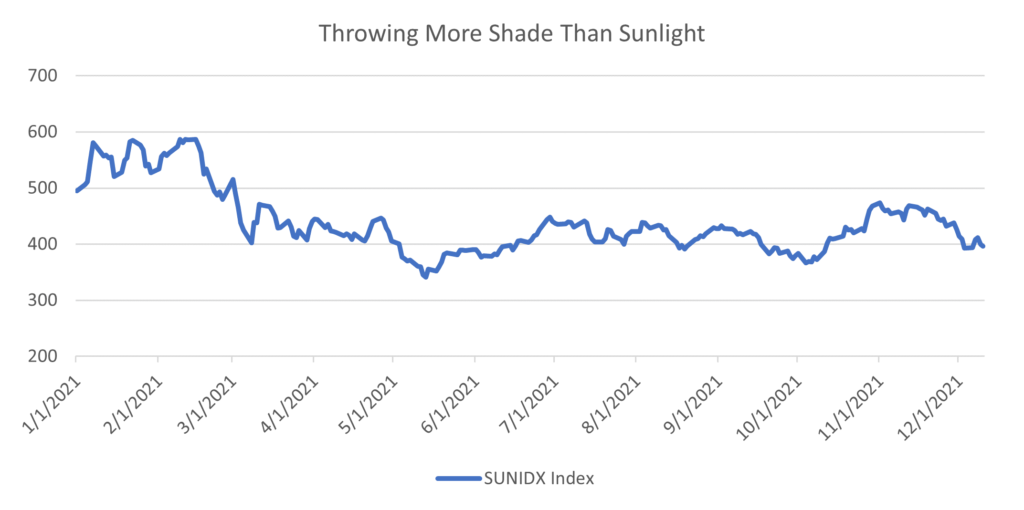
A popular global solar index the MAC Global Solar Energy Index (SUNIDX) and an ETF that tracks it (TAN) are both off 16% – 17% since November 1. Well-known index names are down 20% – 31% from November 1 to the close last Friday. HDRO is down 21% in the timeframe, an ETF with hydrogen and other “next-generation” energy names. You get the picture. To make sure we did, our colleague John Roque scored SUNIDX members from a technical standpoint. John’s work points to an overall weak group with a few strong names therein. Look for this sub-sector to pop if BBB becomes law this year, and for its holders to hope our Scenario Two remains viable.
Under-Powered
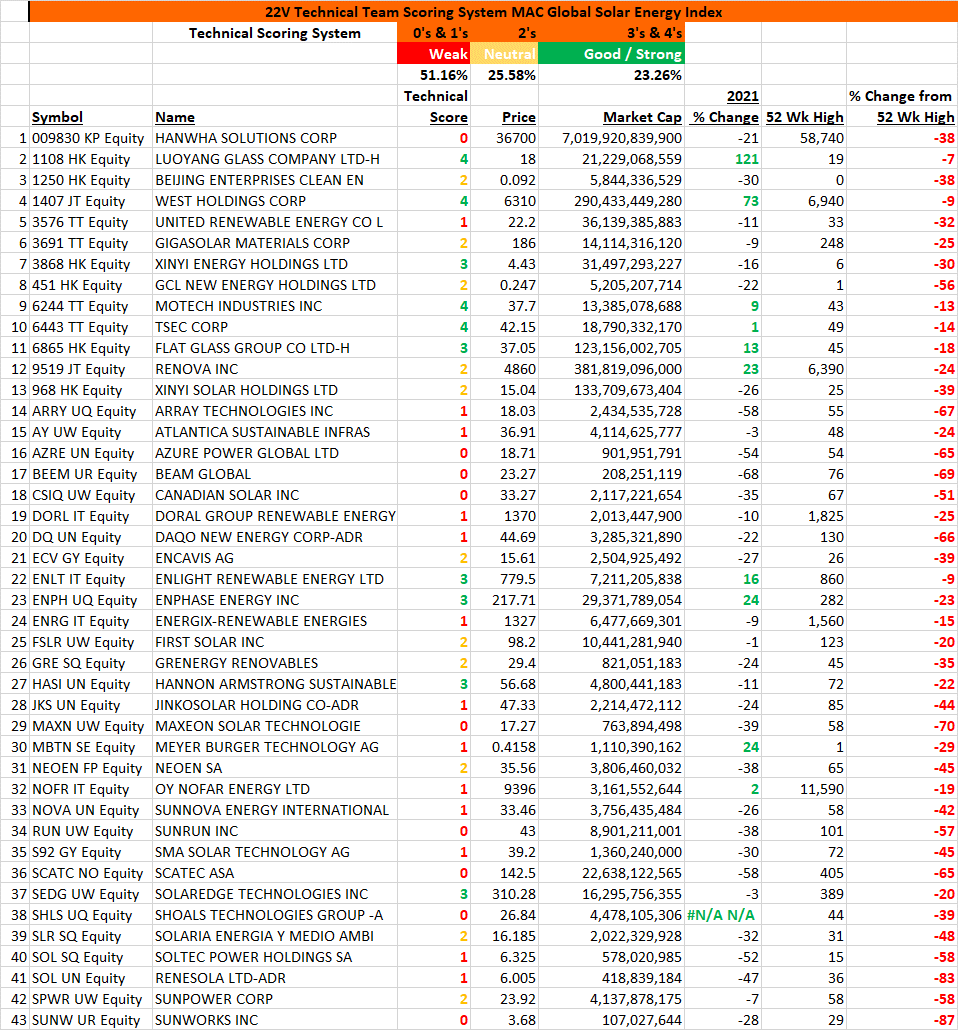
Source: 22V Research
Scenario Analysis
Our view of BBB’s outcome leans on history, policy prerogatives, and politics. A few caveats are in order. When we speak of BBB as the sixth major fiscal agenda proposal of first-term presidents offered in their first year under 1980 reconciliation law, we exclude the March 2021 American Rescue Plan. It was largely a holdover of unconsummated 2020 negotiations between Senate Majority Leader Mitch McConnell and Speaker Nancy Pelosi. Also, George H. W. Bush’s 1989 fiscal agenda wasn’t transformative. President Obama is the only one who’s signature first-year economic thrust, healthcare reform, spilled into the second year since the enactment of reconciliation legislation.
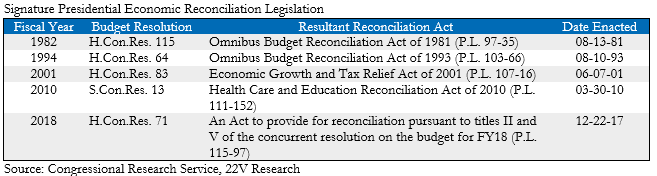
That was a brutal process but succeeded ultimately because (a.) it promised wider healthcare coverage, (b.) Majority Leader Harry Reid had a firm grip on his caucus, greatly strengthened by having 57 votes precluding a veto to any would-be kingmaker from within that majority, and (c.) deflation not inflation was the worry. Nearly everything in 2021 is different from 2010, and the other four cases for that matter. The following table shows presidents Ronald Reagan, Bill Clinton, George W. Bush, and Donald Trump advanced signature economic legislation in their first year.
Our sense of the policy and political aspects of BBB hasn’t changed. Democrats embraced the bulk of Biden’s original $3.5 trillion bill, the $2.1 trillion bill adopted last summer by the House Ways and Means Committee, and the roughly $1.7 trillion bill that passed the House this fall. Despite a few Senate Democrats’ concern about fueling inflation (a topic we doubt any politician understands better than Treasury Secretary Janet Yellen), the politics of failing to enact BBB now carries the same risk it did during summer and fall conversations. Omicron uncertainty qualifies as a new economic risk which might strengthen the case for additional bolstering of working family households. SALT restoration or modification isn’t popular with many Democrats but the politics of it are irrefutably consistent with inclusion in a shrunken but balanced bill across the barbell we mentioned.
Outlook
The complications confronting Democrats this week and next are myriad but that’s the price of being in the majority with your first year, first-term president. Any Byrd Rule violation will quickly fall by the wayside, possibly streamlining Senate consideration and maybe highlighting House/Senate differences as a risk causing the House to reject the Senate bill, leading to Scenario Two.
That would have Congress set to return on January 10 to pass a similar bill before the January 15 expiration of child tax credits, or a strategy for doing so in February. We continue to believe Scenario Two’s game theory rests on weak strategic assumptions. President Obama had a large Senate margin; President Biden does not. Going home this month without completing BBB risks inviting a lobbying feeding frenzy in which sharks, vultures and other metaphorical actors tear apart sections of the bill which had kept the process together the past half year. That known risk could easily lead to Scenario Three in which Democrats spend most of 2022 attempting to explain to their base why nothing was built back better in 2021.

