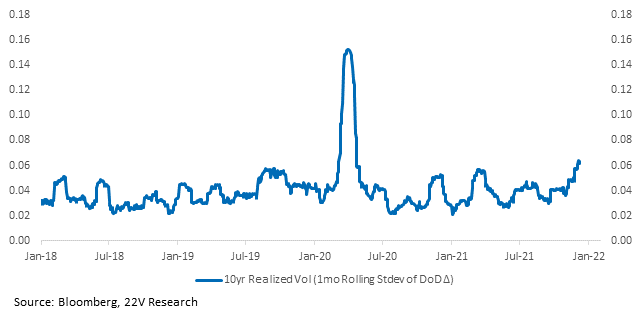
SUMMARY: Market internals are volatile. Our Recovery Portfolio underperformed yesterday and growth and earnings turbulence factors outperformed as the market rallied. The lack of clear COVID data is showing its effect. Implied and realized volatility of 10yr yields is at its highest level since the pandemic, contributing to the volatility in market leadership. Covid fears easing would remove a significant headwind to 10yr yields. We got some positive news from Pfizer this morning; a Pfizer booster increases antibody response while two doses may still prove effective protecting against severe illness. We still do not have a percentage estimate of efficacy. Investors we speak with expect ~50-60%. Higher would be a tailwind to 10yr yields. Fair value for the S&P implies upside for the index even if the 10yr were to increase to 3.25% (above the maximum estimate in the Blue Chip consensus for 2022 or 2.8%).
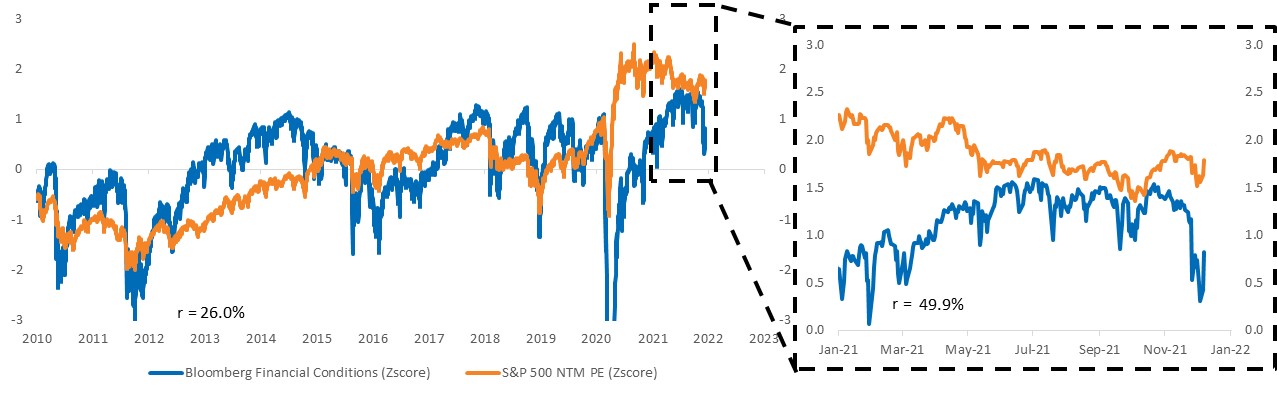
Earnings were the driving force behind equity gains this year as PEs contracted slightly even as overall financial conditions eased. Over the past few days, we have seen a rebound in PEs in part due to a reversal of the financial condition tightening that followed the Fed policy shift and rise of Omicron. With the fed widely expected to tighten next year, financial conditions are likely to tighten some as well. That will put increased pressure on earnings to carry equities higher.

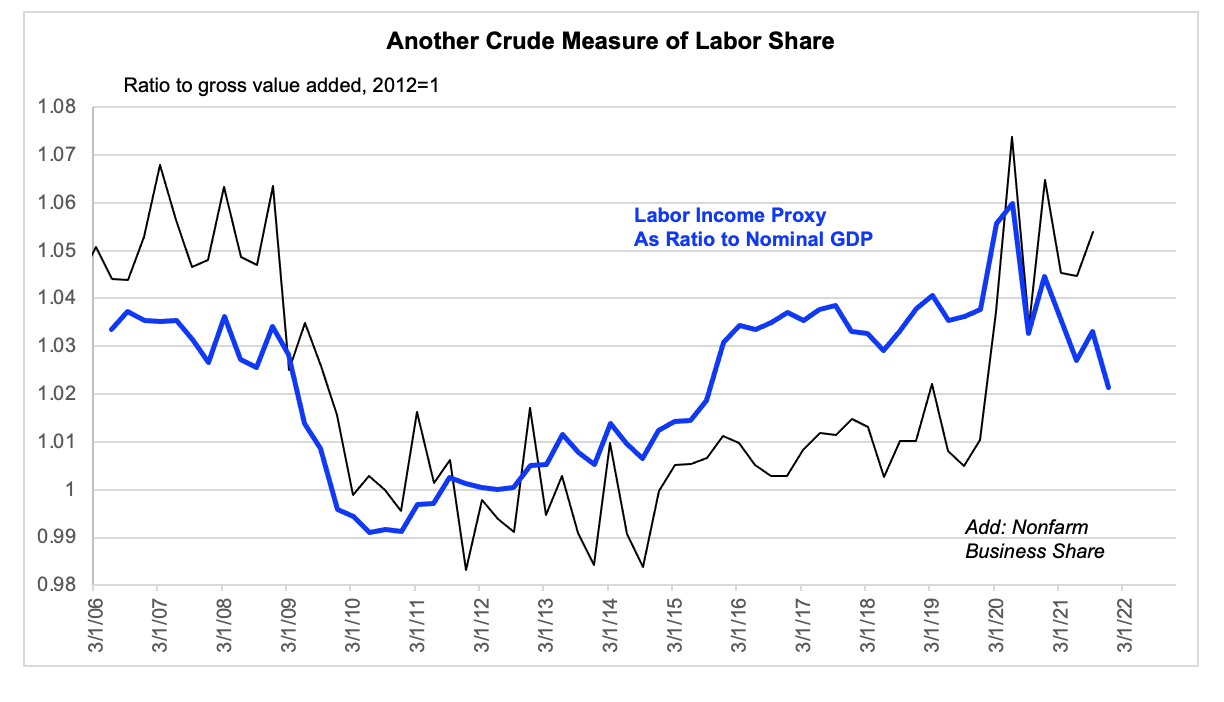
Margins have consistently surprised to the upside over the past several quarters, and as Gerard has noted, “there is little reason to suspect that margins will have weakened during the fourth quarter. The combination of strength in real output and continuing pricing power strongly suggests that the business sector’s value added has boomed, outright and relative to fixed costs and even labor costs…” So expect more upside surprises to EPS when 4Q gets started next month. Near term, the risks to earnings are tilted toward the upside. But later in 2022, the risks become more negative. Wage and productivity data will determine the path of S&P EPS revisions in 2H22.
Companies are planning for steep wage increases next year, according to a new report, amid a tight labor market and the highest inflation in three decades. According the WSJ the Conference Board is expected to release data today showing “that companies are setting aside an average 3.9% of total payroll for wage increases next year, the most since 2008.” So far, consumers do not expect their incomes to rise next year, which is unusual give the collapse in the urate. Arguably, consumers expect their incomes to be restrained by rising inflation. Consumer inflation expectations could impact spending (so far retail sales have remained robust), but they are not an important signal about the future path of prices.
MARKET VIEWS: As we discussed yesterday, investors are reducing tail risk positioning. Credit tightened again and the cost of extreme downside hedges normalized some. But the internals were messier; our Recovery Portfolio underperformed, dragged lower by Airlines, and growth and earnings turbulence factors outperformed. The lack of clean COVID data is showing its effect. Implied and realized volatility of 10yr yields is at its highest level since the pandemic, contributing to the volatility in market leadership.
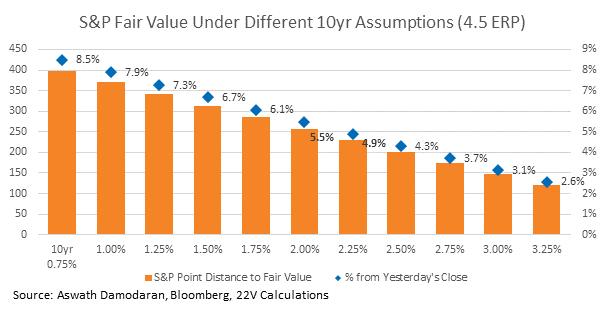
Covid fears easing would remove a significant headwind to 10yr yields. We got some positive news from Pfizer this morning (after mixed news about vaccine efficacy yesterday); a Pfizer booster increases antibody response to Omicron 25-fold compared to two doses, while two doses may still prove effective protecting against severe illness. We still do not have a percentage estimate of efficacy. Investors we speak with expect ~50-60%. Higher would be a tailwind to 10yr yields. Fair value for the S&P implies upside for the index even if the 10yr were to increase to 3.25% (above the maximum estimate in the Blue Chip consensus for 2022 or 2.8%).
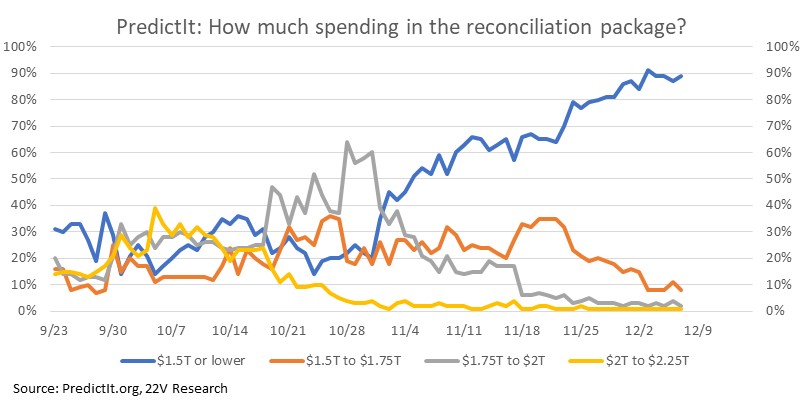
If Omicron concerns continue to fade, attention will shift back to the Fed and the outlook for growth. Kim Wallace still expects the U.S. reconciliation bill to come in between $1.5-1.7tril. That would be an upside surprise relative to betting markets. PredictIt puts the odds of a $1.5tril or less (which includes no passage by year end) at just under 90%.
STRONG NEAR TERM EPS: Earnings were the driving force behind equity gains this year as PEs contracted slightly even as overall financial conditions eased. Over the past few days we have seen a rebound in PEs in part due to easing of the financial condition tightening that followed the Fed shift and rise of Omicron. With the fed widely expected to tighten policy next year, overall financial conditions are, likely to tighten some as well. That will put increased pressure on earnings to carry equities higher.
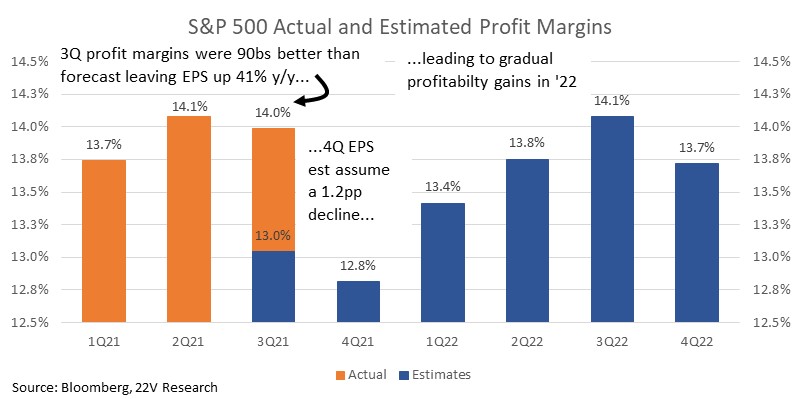
Consensus estimates imply a 1.1pp decline in S&P margins in 4Q. If margins remain steady relative to the first 3Qs of 2021, actual S&P EPS in 4Q will beat expectations by $4 and index level earnings will end 2021 around $208. Margins are expected to contract in early 2022 as well.
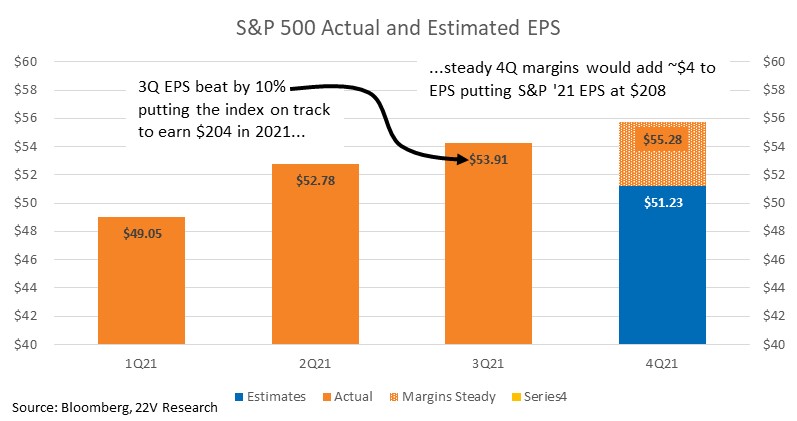
Margins have consistently surprised to the upside over the past several quarters, and as Gerard has noted, “there is little reason to suspect that margins will have weakened during the fourth quarter. The combination of strength in real output and continuing pricing power strongly suggests that the business sector’s value added has boomed, outright and relative to fixed costs and even labor costs…” So expect more upside surprises to EPS when 4Q gets started next month.
Source: IHS Markit, BLS, FH calculations
Consensus estimates forecast profitability to remain low in early 2022 and improve as the year progresses. That seems to be a result of the same miscalculation about margin pressures (that inflation in necessarily bad for corporate profitability) and an assumption that inflation fades in late ’22. But as Gerard notes “the Fed correctly views “pricing power” as inflation and now has reduced tolerance of either.” Near term, the risks to earnings are tilted toward the upside. Later in 2022, the risks become more negative. Wage and productivity data will determine the path of S&P EPS revisions in 2H22.
Since the start of 2021 the unemployment rate has fallen to 4.2% (down 2.5pp). Companies are planning for steep wage increases next year, according to a new report, amid a tight labor market and the highest inflation in three decades. A survey by the Conference Board set for release Wednesday finds that companies are setting aside an average 3.9% of total payroll for wage increases next year, the most since 2008. So far, consumers do not expect their incomes to rise next year, which is unusual give the collapse in the urate.
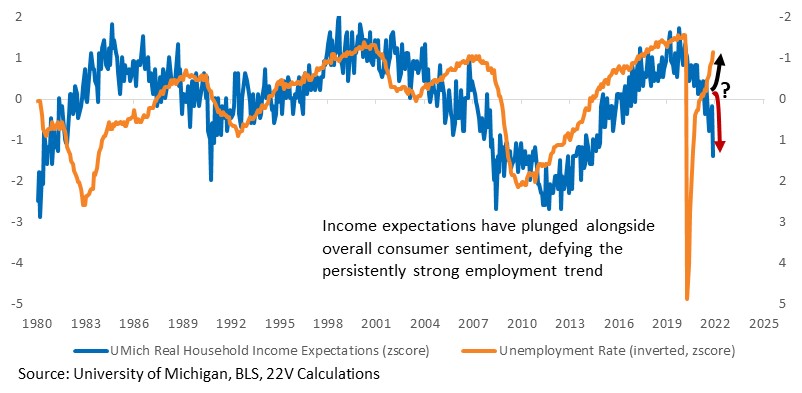
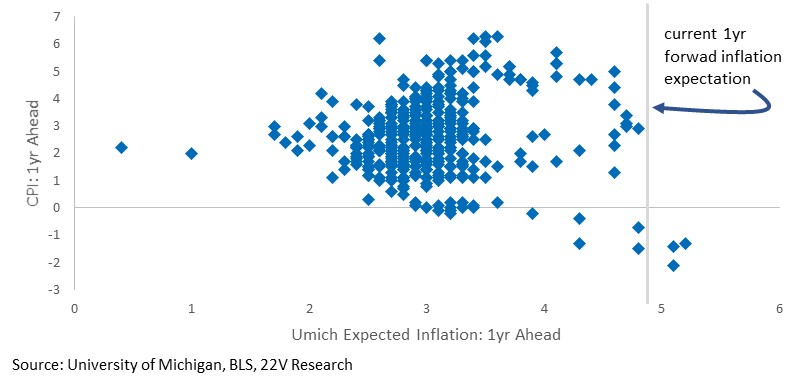
Arguably, consumers expect their incomes to be restrained by rising inflation. Consumer inflation expectations have shot higher, but it is important to keep in mind that consumers are NOT good at forecasting inflation. Historically, there is almost no relationships between consumer’s year ahead inflation expectations and actual inflation. Price pressures have clearly been stronger than economists expected, and persistent supply chain bottle necks are doing little ease those pressures. Consumer inflation expectations could impact spending (so far retail sales have remain robust), but they are not an important signal about the future path of prices.