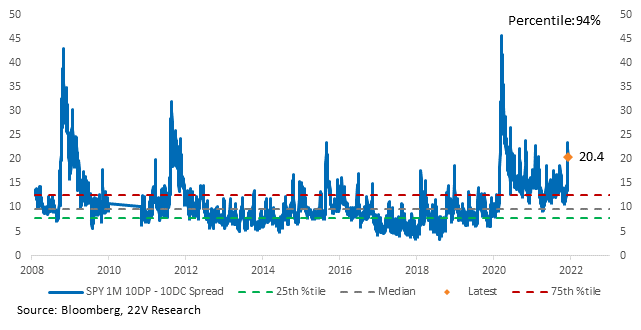
SUMMARY: Investors approached the shift in Fed policy and the emergence of Omicron reasonably, rotating out of the most speculative areas of equities, taking a more defensive factor stance and buying extreme downside protection (the price of 10 delta puts shot higher relative to 10 delta calls). Case growth from the latest variant continues to increase and we still do not have enough information to determine severity. China related risks continue to increase as Evergrande’s default saga carries on; it missed the 30-day grace period for an offshore bond. Kaisa, a smaller property developer, is unlikely to meet its $400 million offshore debt deadline today as well. But investors are starting to reduce tail risk positioning. Investors we talk to expect vaccine efficacy against omicron to be very low (~50-65%). Higher than that is a tailwind for reopening stocks and even more so for 10yr yields, which are used as a left-tail hedge. If vaccine efficacy is much higher than 60%, big omicron case growth numbers will have less of an impact on risk assets. That noted, if case growth numbers remain large, there is still political and hospitalization risk (out of sheer volume) that will have an impact on risk assets shorter-term.
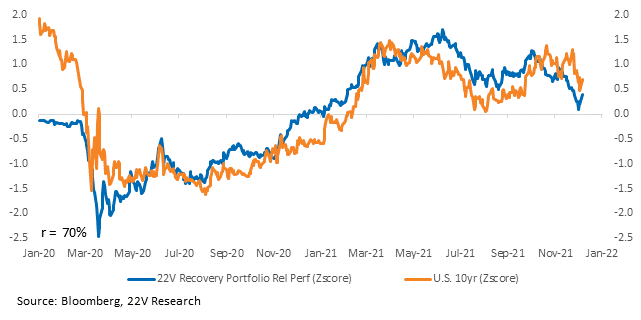
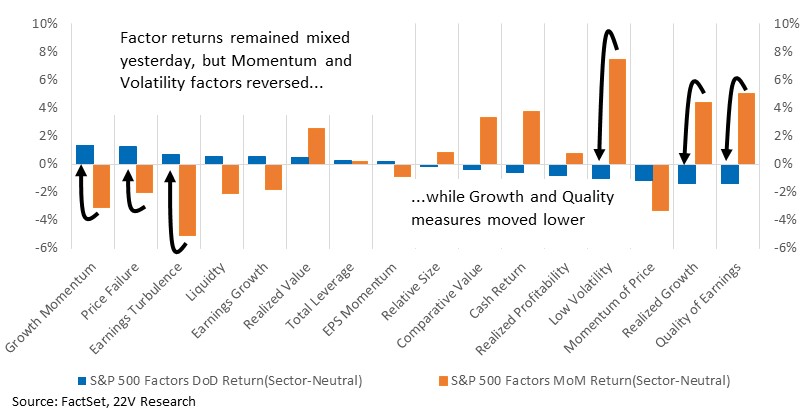
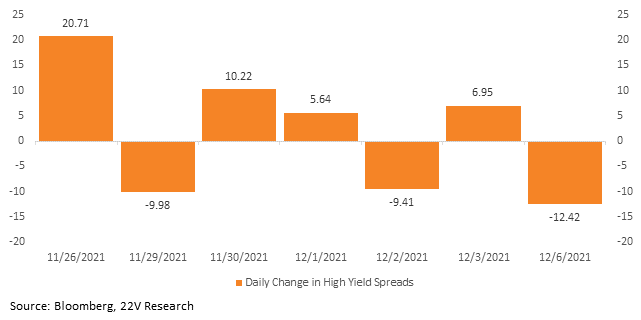
Determining the impact of Omicron will take time and headlines about lockdowns (France) and expanded vaccine mandates (NYC) indicate it is too early to determine the full impact of the current wave. But internals are starting to clearly reflect investor expectations of a modest economic outcome. High yield spreads have moved lower, Baa spreads have collapsed (down -21bp in a little over a week) and Reopening stocks are rallying (+5.2% yesterday). Market internals have firmed. Earnings Turbulence, Momentum and risk-on factors recovered yesterday. Low Volatility and high-Earnings Quality names, which led in November’s de-risking, declined yesterday and that should continue as tail risk is reduced.
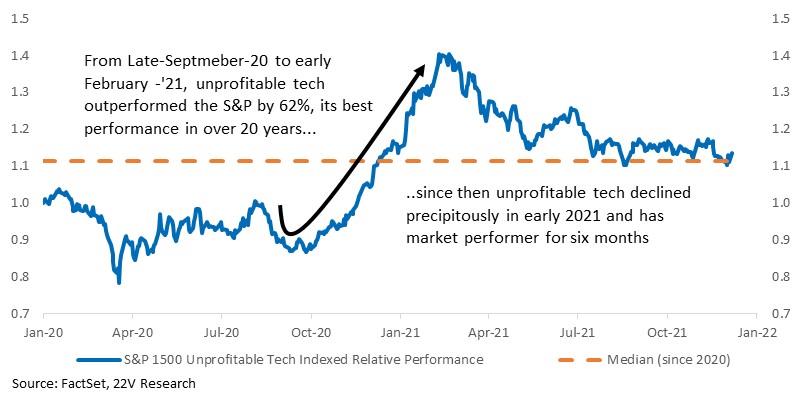
Keep in mind that weakness in unprofitable tech names is not a new phenomenon, it is a return to the normal state of affairs. The 62% relative outperformance of unprofitable tech from late-Sep ’20 to early Feb ’21 was the best performance for the group in at least 20 years. Spec tech, which is dependent low real rates and a long tail, faces persistent headwinds from the shift in the Fed’s tone.
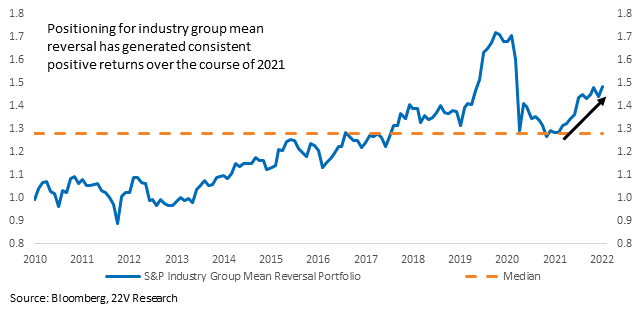
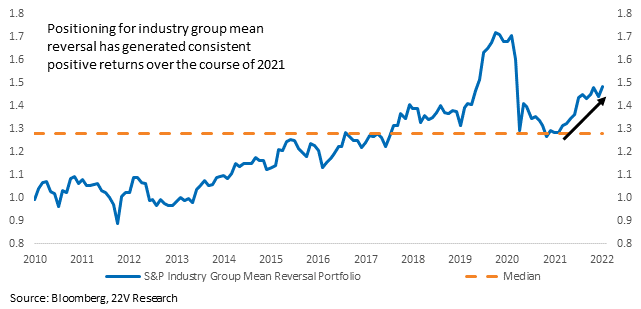
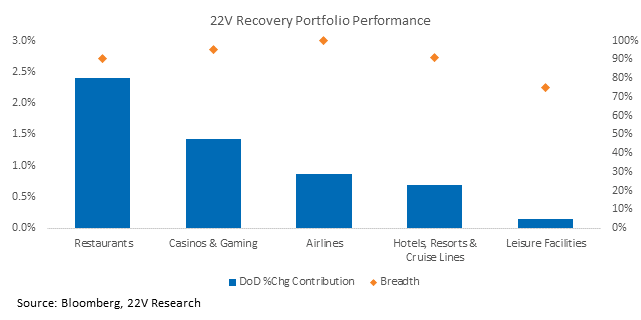
Also, sharp industry group rotations have been the norm in over the past year, not the exception. Industry groups that led in one month have tended to be among the worst performing industry groups in the following month. Semis, Tech Hardware, Retail and Autos were the top performers in November, so some reversal should be expected. The same mean reversal tendency is a tailwind for Banks, Energy, Healthcare Equipment Insurance and Staples, the worst performing groups in November. And our Recovery Portfolio bounced yesterday, recovering +5.2%.
In the full report we also detail our latest thoughts on the omicron outbreak.
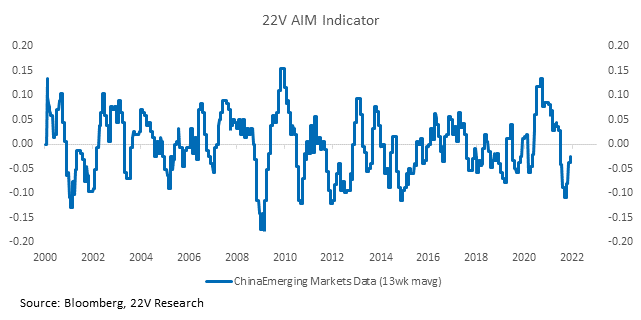
MARKET VIEWS: China’s exports and imports both beat expectations. China, Taiwan, and South Korea exports all surged in November, which is consistent with strong global goods demand. The Communist Party emphasized macroeconomic stability at the conclusion of its Politburo meeting and signaled a loan prime rate cut is likely to follow the PBOC’s reserve ratio cut. Risk-assets are embracing better data and sentiment today (some of China’s large-cap stocks saw record bounces). As we highlighted yesterday, it is tough to get excited about China-levered stocks until the credit impulse improves but being short those names is becoming more difficult as China eases policy AND the breadth of economic data in China rebounds.
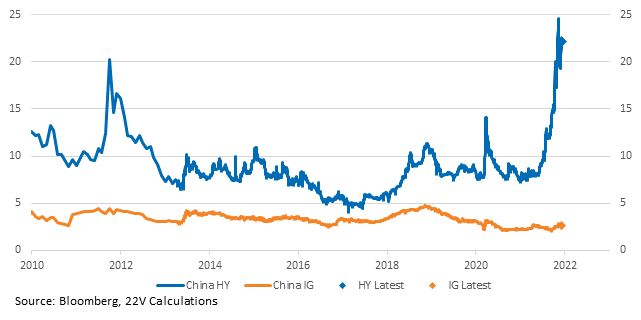
The Politburo said it would boost the healthy development of China’s real estate sector and dropped (at least temporarily) anti-speculation rhetoric but headline risk from the property sector remains. High yield credit spreads have widened again. Evergrande’s default saga carries on; it missed the 30-day grace period for an offshore bond. Kaisa, a smaller property developer, is unlikely to meet its $400 million offshore debt deadline today as well.
Investors we talk to expect vaccine efficacy against omicron to be very low (~50-65%). Higher than that is a tailwind for reopening stocks and even more so for 10yr yields, which are used as a left-tail hedge. If efficacy is much higher than 60%, big omicron case growth numbers will have less of an impact on risk assets. That noted, if case growth numbers remain large, there is still political and hospitalization risk (out of sheer volume) that will have an impact on risk assets shorter-term.
Equity market volatility has increased and investors are concerned that the rotation out of spec tech names will translate into a broader market selloff. But the weakness in unprofitable tech names is not a new phenomenon, it is a return to the normal state of affairs. The 62% relative outperformance of unprofitable tech from late-Sep ’20 to early Feb ’21 was the best performance for the group in at least 20 years. Spec tech (ARKK, Meme, Twitter, etc.), which is dependent low real rates and a long tail, faces persistent headwinds from the shift in the Fed’s tone, but the general weakness in unprofitable tech and unprofitable companies in general is less an internal shift and more a return to normal.
But sharp industry group rotations have been the norm in over the past year, not the exception. Industry groups that led in one month have tended to be among the worst performing industry groups in the following month. Semis, Tech Hardware, Retail and Autos were the top performers in November, so some reversal should be expected. The same mean reversal tendency is a tailwind for Banks, Energy, Healthcare Equipment Insurance and Staples, the worst performing groups in November.
Market internals measured at the factor level have started to improve as well. Low Volatility and high Earnings Quality names led in November as investors de-risked while digesting the shift in the Fed’s stance (from pushing for to tolerating higher inflation) and the emergence of Omicron. Earnings Turbulence, Momentum and other risk factors, which been performing well, declined rapidly.
The cost of hedging against a 10%-probability decline in the S&P is still extreme relative to a 10%-probability increase.
If Omicron leads to a higher severity wave than previous COVID variants, there is downside risk to economic activity and risk assets. But investors have started to reduce tail-risk equity positioning. Our Recovery Portfolio increased +5.2% yesterday. The breadth of recovery names increasing has been strong as well.
Yield spreads are narrowing too.
OMNICRON WATCH: Levels are also important, and this wave has started from very low levels of infections and hospitalizations.
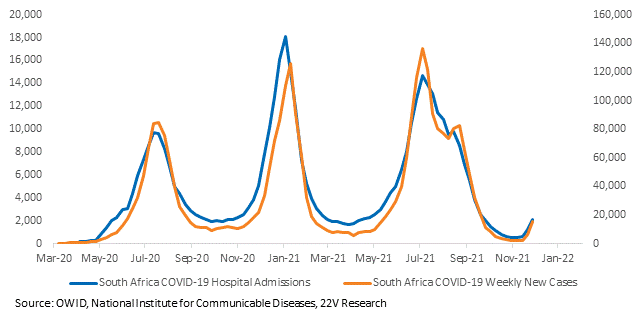
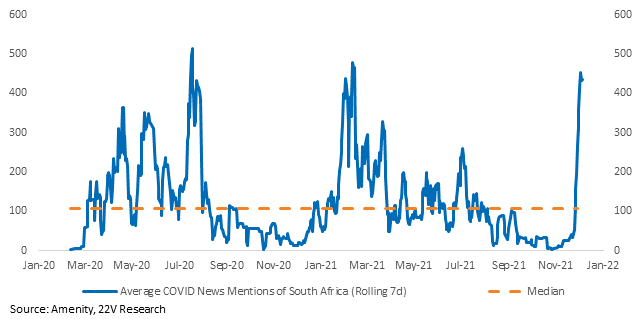
It’s important to assess the data we are all relying on. The attention people are paying to South Africa’s covid outbreak has skyrocketed. But the data that is being extrapolated to the rest of the world is from a province in South Africa that accounts for ~26% of the population of South Africa (and ~0.2% of the global population). And South Africa is not necessarily representative of the global picture. South Africa’s human development index (an admittedly imperfect metric) ranks 115th globally. Life expectancy is 15 years below the U.S. The point is that what is happening in South Africa is not necessarily the fashion in which omicron will play out elsewhere, like in Europe and the U.S.
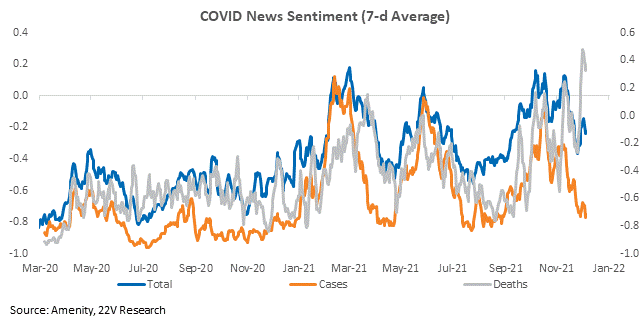
Sentiment toward case growth has collapsed, which is consistent with rising global case growth. But sentiment toward severity, in this case hospitalizations, has actually been improving.