
US legislators and regulators are focused on the strategic, economic, employment, and manufacturing base implications of the country’s microelectronics position. The pandemic exposed the frailties of offshoring production of semiconductors and other microelectronics, and STEM education under-investment over the past few decades.
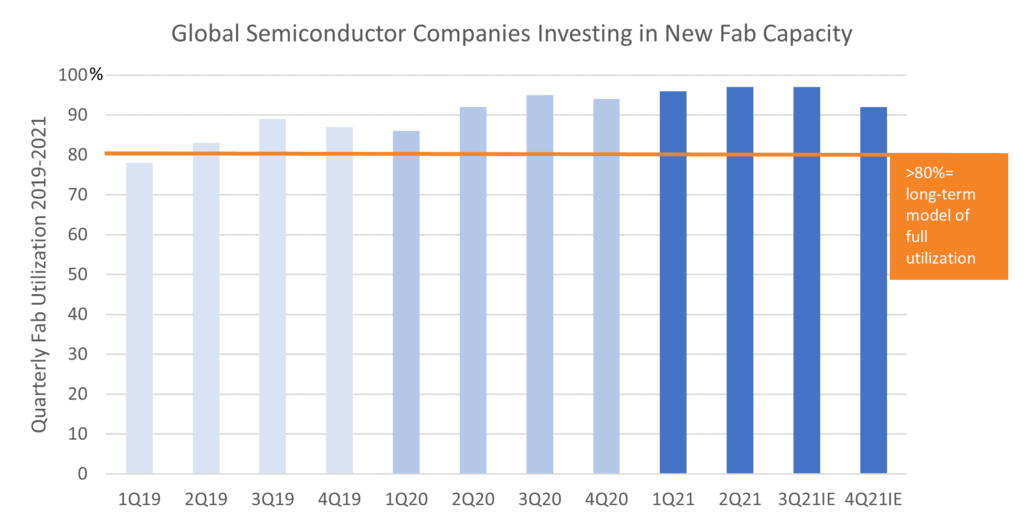
The House Committee on Science, Space and Technology held a hearing yesterday on “appropriate” steps necessary to enhance America’s position in support of this critical public/private partnership. Restoring domestic innovation and manufacturing investment and capacity is the objective. Capacity utilization rates of semiconductor manufacturers the past ten quarters has exceeded 80% and, in some quarters, more than 90%, underscoring the case for investment.
A bipartisan Congress, as well as the Trump and Biden administrations for nearly two years have passed and enacted legislation focused on the challenge. Washington’s history of partnering with microelectronic innovators escalated near the end of WWII, much of it through the Advanced Research Projects Agency (ARPA) which soon added the Defense Department’s ‘D’ to form (DARPA) a unit that since the late 1980s has managed much of the US investment, as well as the benefits of that capital.
Pandemic-related global value chain disruptions have spurred Germany, China, Japan, Taiwan, South Korea, and other economic and geostrategic competitors to invest in chip manufacturing. Top-down actions include competition policy. The Federal Trade Commission also yesterday sued to block NVIDIA’s proposed acquisition of UK chip designer Arm on grounds that the vertical transaction would “stifle innovation of next-generation technologies.”
The multi-step semiconductor production sweet spot seemingly is within the integrated device manufacturers of which three are headquartered in the US: Intel, Micron, and Texas Instruments. Washington is attempting to invest in this space, and incent private investment, while avoiding trade rule violations and the political downsides of what can only be viewed as industrial policy.
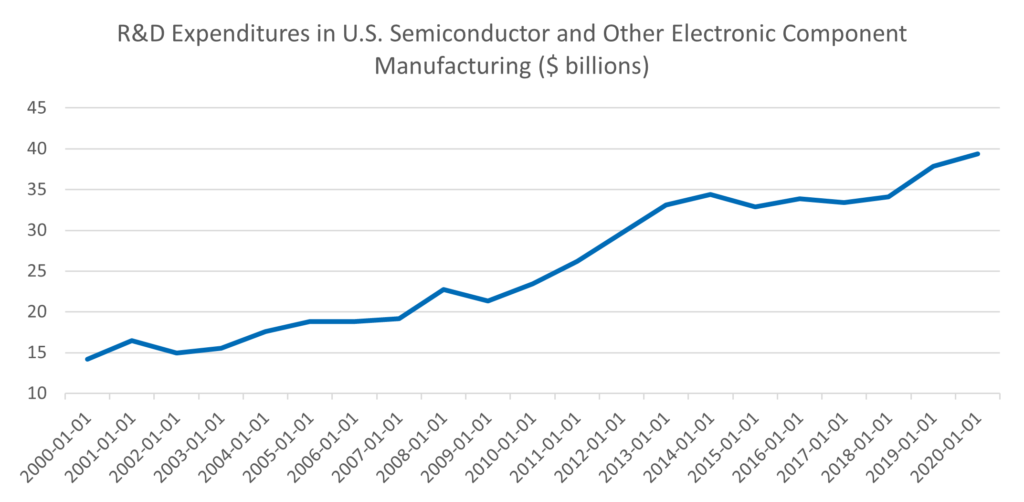
On Tuesday, the Department of Commerce established an industrial advisory committee to be managed by the National Institute of Standards and Technology (NIST). The growth of private sector R&D investment has averaged a nominal $1.25 billion annually since the start of this century. Government actions before and after supply chains broke would suggest more would be beneficial.
In 2019, the Pentagon released an unclassified summary of the Department’s Trusted and Assured Microelectronics implementation plan designed to ensure evolving national security needs are met. The summary points follow:
We expect that the Nord Stream 2 politics currently stalling final passage of the 2021 National Defense Authorization Act will be resolved this month, especially because of the increasing momentum to secure microelectronic product for national security. The House/Senate impasse on passing the Innovation and Competition Act this month or next quarter will get caught in the same momentum.

