
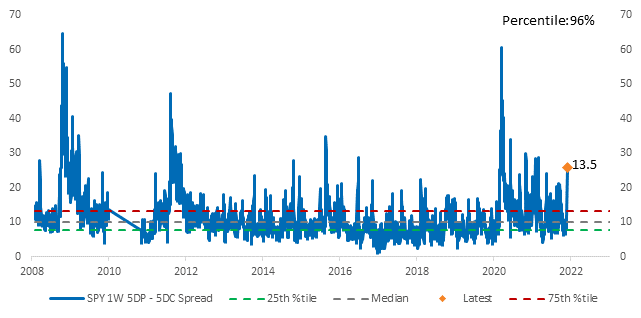
SUMMARY: Investors are digesting the political reactions to the Omicron variant (travel restrictions increased meaningfully), but likelihood (for now, we are waiting on more data) that severity is unlikely to be much worse (see here, here). Fiscal impulse in Europe and Japan and strong consumer/Capex trends in the US are supporting developed world demand, limiting the economic impact from travel restrictions and reducing volatility near term. FYI…the price spread between a 5% probability decline and a 5% probability increase over the next 5 days has moved significantly higher. In other words, investors are paying far more for protection against a severe decline than for a strong rally over the next week. We would fade that fear.
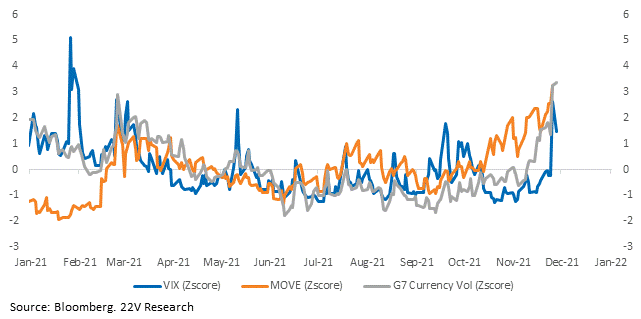
It’s Complicated Though: Coming out of previous COVID waves the Fed was max dovish. This time around, the rate hike expectations that have been priced out will be priced right back in as/if Omicron concerns fade. That helps explain why currency and bond volatility remain elevated this morning. Gerard had an excellent piece yesterday on why the Fed is likely to worry about inflation being too high. Gerard has a central case of core inflation ending 2022 at 2.8% and even if the Fed hits its target of 2.3% core by year-end 2022, the eventual achievement of full employment (highly likely next year) would imply policy should be moving toward neutral (keep in mind that most economist are 2.5% or above on core PCE in 2022). The good news, real implied high yield rates are low relative to history, S&P fundamentals are strong and have been driving returns, and the implied equity risk premiums suggest fair value is higher even if the 10yr yields move well above 2%. The equity market backdrop is more complicated, not negative.
Focusing on the internals: After sharp drops in U.S. 10yr yields and VIX spikes, Growth factors and Momentum of Price tend to outperform (5 days and 1 month out) while Realized Value and Low Volatility tend to face headwinds. Interestingly Energy, Auto and Banks are the industry groups most exposed to Momentum currently. Also, The S&P remains unusually mean reverting. Industries that led in one month tend to see reversals in the following month. Banks, Energy and Media names stand to benefit most if there is another period of industry mean reversal in December.
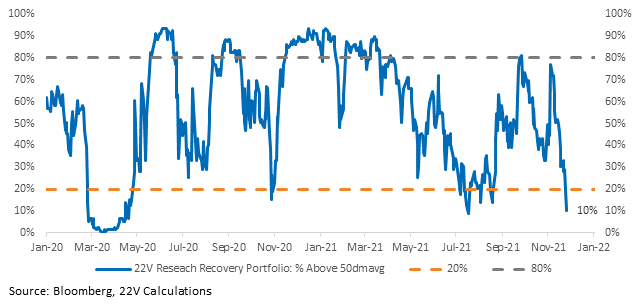
Lastly, 10% of reopening names are trading above their 50-day moving average. The history is short, but when that has happened in the post COVID era, reopening stocks have tended to outperform.
That’s it for the summary…full report and charts below.
MARKET VIEWS: Risk assets are higher as investors digest the political reactions to the Omicron variant (travel restrictions increased meaningfully), but the likelihood (for now, we are waiting on more data) that severity is unlikely to be much worse. The Chair of South Africa’s Medical Association, Angelique Coetzee, said symptoms were “extremely mild” and that sentiment was echoed by experts in Israel. The developed world (US, Europe and Japan) still have strong demand drivers (fiscal in Europe and Japan and strong consumer/Capex trends in the US), which helps limit the economic impact from travel restrictions and reduces volatility near term. FYI… the price spread between a 5% probability decline and a 5% probability increase over the next 5 days has moved significantly higher. In other words, investors are paying far more for protection against a severe decline than for a strong rally over the next week. We would fade that fear.
The complicated backdrop for risk assets remains the same though. Although we expect some near term recovery in equities, a surge to new highs seems unlikely. Coming out of previous COVID waves the Fed was max dovish. This time around, the rate hike expectations that have been priced out will be priced right back in as/if the Omicron impact fades. That helps explain why currency and bond volatility remain elevated this morning.
Gerard had an excellent piece yesterday on why the Fed is likely to worry about inflation being too high. Core PCE is unlikely to decline rapidly and that complicates the Fed picture going forward. Gerard has a central case of core inflation ending the year at 2.8% and even if the Fed hits its target of 2.3% core by year-end 2022, the eventual achievement of full employment (which is likely next year) would imply that policy should be moving toward neutral. The good news, real implied high yield rates are low relative to history….
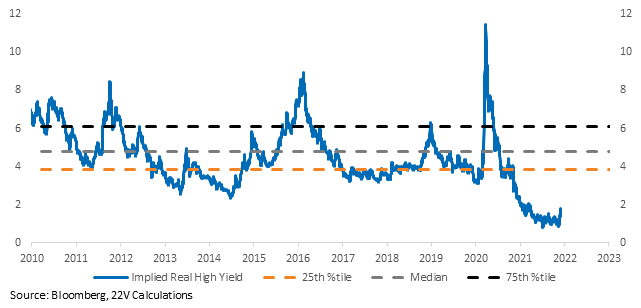
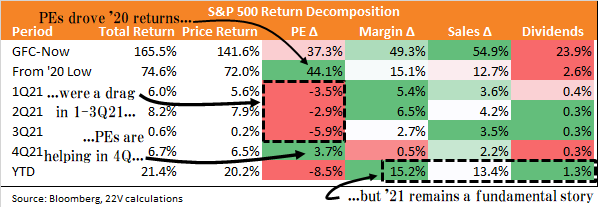
…and S&P earnings fundamentals are strong, so we don’t expect a large drawdown. Margins, sales and dividends have been the driver of returns in 2021, not PE expansion.
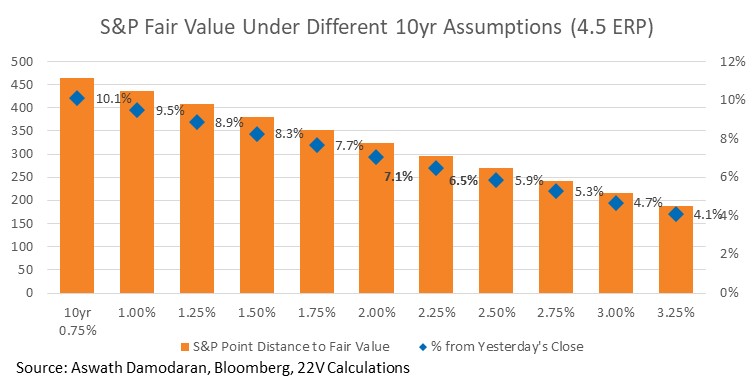
Assuming the implied equity risk premium stays near its current level, the S&P still has upside assuming the outlook for earnings growth and cash returns doesn’t change significantly. A higher implied equity risk premium is possible if investors view Fed tightening as likely to lead to sharper downside issues for economic growth.
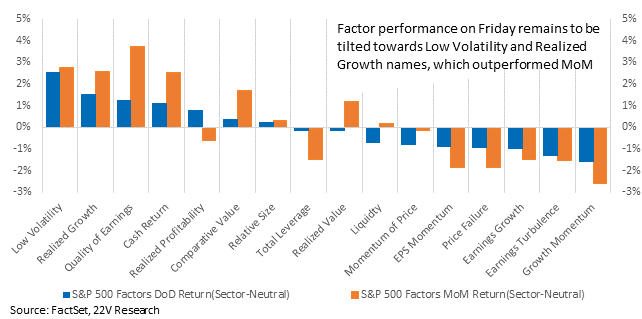
INTERNALS IMPORTANT FOCUS: The overall equity call is more complicated, which is why we are focused on the internals. As we noted in a Quant Report earlier today, although macro uncertainty increased significantly on Friday, factor performance followed the same trend over past week as the past month. Low Volatility, Realized Growth and Quality of Earnings remained the leadership. That could change near term given the sharp drawdown.
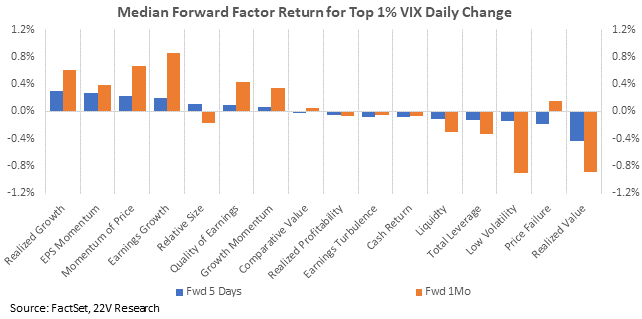
After sharp declines in U.S. 10yr yields and VIX spikes, Growth and Momentum factors typically gain while Realized Value and Low Volatility weaken. Looking at the VIX Realized Growth usually gains short term (5 days) following spikes. Earnings Growth has performed the best in the month following VIX spikes. Momentum factor performance is also strong. Realized Value and Low Volatility were among the worst performing factors.
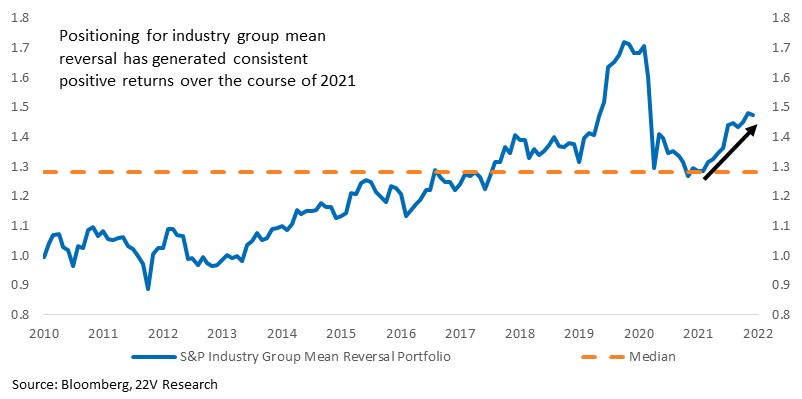
The S&P remains unusually mean reverting. Industries that led in one month tend to see reversals in the following month. Banks, Energy and Media names stand to benefit most if there is another period of industry mean reversal in December and are exposed to many of the factors that have outperformed in previous post sell off periods.
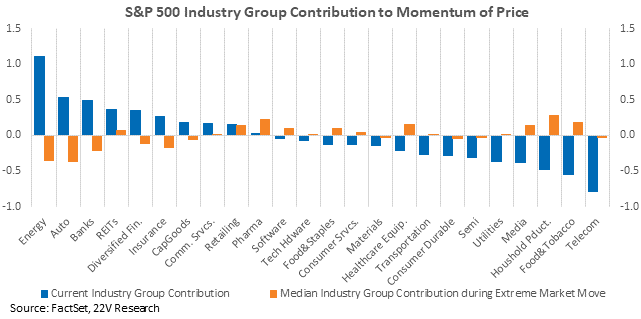
Interestingly, Energy, Auto and Banks are the industry groups most exposed to Momentum of Price. Energy has rebound significantly since last year, leading to high exposure to Momentum. However, falling oil prices (WTI is down -13.1%) are likely to overpower factor/industry rotation related tailwinds for Energy.
FYI on reopening. Reopening names have underperformed significantly and only 10% of reopening names are trading above their 50 day moving average. The history is short, but when that has happened in the post COVID era, reopening stocks have tended to outperform.


