
Policymakers continue to indicate digital money rules are necessary and coming. We continue to see this rules-setting evolution as constructive. SEC Chairman Gary Gensler’s wild west analogy remains useful. Back then, lawbreakers owned and controlled territory without regard for damage to others. The introduction of law enforcers empowered by national policymakers over time resulted in the development of physical and markets space, enriching many. The wild west wasn’t tamed as much as it was made tamer, safer overall. This risk mitigation led to outcomes like the State of California – a wealthy, vibrant territory still imperfect but nonetheless attractive.
Transatlantic policy is very attuned to creating a tamer, safer place for digital money platforms, and people to innovate without creating systemic risk. As best as we can discern, those regulators continue to focus on creating necessary safeguards without crushing technological and legitimate financial innovation. If we’re reading this correctly, rules-setting on whole will prove positive.
The broad subject gained attention in the Federal Reserve System’s annual financial stability report. As a recent speech by Governor Christopher Waller on stablecoins indicates, there is a persistent, if varied, focus on this subject by board governors and bank presidents. On Tuesday, national bank regulatory agencies updated progress on their path to issuing rules in a Joint Statement on Crypto-Asset Policy Sprint Initiatives and Next Steps.
Congressional interest hasn’t slowed. Also on Tuesday, Senate Banking Committee Chairman Sherrod Brown requested data from a handful of the largest stablecoin issuers and exchanges including Circle Coinbase, Gemini, Paxos, TrustToken, Binance. US, and Centre. The takeaway line in his letter: “I have significant concerns with the non-standardized terms applicable to redemption of particular stablecoins, how those terms differ from traditional assets, and how those terms may not be consistent across digital asset trading platforms.” Responses to the committee are due by December 3.
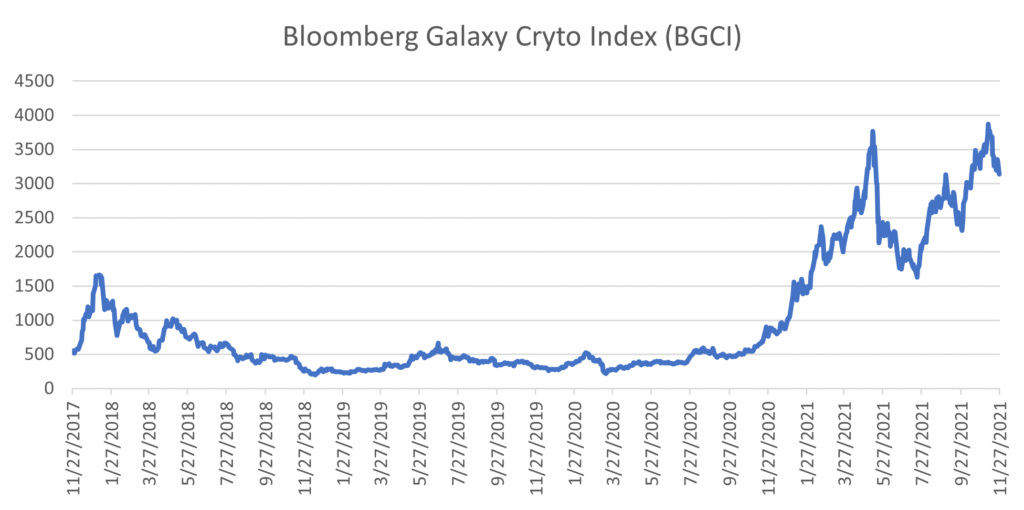
The newest Covid-19 variant shock reportedly verified in South Africa about two weeks back is rocking global asset markets today. Digital money players have been hit hard. Early Friday morning eastern time, Ether was off 9%, while Bloomberg’s Galaxy Crypto Index fell more than 7%, and is down 19% since November 9. We expect that the wild west will remain vulnerable to wide swings so long as participants operate outside a rulebook meant to weed out the feeble and criminal from well-capitalized, demonstrably safe ones.
A reasonably constructed digital money rulebook supports the marketplace for innovation and widespread utility. This view rests on policymakers correctly establishing safeguards, which means avoiding overreach. Governor Waller’s speech near the end draws a straightforward and illuminating distinction between lending and payment activities. This is an example of the clear lines that can be drawn in rulemaking. Even if iterative, the process at times seems overwhelming. We anticipate a comprehensive, fast-moving approach for two related reasons: the marketplace has moved swiftly the past four years, and macroprudential regulators’ deliberations have lagged the marketplace.
Eventual and sustained winners will employ technology, strong balance sheets (including transparent liquidity and capital buffers), and facile operation within rules designed to protect taxpayers and investors. Those playing at the edges of either finance or rules will remain vulnerable to shocks from both systems.

