
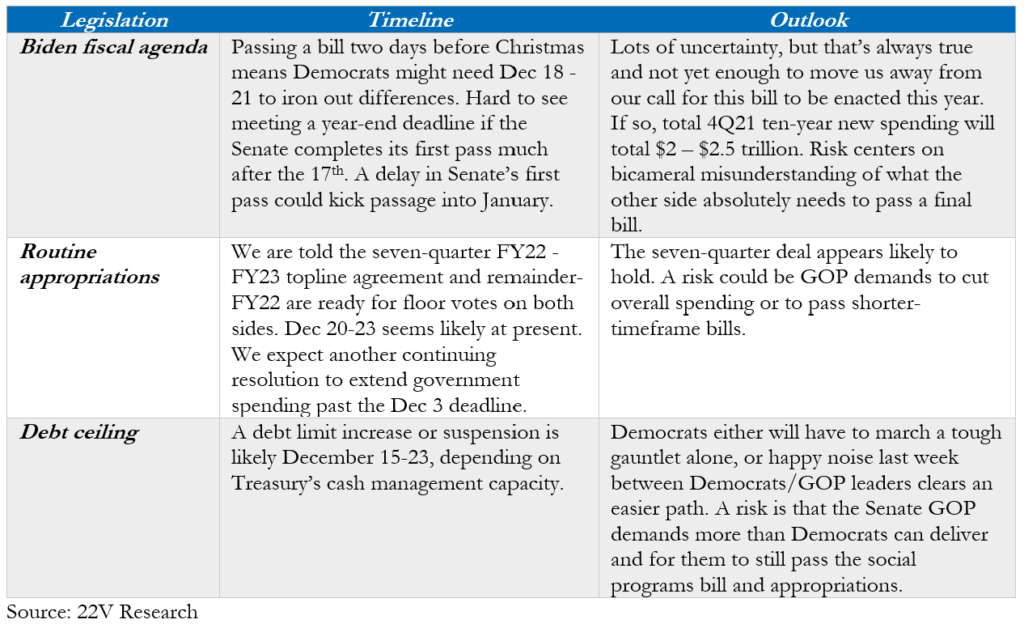
Plenty of uncertainty envelops the process for getting the final three pieces of fiscal legislation sought by President Biden through the Senate and back to the House of Representatives before the 2021 calendar runs out. A NYT retrospective of how Speaker Nancy Pelosi managed House Democrats’ reconciliation bill through the chamber reminded us of a long-known fact about Senate deliberations: Majority Leader Chuck Schumer and Senator Joe Manchin reportedly long ago reached agreement on what was possible in the Senate.
While the details of their compact remain closely held, we know that the West Virginian publicly put a $1.75 trillion cap on the bill around the same time it was set. We are sticking with our $1.7 trillion estimate for what passed the House Friday morning. If that is accurate the numbers might suggest not much work left for the Senate to do. Nothing could be further from the truth. The Manchin-Schumer agreement likely does not include legislative language required to pass the House bill, such as paid family and medical leave which Manchin has said he opposes. Climate change and SALT tax provisions are examples of other legislative text that might need to change for the Senate to act.
We continue to see a $1.5 – $1.7 trillion range for the reconciliation bill that the Senate will pass likely the week of December 13. That same range applies to what the president is likely to receive in a final bill by December 23 or so, albeit toward the upper end of the range. Most significant negotiations will occur among Democrats, although it is clear some in Schumer’s caucus are keeping some GOP senators apprised of discussions.
Over the coming five weeks, Congress must pass the reconciliation bill pending in the Senate, a debt limit increase or suspension, and remainder-year FY 22 appropriations (with possibly topline numbers for FY23 as well).
Public opinion surveys still contain enough bad news for Biden to worry his staff and other supporters. But some polls offer some lift to Democrats’ mood. A recent Quinnipiac University poll shows 58% of registered voter respondents support the “roughly $2 trillion spending bill on social programs.” That is 23 points more than the president’s score on the economy, 20 points higher than his overall job rating, 32 points better than respondents rated Republicans in Congress, and 28 points more than they gave Democrats in Congress. Sentiment indicates the Democrats have much support to gain by passing the president’s social spending and investment package.

