SUMMARY: Questions about inflation took center stage again yesterday after headline CPI printed a 6.2% y/y gain, handily beating 5.9% consensus estimates. Shorter term and less volatile measures were no better. 10yr yields backed up 11bp, the USD increased 1.0% vs the Euro as volatility increased across asset classes. Stock volatility, which had been low relative to bond volatility, increased significantly on the day and Defensives/other recent laggards outperformed.
Gerard MacDonell, 22V’s economist, wrote “The inflation data remain difficult to read, because much of the price advance is still concentrated in goods that are being affected by supply-chain issues…” BUT “The aggravating influence of higher rents inflation is going to persist, perhaps for as long as a year.” The backdrop that Gerard describes will keep inflation uncertainty high for the next few months. Although CPI should decline next year as supply constraints ease (see the outperformance of companies with the most supply constraint headwinds), next month’s reading will likely be high again, so its tough to expect a sharp decline bond/USD volatility.
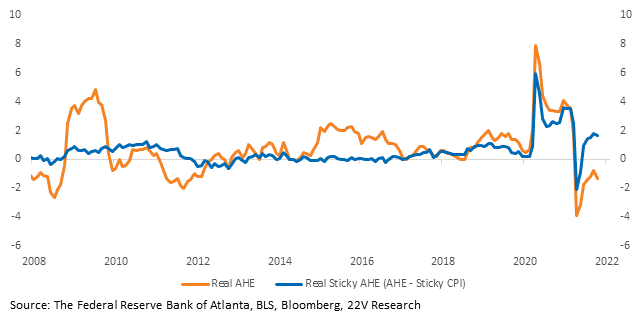
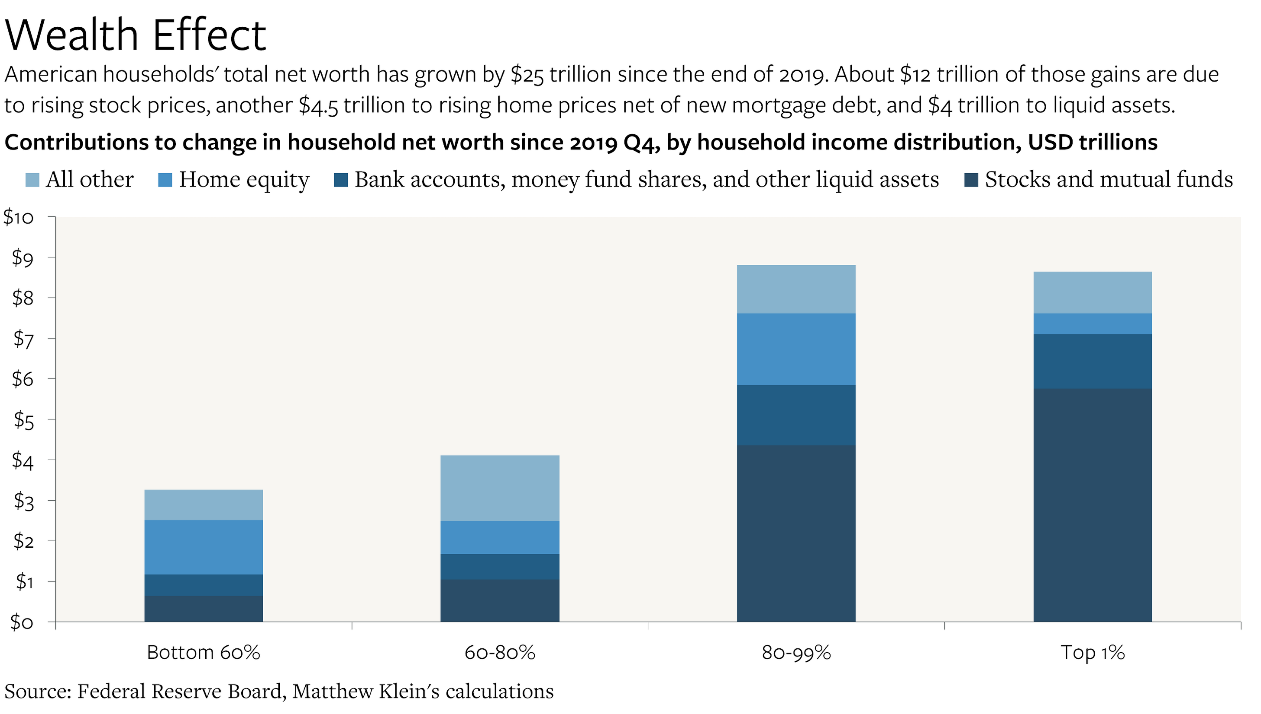
Demand growth (particularly consumption growth) remains strong. Don’t get caught up in the negative real wage fear. As we pointed out yesterday, Real Sticky AHE, constructed using the Atlanta Fed’s Sticky-Price CPI, remains well in positive territory. Sticky inflation is 72% of CPI, so we feel comfortable making this adjustment. Headline CPI will come down next year and wages will remain biased higher. Real average hourly earnings will increase. Plus, the massive wealth effect, across income levels (see chart below), supports growth.
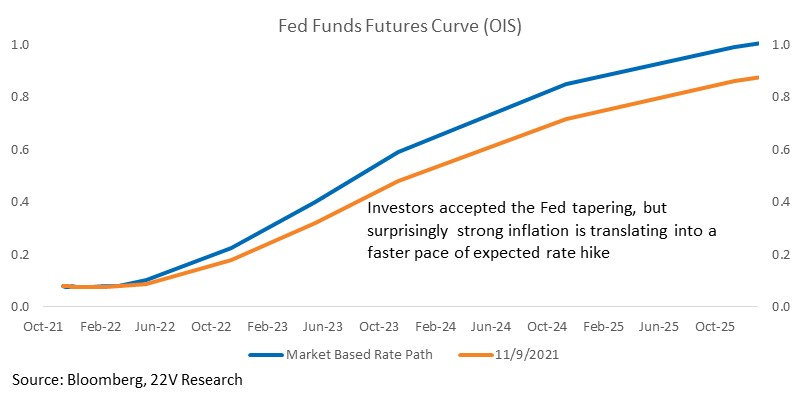
The path towards a higher level of yields is through a backup in expected inflation, an increase in the real term premium, and in the further upward adjustments to the real fed funds rate (increase in r*). Fed rate hike expectations increased on the CPI print, which makes sense as the Fed is more data dependent, but short-term inflation readings don’t matter because the Fed is still betting inflation is transitory.
Rate hike expectations have increased, but not meaningfully and don’t expect a sharp tightening of financial conditions. We are biased higher on the market, but admit the call is less obvious now and more volatility should be expected. Focus on internals and companies that benefit from strong demand and improving supply chains (can send list). Also, if volatility remains high, low vol names will outperform. That favors Healthcare.
Full report below…
MARKET VIEWS: Questions about inflation took center stage again yesterday after headline CPI printed a 6.2% y/y gain, handily beating 5.9% consensus estimates. Shorter term and less volatile measures were no better. On a m/m basis cpi was up 0.9% (est 0.6%) and core CPI gained 0.6% (est 0.4%). macro volatility is high and that will keep some upward pressure on equity vol (there is still a large disconnect between bond and stock volatility). Fed rate hike expectations increased, which makes sense as the Fed is more data dependent, but short-term inflation readings don’t matter because the Fed is still betting inflation is transitory.
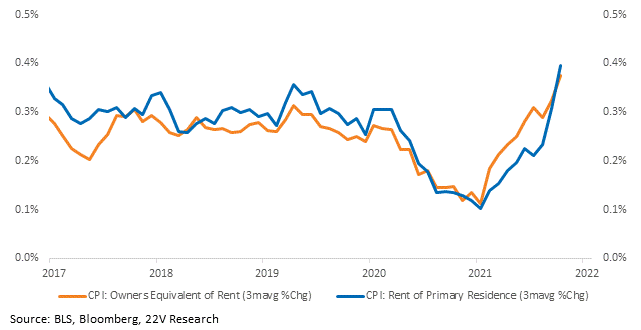
Gerard MacDonell, 22V’s economist, wrote “The inflation data remain difficult to read, because much of the price advance is still concentrated in goods that are being affected by supply-chain issues, which are temporary in terms of their effect on the rate of change and possibly reversible even in level terms.” BUT “The aggravating influence of higher rents inflation is going to persist, perhaps for as long as a year. And it is going to strain credulity to start stripping out rents on the grounds that the measured inflation rate there is surging.”
Demand growth (and particularly consumption growth) will remain strong. Labor market data was overshadowed by CPI, but continuing claims remained near their cycle low. Real wage growth moved further into negative territory. As we pointed out yesterday, Real Sticky AHE, which we construct using the Atlanta Fed’s Sticky-Price CPI, also fell but remains positive. Sticky inflation is 72% of CPI, so we feel comfortable making this adjustment.

The chart below is courtesy of Mathew Klein’s Substack. As Matt notes, While the bulk of household wealth gains “have gone to the people who had the most to start with, people lower down the income distribution are also a lot better off than they were before.”
|
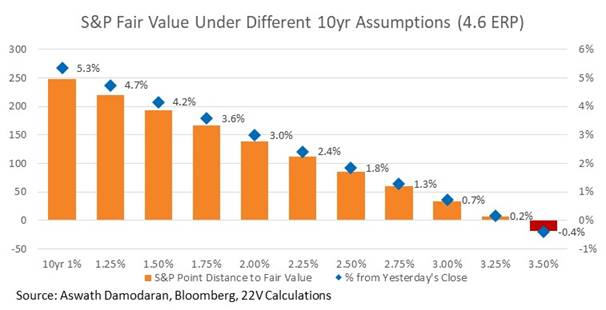
Yields backed up to 1.55% yesterday and peak in 2021 at 1.74%. There is a plausible argument for yields moving toward 2.5% (normalization of the inflation, rate hike expectations + rebound in the term premium as economic uncertainty declines). Beyond that level is harder to arrive at without an inflationary spiral (negative for risk and real growth) and a material increase in economic activity that pushes the term premium and r* higher (good for growth, mixed for risk assets). While financial conditions remain easy and corporate cash return elevated, downside risk to equities from a backup in yields is limited. Sudden shifts like we saw yesterday would push asset prices lower short term, but the medium-term outlook remains positive unless yields move MUCH higher.
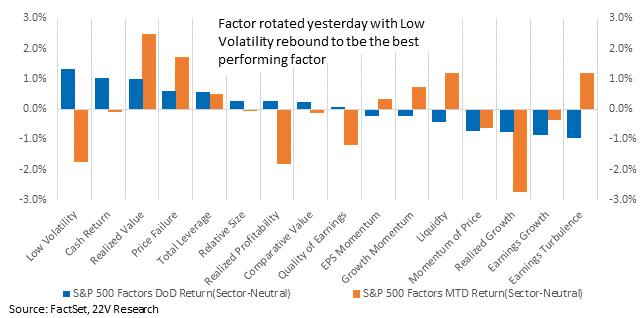
At the factor level, investors rotated into Value, which is traditionally a beneficiary of rising yields. Value has trailed Growth over the past few quarters and was trading at an exceptional discount to yields, which we noted in a Quant report a few weeks ago. Low Volatility names outperformed as well, rebounding sharply from their MTD trend. As we noted earlier this week, Low Vol tends to be concentrated in the most Defensive sectors.
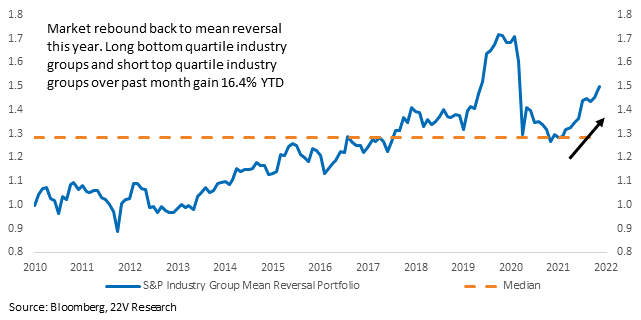
Part and parcel with the reversal in factor returns, investors rotated into more defensive market segments. Even as yields backed up, Utilities were the best performing industry group within the S&P, followed by Food & Beverages and Personal Products (both Staples). Energy suffered the biggest drawdown, followed by Semis. Month to month reversals have been common in 2021 leaving our Industry Group Mean Reversal portfolio up 16.4% YTD.
YIELDS ARE ABOUT UNCERTAINTY: The path towards a higher level of yields is through a backup in expected inflation, an increase in the real term premium, and in the further upward adjustments to the real fed funds rate (increase in r*). Those forces are tied together. Fed rate hikes are still expected to be on hold, likely until the back half of 2022. Signs productivity is failing or that participation is weakening would put upward pressure on rate hike expectations and inflation.
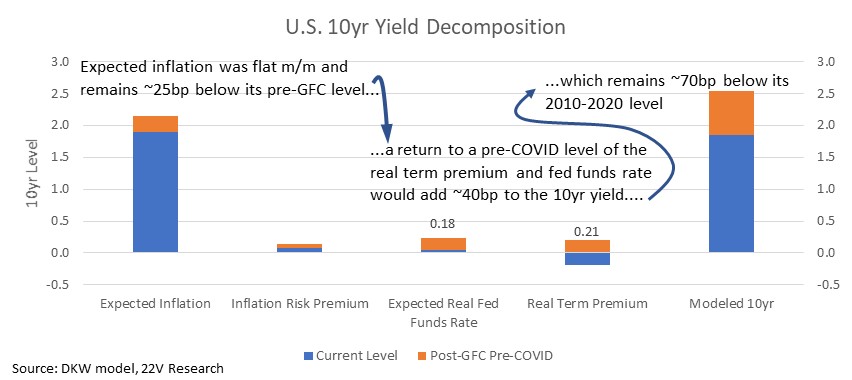
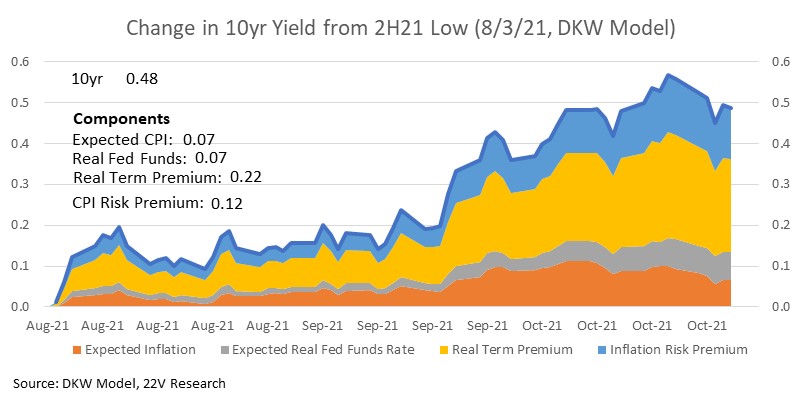
Through the end of October, implied expected inflation moved modestly lower (-3bp) while the term premium and inflation uncertainty added 8bp to yields. If investors changed their inflation outlook, there is further room for upward pressure on bond yields
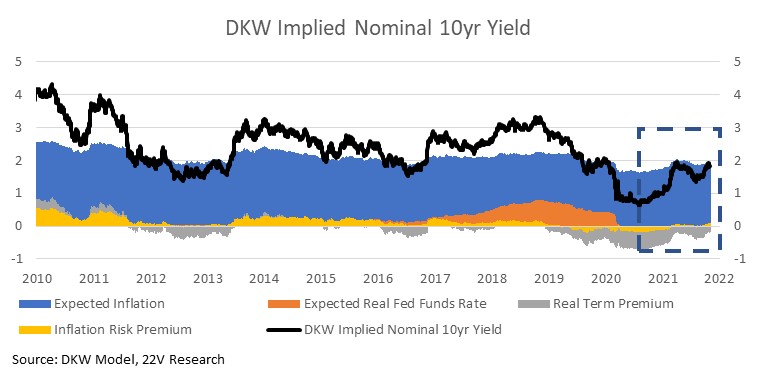
From the low on the 10yr in early August, uncertainty (term and inflation) has been responsible for most of the increase in yields. Expected inflation and funds rate are responsible for the rest. Easing of supply chain pressures would help reduce inflation uncertainty and expectations. That does not put downward pressure on yields but does suggest less of an upward bias over time.