
White House schedule planners are busy anew. Pressure on productive action – obvious in all manner of numbers for months – exploded after Election Day last week.
Inflation felt and perceived, and sometimes politically exploited, is one of a few anchors on President Biden’s net double-digit negative job rating. The disapproval swoon is more than four months long and naturally has morphed into questions of policy competence and political management – two areas in which he and his staff were expected to excel. We must be counted among the surprised and chagrined as events clearly have overtaken an ambitious White House economic agenda full of promise (to some). Close congressional voting margins in what can only loosely be termed a majority are a factor but much of the public opinion animus comes from ‘own goal’ mistakes.
Nonetheless, passage of the infrastructure bill and a hopeful employment report late last week could indicate a trough. These positives were overshadowed this week by Federal Reserve nomination options and related inflation concerns. Both fundamental economic and political pendulums would need to swing in unison through this and next quarter to have a shot at a public opinion turnaround. Even if those conditions develop, the president will be challenged to demonstrate he can effectively manage the seating of a restructured Fed, a second-year agenda, and the surprises that inevitably pound presidents. The administration has seemingly lined up November 18 as a test case.
Financial Services (What You Read vs What You Hear)
The regulatory part of Bidenomics is as polarizing as elements of his macroeconomic proposals. A week from today, the Senate Banking Committee reportedly is set to hold a confirmation hearing for the Office of the Comptroller of the Currency (OCC) nominee Saule Omarova. It will be contentious, to say the least. Whether it should be is not terribly pertinent yet. That question becomes compelling as the hearing ripens and the twelve Democrats, representative of the party’s full spectrum, determine whether they believe she should advance to a floor vote. Each Democrat has a veto since none of the twelve Republicans are expected to support her confirmation. Ties go to the party that holds the chairmanship, per Senate rules.
For the president, it is important that the hearing cut through noise to explain, not necessarily justify, why she was nominated. Suffice to say she is qualified, as reflected in a letter former and current bank regulatory litigators, academics, and regulators of both dominant political parties sent Senate Banking Chairman Sherrod Brown. It states, “There are few other scholars – or attorneys – who can match the depth of Professor Omarova’s technical knowledge about American banking regulation or have her breadth of policy knowledge.” Detractors’ marketing blitz presents a very different picture of Dr. Omarova, which certainly is not novel in the confirmation process.
Another question is whether the president has decided to announce his Federal Reserve plans before the hearing. Inflation isn’t cooling. Maybe the White House wants a ‘bank regulator week’ to heighten focus. Alternatively, the administration and/or the Senate Banking chairman takes a pass on announcing the slate before November 18. The calendar must be considered. Waiting until early December to announce Fed plans, leaves another three weeks of possibly unhelpful speculation. Market uncertainty currently is wrapped around inflation and the Fed – separate but intertwined topics.
Supply Chains (The Wrath of Khan)
Late yesterday morning, the Federal Trade Commission (FTC) tentatively added another item to a previously scheduled meeting of Chair Lina Khan. The Commission could vote to order large retailers to supply it with information on sector competition to study supply chain disruptions. The S&P retail ETF (XRT) sold off 3% on the news and regained a point before closing at $100.43. (I’m fortunate for many reasons to sit next to our colleague and star technician, John Roque).
We certainly do not know whether or to what degree the White House is responsible for this tentative increment to the FTC agenda, but it is unlikely a coincidence. It fits the notion of an administration attempting to reverse its (mis)fortunes by reasserting leadership and illuminating potential sources of the president and the country’s pain. Transatlantic monetary policymakers sound increasingly defensive as transitory timelines elongate. The topic and reality of inflation is owed to many factors including global value chain dysfunction, wage pressures, the lingering pandemic, and the midterm elections. Some analysts see loose financial conditions as an accelerant.
The components and weights of the problem are in the near term irrelevant since headlines and perceptions validate at minimum a political problem and possibly a longer run economic policy challenge. It has become impossible to separate market reactions from kitchen table discussions within media headlines and political debate.
Trade (Home Restoration)
The three North American heads of state will meet at the White House next week. Supply chains, migration, and the pandemic surely will be featured discussion points. The original NAFTA and its recent update continue to underscore the realities of geography. The most recent recession and the one last decade clearly affected total trade flows. It is unlikely this meeting can resolve or meaningfully influence transcontinental commerce, but a post-session communique stressing positives and a renewed commitment to work through addressable problems would benefit all three executives.

Source: Bureau of Economic Analysis
The southern border remains a multi-decade mess with regards to immigration policy and its consequences. Democrats are unlikely to have new legislation that might soften the blows around this topic. The need for it is certain to intensify as the 2022 electoral cycle ramps up. But a constructive communique with specific policy agreements would be better than nothing. This is especially true for a Latino community all but certain to be disappointed (again) that Washington is on track to pass another large fiscal package devoid of immigration language. On average, legal immigration over the last decade declined, which some believe invites illegal attempts to enter the US. The topic certainly will come up but is not easily given to resolution.
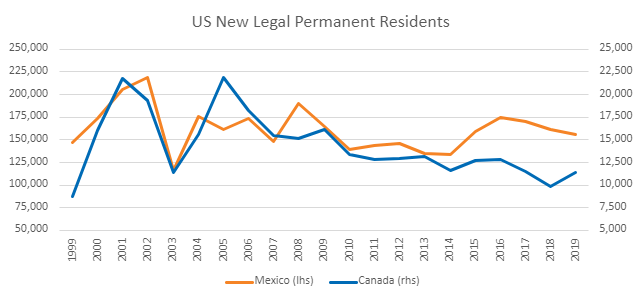
Source: Migration Policy Institute
Reversals of momentum require action. It is unlikely these events came together accidentally on the day much of Washington slows down for Thanksgiving. Whether last week began a series of events that will help Biden’s standing probably cannot be accurately gauged for a year.
We were wrong to posit the administration’s collective experience as governance prologue. As we continue to absorb this lesson, the president’s attempt at early-course correction is challenged by meaningful impediments – practical and political. The least of these is better optics and messaging at which the Biden team has under-performed. The most consequential will be reactions to his pending macroeconomic and sector regulatory agendas. November 18 is shaping into one of a few dates this quarter that will offer signals about whether the president and his team can bounce back in the interest of the country and his party.
Our ability to write this note is enabled by the sacrifice willingly made by millions of veterans, active and no longer serving, through the course of America’s history. Our Republic would not exist, could not progress but for their contributions (thanks, Dad and all veterans).

