
The second version of House Democrats’ tax policies scheduled for floor consideration today won’t be the last iteration of this legislation. There are a few provisions yet to be scored by the Congressional Budget Office, and additional changes are likely before the bill comes off the House floor based on what the Rules Committee will allow during debate. Senate changes are also likely after the House completes its work.
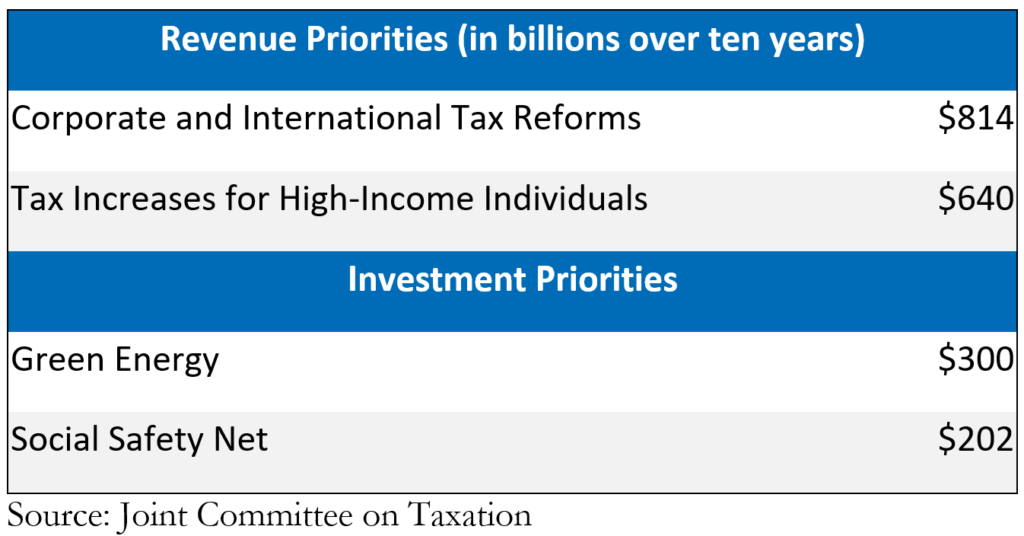
Grinding lower in response to compromises among Democrats, what was once a $3.4 trillion list of revenue-raisers presented by the White House in May was constricted to $2.1 trillion in the Ways and Means Committee’ first version in September. House tax-writers’ current place-holder scored yesterday by the Joint Committee on Taxation is down to $1.5 trillion. The two largest buckets of financing remain business and high-earner tax increases. Similarly, social safety net and green energy tax expenditures would still receive the lioness’s share of new money.
The moment of political triumph usually available to first-term presidents has diminished for Biden and his party. Democrats now are confronted with passing what remains of 4Q21 fiscal stimulus because of its policy appeal rather than any sense it fuels momentum to overcome historical midterm loss drags suffered by most first-term presidents and their parties. Enactment of the packages hinges on willingness of Democrats to both absorb Tuesday gubernatorial results in Virginia and New Jersey, recognizing the Boston and New York mayoral victories are not national political indicators.
Tuesday elections earlier this week are setting up to be uniquely indicative of and consequential for elections next year. Despite the policy advantages most Democrats see in much of the core Biden economic package, risks have risen that the national political mood and lingering factional disputes within the party block enactment of the legislation.
Looking back, it’s likely national events defined the opening and closing of Bidenomics. George Floyd and the pandemic provided the uplift for fiscal realignment around which the president hoped to build an economic agenda focused on workers and their families. Deere’s walk from the negotiating table likely acknowledges at minimum the political end of that currency.
We maintain our original call that 4Q21 stimulus will be in the $2 – 2.5 trillion range when infrastructure is included. This version of the legislation likely represents as ambitious an economic package as President Biden or other Democrats might have hoped for once the legislative process incorporated campaign themes from last year. Whether it addresses cleavages exposed by campaigns this week will be the subject for debate among candidates for the midterms.

