SUMMARY: As we wrote yesterday, the Fed is transitioning from stimulative to flexible and is comfortable with asset prices reflecting that, but is not going to tighten financial conditions over the short-term. That should be a neutral for risk assets, but much depends on what Powell says at the press conference. Expect rates, credit and to some extent equities to be range bound into the Fed (wed), OPEC (Thur), and Payroll (Fri).
Eurozone manufacturing PMI missed slightly, but once again blame is being put on supply chains, not demand. New orders relative to inventories in the ISM manufacturing PMI have dropped, but much of that is priced into the market. Also, Gerard pointed out yesterday, although ISM inventories declined “Fed indicators and the ISM are consistent in suggesting that inventory investment has picked up strongly to very strongly. In fact, though, inventory investment is still very weak, i.e., the accumulation is negative. Inventory run-off is just less steep than it was. So, I stick with the view that these indicators pick up the aspiration! Purchasing managers know their firms want to build inventories, and reflect that when answering the survey, but they are having trouble doing so.” End demand remains strong, helping explain persistently better than expected corporate revenue, margins and earnings, even as spot inflation has moved sharply higher.
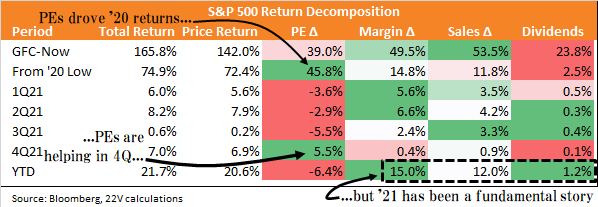
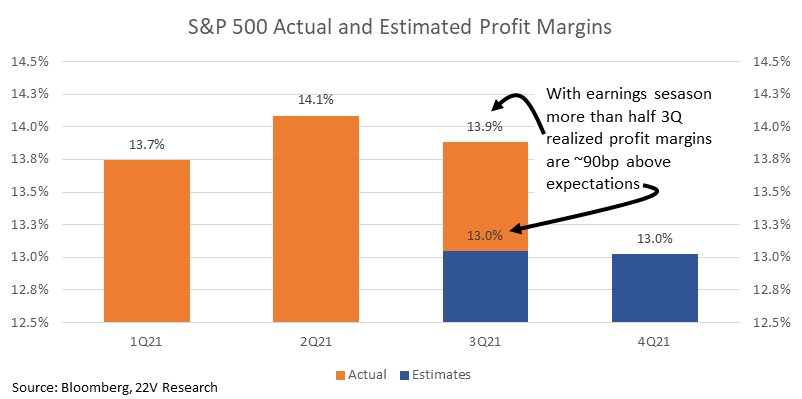
Even as pricing pressures have built, strong consumer demand has allowed companies to maintain profitability. So far in earnings season blended actual/estimate data leave 3Q Index margins tracking ~13.9%, 90bp better than analysts were expecting at the start of reporting. Full year 2021 EPS estimates have risen to $202 as 3Q EPS have come in ~8pp better than expected at the start of October. Margins remaining steady at their 3Q level would push S&P EPS $4 higher to ~$206. So far in 2021, equities have risen despite a decline in forward PE from 22.6x to 21.2x. If the equity risk premium continues to decline (PE increases) and fundamental growth continues to beat expectations, our 4,700 target for the end of the year would prove too low. Moving off the zero lower bound COULD be the catalyst for lower equity risk premiums.
Full report below…
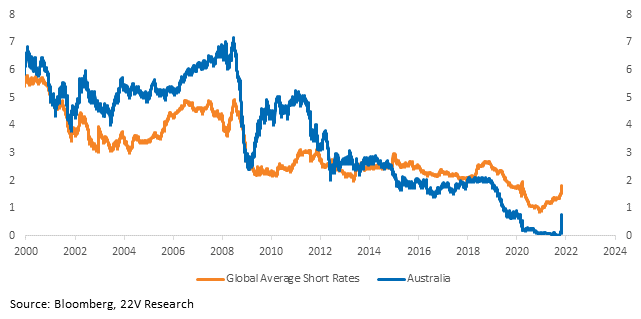
MARKET VIEWS: Overnight headlines remain dominated by supply chain issues and policy shifts as we head into the start of the November FOMC meeting. Global short rates continue to increase. Overnight, the RBA dropped its bond-yield target but emphasized that does not mean it will tighten. Keep in mind that the Fed and the ECB, the ones that matter the most, are not restrictive. As we wrote yesterday, the Fed is transitioning from stimulative to flexible and is comfortable with asset prices reflecting that, but is not going to tighten financial conditions over the short-term. All else equal, easy financial conditions continue to support Cyclical outperformance.
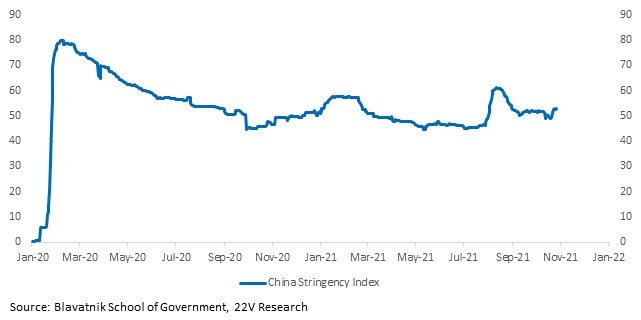
Elsewhere, the Eurozone manufacturing PMI missed slightly, but blame is being put on supply chains, not demand. End demand remains strong, helping explain persistently better than expected corporate revenue, margins, and earnings, even as inflation has moved sharply higher. Scary headlines about lockdowns in China continue to surface, adding to concern about supply chains. Authorities in China are now advising people to stockpile food. Data about China’s COVID situation is opaque. We are following stringency indices put together by the Blavatnik School of Government at Oxford to gauge how disruptive policy is, rather than guess based off of headlines. China has become more restrictive over the past couple of weeks, but not even as severe as in August of this year.
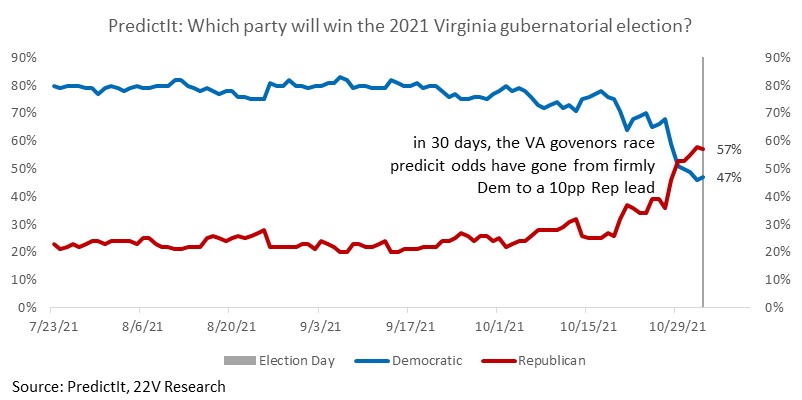
Virginia’s gubernatorial election is today. Kim Wallace, 22V’s Washington policy analyst, has maintained the race is an indicator for policy this quarter and the political prospects for each party heading into the 2022 midterms. If the Republican candidate, Glenn Youngkin, wins, then Congressional Democrats will take notice. Betting market ‘odds’ now favor Youngkin. But this election does not affect reconciliation or the infrastructure package. Also of note, Kim tells us to fade concern over Manchin’s comments about the reconciliation bill. Per Kim, it’s unlikely Manchin is going to vote against the bill given 1) no one shaped it more than he and 2) his state wins big in terms of new spending.
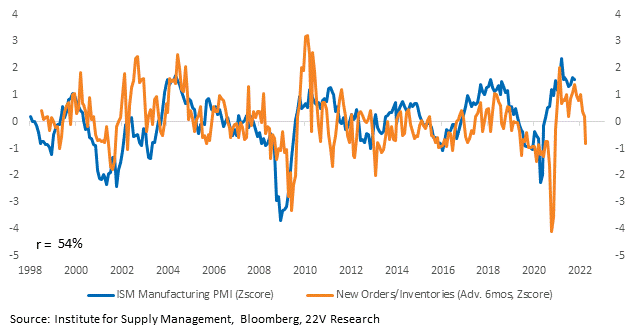
New orders relative to inventories in the ISM manufacturing PMI have dropped. Much of this is priced into the market as the entire world expects the PMI to come down. But it will happen AND demand growth will stay above trend given the housing and consumer backdrop. An acceleration in auto demand (when there actually is supply) will help as well. Plus, there’s still some inventory kick to GDP. Expect MANY charts going around (usually dual scale and not adjusted for different levels of volatility) pointing to imminent economic problems due to the decline in the ISM. We would fade those arguments.
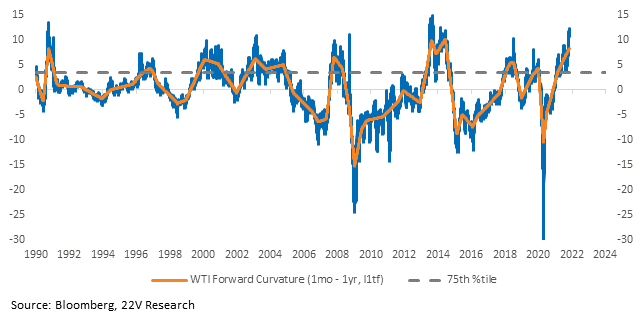
ENERGY OUTLOOK: WTI futures curves are in backwardation, meaning the spot price for crude is well above future prices. The 1yr out curve (so December ’22 to December ’21) is in its 99th percentile. In order for the curve to go back to ‘contango’ (the opposite of backwardation), given the current spot prices, the out-month price of WTI would have to increase +17%.
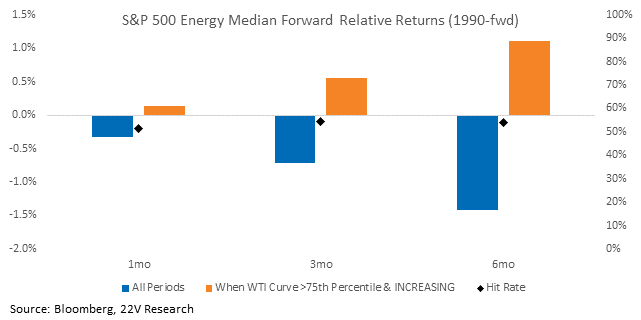
The median forward relative returns for Energy when curvature is above the 75th percentile are all over the place, but that’s because it matters whether the curve is increasing or decreasing. Returns are much better than normal when the curve is above its 75th percentile and INCREASING and a little worse than normal when the curve is above its 75th percentile and DECREASING. It therefore matters whether the curvature is going to fall or keep increasing. We lack the expertise to have an educated opinion on the WTI forward curve, but Energy is an interesting opportunity if you expect the curve to become more backwards.
RESILIENT EARNINGS: Supply chain issues continue to make headlines as the holiday season approaches and production/distribution bottlenecks remain firmly in place. As we noted yesterday, supply chain issues have been weighing on management sentiment toward Earnings and Financial factors. So far though, revenue growth and profits have been stronger than expected, margins have been 90bp better than consensus estimates implied, and index level EPS are on track to increase nearly 50% y/y.
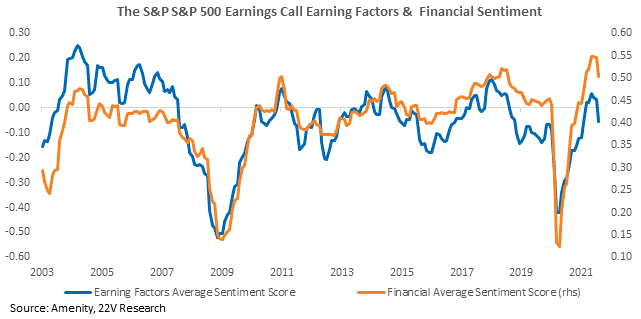
So far in 4Q though, the S&P is up more than 7% and the weekly pace of gains has accelerated over the past few, even as mega cap tech names missed expectations and guided lower. The equity risk premium has fallen ~30bps MTD as investors have more aggressively embrace risk assets. Though long-lasting supply chain issues would add to uncertainty, it appears investors are adjusting their positioning for new fundamental data. Specifically, that even as pricing pressures have built, strong consumer demand has allowed companies to maintain profitability. So far in earnings season blended actual/estimate data leave 3Q Index margins tracking ~13.9%, 90bp better than analysts were expecting at the start of reporting.

Full year 2021 EPS estimates have risen to $202 as 3Q EPS have come in ~8pp better than expected at the start of October. 4Q EPS estimates have been revised modestly higher, but are still pricing in an 80bp decline in margins. If margins remain steady at their 3Q level, S&P EPS will increase more than $4 to ~$206. That is a $1 better than out already above consensus estimates and does not account for any upward revisions to revenue growth, which we would expect if growth remained above trend as we anticipate.
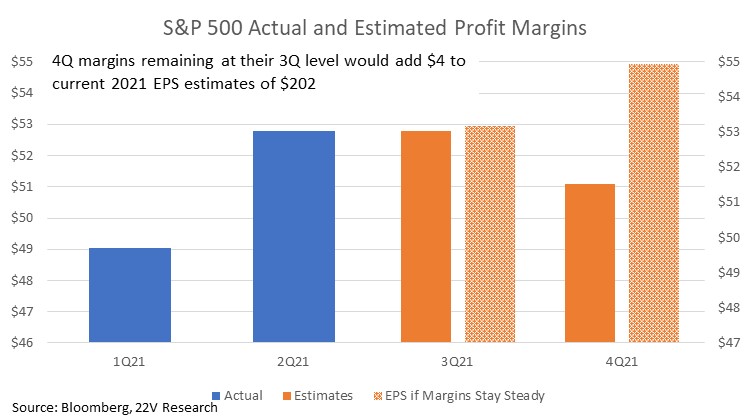
To be clear, we were looking for a roughly 9% rally in 4Q and most of those gains have been achieved. But our target is based on a steady level of multiples. So far in 2021, equities have risen despite a decline in the index level forward PE from 22.6x to 21.2x. If the equity risk premium continues to decline (PE increases) and fundamental growth continues to beat expectations, our 4,700 target for the end of the year would prove too low.