

Literally, it is what it is for all dimensions of President Biden’s proposed fiscal framework. Beholders’ eyes matter most in the field of marketing, especially the political kind. But policy agreement more than messaging likely will determine whether enough House Democrats see value in supporting President Biden’s outline with Senate Democrats as he departs to the Joint Andrews Air Force Base later today. Biden’s rally cry to House Democrats that his and their future rely on enactment of the framework deal is true. Those comments underscore a crucial risk for national Democrats: a generally younger faction of progressive Democrats plan to be around longer than the President Biden, Speaker Nancy Pelosi, and Senate Majority Leader Chuck Schumer.
This glacial changing of the guard carries import into next year and beyond as we outlined in a 2022 agenda note (Pivoting from Fiscal to Everything Else) earlier today. In the immediate term, the 4Q21 fiscal agenda outlook rests on the simple answer of whether what is in Biden’s framework agreement with Senate Democrats has enough of their priorities for House Democrats to support. This week’s success on reconciliation, could ease or complicate efforts to pass infrastructure without changing one word of the Senate’s bill. In December Democrats very likely will use the reconciliation process to raise the debt ceiling by $10 trillion or so, mainly to cover cash balances created before Biden took office. They also will need to extend funding for FY22 appropriations, an effort that seems likely without risk of shutdown.
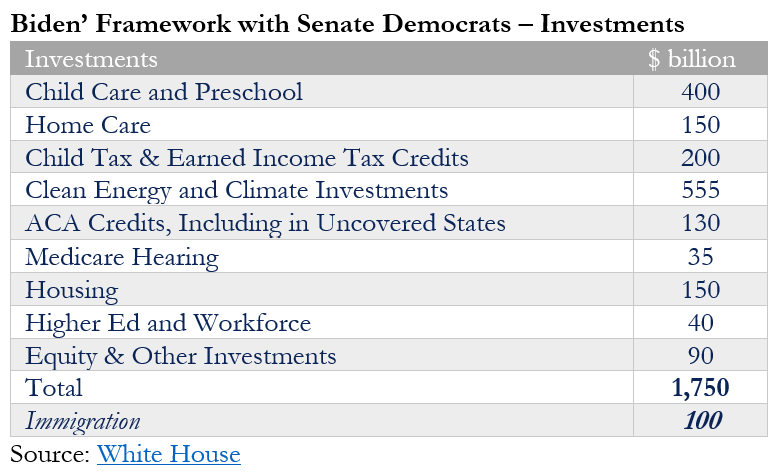
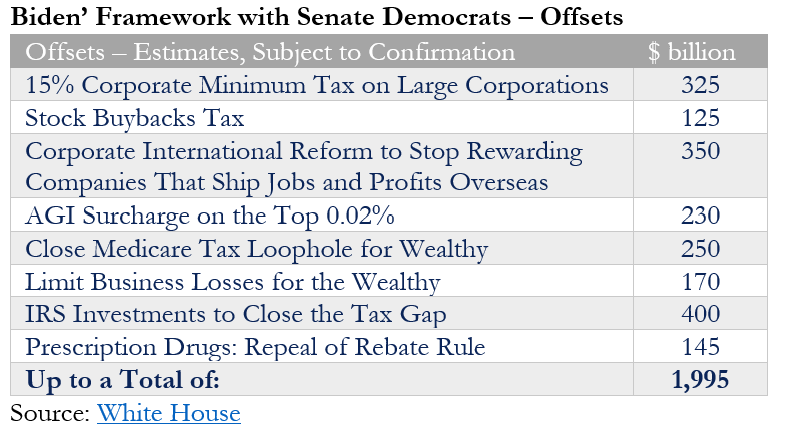
If President Biden’s “framework” announcement reflects a true agreement with 48 Senate Democrats and both Independents to cull $1.75 trillion of offsets from a list of $1.995 trillion, he leaves for Europe with more than the usual tailwinds. If more than three House Democrats see it as insufficient, his overseas trip risks inviting very early lame duck status. Speaker Pelosi is set to address the framework at 2:00 p.m. today.
We will watch the outcomes of Senate Democrats’ third attempt to convince the Senate parliamentarian that immigration policy meets the tests for inclusion in reconciliation (our guess is the third time will not be the charm), and whether, as is likely, some of the unused revenue proposed could fund a modification of the state and local tax deduction $10,000 cap.
What some Virginia voters see in the outline agreement will matter to next Tuesday’s turnout for former Governor Terry McAuliffe. Unmistakably, that will matter to Biden as much as McAuliffe and the Republican candidate Glenn Youngkin. For markets, what matters most is whether these stimulus conditionals are answered affirmatively, and Washington enacts reconciliation and infrastructure this quarter. The president’s framework remains in our expected $2.0 – $2.5 trillion range, including the $500 billion of new spending for infrastructure.

