
United States Senator Joe Manchin and Australian Prime Minister Scott Morrison are timely examples of politicians at different places on the same climate change continuum. Both are politicians in countries benefitting economically from developed hydrocarbon sectors utilizing robust natural resources. Those business plans enriched various stakeholders, powered economies, and created many decent jobs. For much of the past three decades, downsides to this success story have pitted a view of sustainable economics against shorter run advantages for a shrinking base of constituents seeking to slow the pace of environmental change.
Into this transition steps the “PM from Down Under” surprising some with a speech last week that put his government in favor of environmental damage mitigation – in the name of long-term human and economic health. The senior senator from West Virginia understands the tradeoffs implied and knows that his state’s employment base, politics, and economics tilt near-term risks toward a slower transition yet to be articulated. Any national politician has a slightly different remit than a state senator, but global transition pressures are evident.
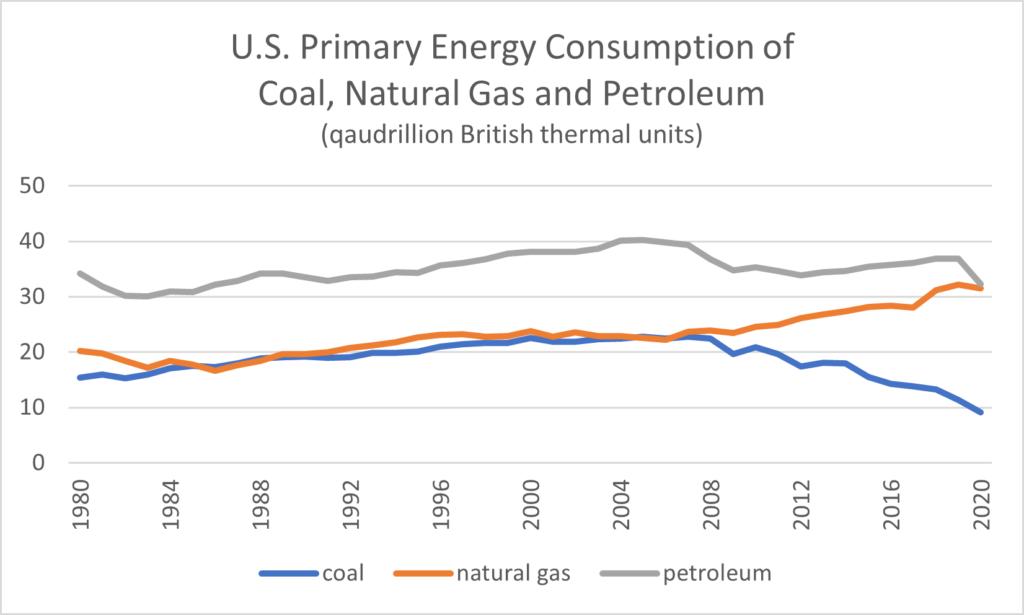
The Clean Air Act of 1970 and two years later significant amendments to the 1948 Federal Water Pollution Control Act, which became the Clean Water Act, was the beginning of a U.S. policy transition. But ever since then, economic outcomes have been the compelling drivers of change. Recessions emphasize the upfront financial and political costs of transition; profits and jobs abundant during expansions stunt procyclical policy built on climate science. The accelerated consumption of cleaner natural gas during the past two decades points to substitution. This is an economic factor which underscores market forces as a primary driver.
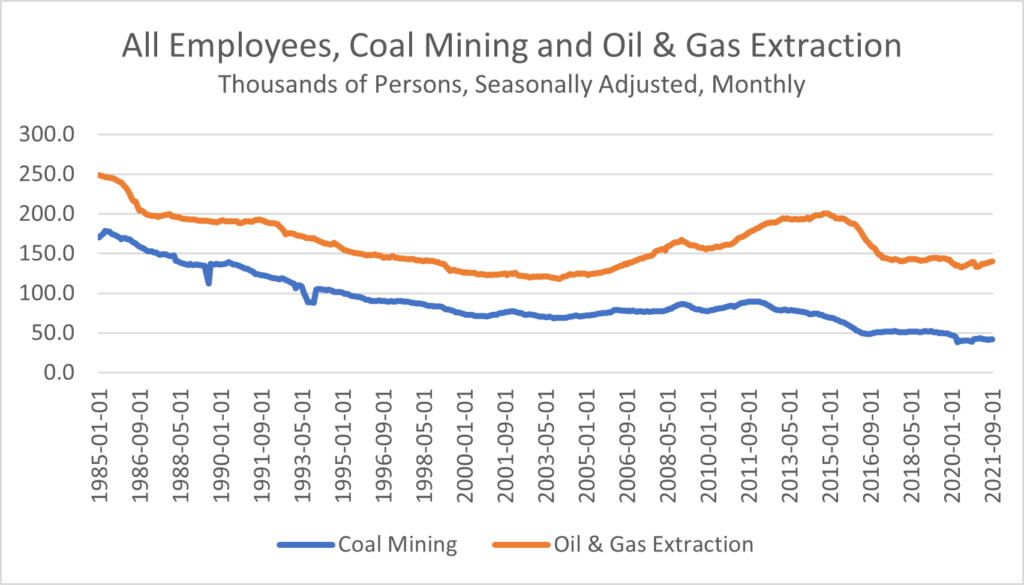
Employment bolsters the political story. With 50,000 coal mining workers industrywide and five states that comprise 71% of coal extraction according to the Energy Information Administration (Wyoming, West Virginia, Pennsylvania, Illinois, and Kentucky), tight voting margins in Congress disproportionately empowers generally smaller congressional delegations in this debate. Other variables including technology contribute to the oil patch employment picture through cycles, but the transition pace is dominated by economics first, then, relatedly, politics.
Public opinion is another element of the story. The Pew Research Center’s recent climate change survey shows Americans less concerned than citizens in many OECD countries that global climate change will harm them personally, and they are three points less worried this year than they were in 2015. The survey presents data to which we’ve unfortunately become very accustomed. Of the 17 advanced economies in North America, Europe, and Asia polled, U.S. political ideology defines respondents’ estimation of personal harm due to climate change. The survey found that there is a 59-point spread between those who self-identify as being on the ideological “left” and the ideological “right” in term of their belief that climate change will cause them personal harm in their lifetime.
The pace of transition to cleaner energy usage has been underway for decades, affecting consumers, employment, capex and margins for businesses and investors. Shorter-term economics are still a more compelling factor than science or politics. Because the economic arguments are still taking shape, expect a less ambitious policy agenda than President Biden would like, and cleaner energy proponents prefer.
On the politics, Democrats paid an electoral price for a never-enacted summer 2010 climate change bill that basically ignored the near-term economics/politics point. All of Biden’s advisors know this and understand the implied policy and political tradeoffs. We’re of the mind that Manchin has or will be willing to accept softening some of his economic agenda demands in exchange for slow walking President Biden’s cleaner energy agenda. The weight of US public opinion is more aligned with Manchin’s transition pace – dominated by short-term economics – than many in the Democratic Party.
Public enunciations of sovereign rather than global strategies around the transition pace could be the more meaningful public benefit of the October 31-November 12 UN Climate Change Conference (COP26). Like Australia, for example, other producer/users and users/non-producers of fossil fuels get a high-profile opportunity to explain their game plan. We believe shorter run growth policies will still drive the global pace of weaning producers and users from ecologically damaging behaviors. All that notwithstanding, we expect U.S. national politics will likely drive (COP26) headlines.

