
Even as the Biden administration pushes to implement fiscal restructuring, routine aspects of federal fiscal policy need tending. A man of the Senate, President Biden enjoys regular order in terms of the legislative process and elected Members’ responsibilities and prerogatives.
As summer rolls over into autumn for example Washington will likely consider emergency spending to address devastating western fires, hurricanes, and the Afghanistan’s mission end. Over the coming four months Washington is poised to handle routine and extraordinary pressures. The former includes FY22 appropriations; the latter to be marked by Biden’s stimulus plan.
On Friday, the Office of Management and Budget under Biden issued its first Mid-session Review. Presidential budgets are quintessential statements of priority in terms of where money should be spent, the origin of revenues to fund that plan, and economic assumptions that help it all meet overall fiscal thresholds sought by the president and often demanded by economic and political circumstances. This MSR is no different; generally, it’s consistent with a large, dynamic economy recovering from a uniquely harmful if relatively short duration contraction.
One aspect of regular order is how laws are created or amended. Usually it’s a two-step process; first activities are authorized and then either taxes or spending is adjusted relative to the baseline. National security authorizations have a history of closely relating to annual authorizations. On Wednesday, the House Armed Services Committee is scheduled to begin the process yielding a new authorization; Senate Armed Services has also begun the process. HASC Chairman Adam Smith wants an actionable plan for prioritizing defense spending informed by the Pentagon. While not new, Smith has made clear he favors a more robust, intellectually defensible approach.
His chairman’s mark (released yesterday) adds an additional $1 billion above the administration’s $715 billion FY22 request. Mike D. Rogers (R-Ala.), ranking member of the committee, plans to offer an amendment that would add $25 billion to the legislation. If approved, the Rogers’ amendment would increase the House bill funding level to follow the version passed by Senate Armed Services Committee in July.
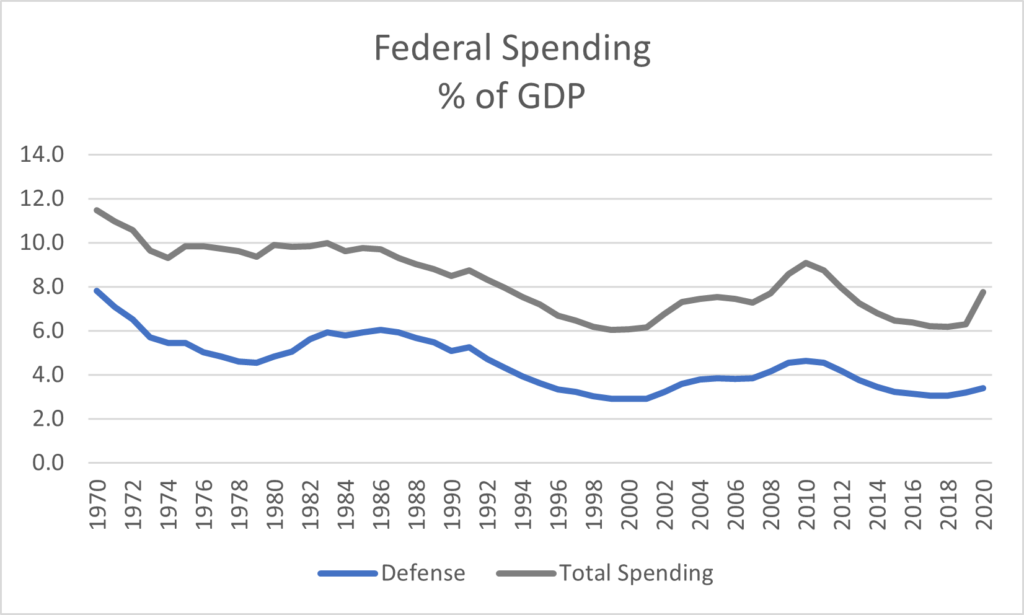
Re-orienting of global policies that contribute to Biden’s foreign policy doctrine includes lowering Afghanistan as a policy imperative, especially compared to China and broader Asia, Russia, those and other actors’ cyber activities, and investments in Africa and Latin America. These objectives are reflected but certainly not achieved in Chairman Smith’s push for the Pentagon to meaningfully engage in program prioritization rather than neatly check boxes that do not result in letting go of even minor weapon systems to focus on higher priorities in current and evolving scenarios.
Emergency supplemental is both a time-honored fiscal chore most years and under all permutations of political balance of power. The 1974 Budget Act as modified contains specific procedures for such spending but like much of budgeting, with the person with the votes determines the timing and content of supplementals. A few persistent sources of supplemental requests are piled into this summer raising pressures pointing to FY21 emergency funds. Climate changes are making natural disasters worse, according to most scientists including the UN Intergovernmental Panel on Climate Change. Costs of closing most US activities in Afghanistan join with natural disasters to indicate a multi-billion dollar supplemental sometime this fall.
The US remains challenged to enact public and private policies that mitigate effects of intensifying global warming. This basket of climate risk-reduction strategies – most yet to be developed much less implemented – are features of Biden’s fiscal restructuring plans. The human and physical costs of 2021 natural disasters will be a part of the supplemental debate, just as they have every time these things happen. A difference this year is presidential support for better risk mitigation planning and implementation strategies as a focus of economic and national security.
An immediate review subject to revision shows critical infrastructure in or near the US Gulf of Mexico cities did not experience worst-case scenarios, especially New Orleans storm-deterrent systems and hydrocarbon production-distribution assets. We expect that once immediate human needs are addressed proponents of infrastructure investment will point to post-Katrina federal infrastructure spending paying off in allowing a faster return to economic activities in the region. The eventual supplemental likely will be subsumed in one of the continuing resolutions Washington will need to enact in September and/or October. This task rounds out the fiscal list this year joining reconciliation, infrastructure, FY22 appropriations, and debt limit. A fiscal full house that is unlikely to be fully played out until December.
Adding weight to the near-term legislative list favored by the White House and congressional Democrats of course creates more space for failure. But the tangible risk of inaction on emergencies is not a substantive increase in political threat to Biden’s economic agenda. Like infrastructure, supplementals naturally attract bipartisan support. Demand for offsets can complicate negotiations but rarely scuttles an eventual deal. And the political dynamic on stimulus is equally unaffected by a probable supplemental request as those supporting stimulus are unlikely to oppose funding these activities

