
August 23, 2021
Timing and substance of FY22 budget legislation (reconciliation), and the Senate-passed infrastructure bill are the more significant uncertainties of President Biden’s 4Q21 domestic agenda. We remain of the view that whatever comes of 2021 debt limit conversations, default is highly unlikely. Likewise, while a weekend of drama is entirely possible before the fiscal year end on September 30, government shutdown(s) are difficult to imagine as a winning strategy for most Congressional members.
Our fiscal outlook rests on the president’s ability to continue driving the fiscal process, enabled by Democrat control of Congress, albeit by tight voting margins. Ideas and public support for that agenda comprise his political capital. Afghanistan allows questioning of Biden’s judgment unlike anything this White House has had to manage, including the pandemic. He inherited both but the perceptions and range of consequences of withdrawing from a hot war differ meaningfully from tweaking a persistent offensive posture against Covid.
As the House of Representatives begins consideration of a FY22 budget resolution this week, we will pay less attention to timing than substance. Congress sets its schedule, driven by leaders’ tactical and strategic decisions successfully sold to enough members that allow passage of a plan. The compelling factor usually is a plan’s content rather than its timing.
Democrats and the Independents in their caucuses know that a single vote provides leverage in any negotiation but up to a point. House members who voted for Speaker Nancy Pelosi to retain her job this Congress are naturally inclined to avoid self-imposed failure. Whether this week or next, the House is very likely to adopt a budget resolution and pass a reconciliation bill like the Senate plan because that resolution and reconciliation instructions closely hew to Biden’s agenda.
Biden’s 2021 policy momentum is owed to the popularity of his administration’s pandemic and economic recovery plans, the discernible results from those plans relative to 2020 experiences, and the president’s ability to keep most of his 2020 general election coalition intact. Risks to each of these factors are persistent as the past two weeks demonstrate. Afghanistan and Covid’s fourth wave are adversely affecting the president’s net approval rating (as the accompanying graph illustrates); the consequential questions relate to intensity and duration of this phase.
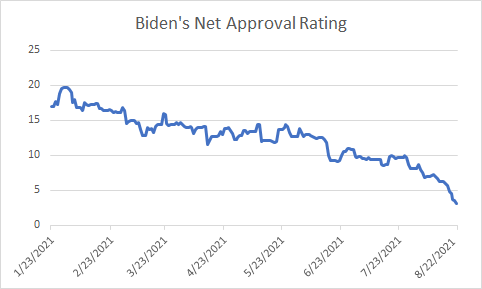
Human suffering evokes emotion in ways realpolitik discussions of geopolitical and geostrategic policy will never match. This is especially true given the former can be captured in pictures or a few words and spread globally as fast as one’s technology permits. Whatever the factors or weights, Biden’s net approval rating has sunk the past few weeks. The gradual downward drift until the end of July could be accepted as normal adjustment coming off a hotly debated general election victory (the so-called honeymoon period). But the drop off since then suggests something changed rapidly and the White House worries the Afghanistan news accelerates that slippage.
Speaking of fiscal policy, savings generated by withdrawing from Afghanistan might be a positive factor in Biden’s rating but probably not this summer. However, explaining why the expenditure does not make sense for a country handling several frontal challenges is unlikely to further erode his standing. The potential hits to the president’s international political capital are unlikely to materialize until next year and are very unlikely to pose serious risks to his ability to rally his electoral coalition’s support for the pending domestic fiscal agenda. Risks here include the chance that allies or adversaries find rationale or ability to bring to the fore the horrible consequences of a poorly executed withdrawal. Those consequences are contained for now but quite unfortunately not for most Afghans and their loved ones who live outside the region.

