
Persistent and growing bifurcation of Americans’ economic experience underpins President Biden’s fiscal policy. The Senate Budget Committee’s reconciliation instructions released earlier this month outline this chapter of Bidenomics. Together with changes to regulatory and spending current law, the president’s tax policy proposals address economic disparities with the goal of giving more people better tools designed to produce sustainable growth. This note examines tax policies likely to be debated and enacted before the end of December this year.
Every policymaker with a plan to change the tax code does so under the banner of simplicity or fairness, sometimes both. Biden leans into fairness, hoping the plan appeals to working Americans up to approximately the 70th percentile of wealth. Taxes on “high earners” would go up while households earning $400,000 or less purportedly would receive tax cuts. Investments in education, healthcare, housing, and climate science would improve productivity and earning power of workers, giving them a greater share of national income.
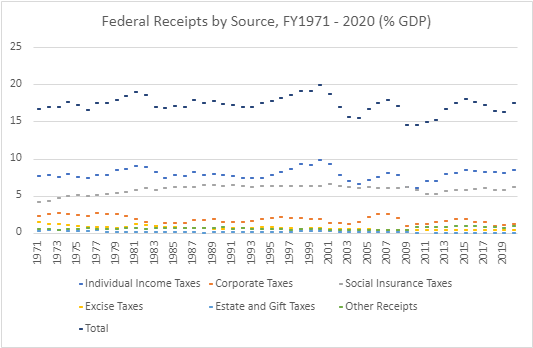
Federal taxpayer receipts from individual income and social insurance taxes comprised 84% of total federal revenue last year as shown in the accompanying chart. Gross income for the bulk of individual taxpayers came in the form of wages and salaries (64.6%). Biden’s intention not to raise taxes on any household earning $400,000 or less likely resonates with many voters. Thirty-five percent of the 177.4 million individual tax returns filed last year came from three deciles encompassing $75,000 – $500,000 incomes. Many, but surely not all, in these three deciles arguably represent the America’s middle class. Bidenomics targets these brackets and the working poor.
Increasing wealth for more Americans means reducing concentration of wealth. In a note carried on the Tax Policy Center’s website, Gene Steuerle makes a quick, insightful argument for increasing the pie as a means of supporting growth. It is a worthy three minutes read: How Can Tax and Spending Policy Together Enhance The Wealth Of The Nation? | Tax Policy Center.
Additional revenue to fund this fiscal rebalance also involves business tax reform. The president’s 28% proposed corporate tax rate looks three or four points higher than some of his supporters will accept. Given the rules of reconciliation, it is important to note that a few of those opposed to 28% are Senate Democrats. Biden also wants to change foreign income taxation, significantly reduce the benefits of tax-policy instigated inversions, and to set a global minimum tax. Compliance gets a boost in a few areas including more IRS personnel capable of conducting sophisticated audits and increasing oversight of hired tax preparers.
Federal support of innovation is a marquee feature of Bidenomics. His executive orders on global value chain resilience and promotion of competition in concentrated sectors are examples of regulatory impulses outside of fiscal policy meant to spur US investment and enhance productivity. But the bulk of his Year One economic policy revisions run through the congressional money committees (appropriations, tax, and budget). The accompanying table shows the administration’s top five revenue and tax expenditure proposals measured by cost.
As the House of Representatives begins consideration of FY22 budget and reconciliation instructions next week, changes to the Senate blueprint are assured. But stark differences of priorities pursued by Biden are unlikely. The table above comes from Treasury’s tax policy shop (usually augmented by IRS specialists). The estimates Congress uses will come from the Joint Committee on Taxation and the Congressional Budget Office, so the numbers influencing floor and possible conference committee debates will change but not by much. Most of these topics have been subject to years or decades of review by administration and congressional tax staff.
Of course, all the revenue raisers are the purview of the House Ways and Means and Senate Finance committees. Those members will also produce legislation covering almost exactly two-thirds of expenditures (or investments depending on your perspective). Everything listed in the table appears in Senate reconciliation instructions and each item is destined to be approved by the Ways and Means Committee in some form.
Bidenomics attempts a bottom-up rebirth of US organic growth. This kind of growth has not been experienced since the top-down marriage of federal and global policies in the early 1990’s and the innovative deployment of desktop computing across much of US businesses. America’s economy and to varying degrees other G10 countries enjoyed a spurt of growth that decade not experienced since the WWII post-war period. That period in US history too was marked by federal investment in physical and human capital.
Presidential administrations, like most organizations, prioritize goals, some are more aspirational than others. To the extent fiscal policy is only about ‘who gets what when’ (we’d add ‘why’), then it is the most important political science discipline. Presidents Franklin D. Roosevelt, Lyndon B. Johnson, Ronald Reagan, Bill Clinton, George W. Bush, Barack Obama, and Donald Trump dealt with crucial geopolitical choices but their tenures each had a meaningful fiscal component.
Biden has a very narrow window through which to complete his first term fiscal agenda. His political equity in promoting clean energy, competition, revamping supply chains, and re-asserting US geopolitical influence are particularly important to his legacy but enactment of his infrastructure and tax policy proposals are a much more politically and economically transformative opportunity. Momentum currently rests with the president and his party to enact FY22 reconciliation legislation and complete the most significant fiscal policy first year of any president in three decades. We will discuss the myriad risks to this outcome in subsequent notes.
Policy runs in long and short cycles. The ten-year flip from global austerity to stimulus occurred within a half century cycle of labor vying against capital in economics. Capital remains a necessary and welcome factor in US economics, but the pandemic exacerbated conditions faced by many workers and families. That has contributed to populism on the political right and left. Biden’s fiscal realignment plan hopes to establish a more balanced economic and political equilibrium.
There are echoes of the early 1990’s German policy revision struck by Gerhard Schroeder between labor and capital that successfully improved relations and expectations of both camps largely by increasing predictability of wages and productivity. The agreement helped the country enjoy annual GDP per capita growth for much of the following 20 years after basing at a negative 1.63 in 1993. Of course, euro euphoria and EU policy liberalization were contributing factors, but many Germans still point to Schroder’s policy input as welcome repair between capitalists and labor during a destructive period of deep mistrust.
For Bidenomics to succeed, the president must maintain policy momentum around the country and within his party – in that order – and he must maintain the confidence of businesses and markets that the tradeoffs implied by his agenda support sustainable economic growth. Most importantly, Biden plans to achieve the turnaround by investing in human capital in a way that invites greater private capital investment. Our sense is that the next four months will determine whether policy success is achieved; whether business accepts the signal and tradeoffs will be judged politically and economically next year.


