

Today’s PPI was understandably taken as somewhat hawkish for the near-term rates outlook because it nudged up estimates of how the Core PCE Price Index due at the end do the month will print by a couple to few basis points. Moreover, the estimates, though heavily subject to revision tomorrow, look a bit too high in absolute terms to allow the Fed comfortably to remain on hold at the meeting next Wednesday. The Fed will not have the PCE Price Index by then, but by many accounts the decision will be quite sensitive to what the PPI and CPI for August imply for the September PCE. The Wally made that point just this morning.
That is the most practically important issue, although I think it is in the price. Stepping back a bit, I think there is a bit of extra hair on the end of month PCE release because of the normal revisions associated with the Q2 National Accounts data and because of the methodological changes that analysts have been discussing for the past couple months now. There is a lot going on there, but I figured I might try to provide a rough and ready estimate of how the underlying inflation pattern is now implicitly expected — by the informed consensus — to appear in the September data when they finally come.
To get at this issue, I pull four tricks that I would prefer you not tell my econometrics professor about:
- I assume that the consensus assumes that the Market Price Only (MPO) version of the Core PCE Price index will be up 24 basis points. I work with the MPO because I want to focus on a measure that is less subject to revision and less susceptible to lingering uncertainty around the timing of the imposition of the new methodology for handling portfolio management and advisory fees.
- I incorporate the view that the 12-month rate of the MPO will be revised down 18 basis points. And I model this by assuming the effect on the 12-month rate begins at 1.5 bps in the September 2025 data and rises to 18 bps by the August 2026 print, due on September 30. This is a crude simplification, admittedly, but I want to keep this simple to avoid an even bigger mistake by getting too far down in the weeds there.
- I add a constant 15 bps to the result to reflect that the MPO inflation rate will probably continue to understate underlying inflation slightly, because non-market prices tend to rise relative to market prices over time.
- I show only the 12-month rate.
So, I guess you can see why the market thinks the set-up here means that the Fed is more likely than not to raise the funds rate at the September meeting. But this is subject to change tomorrow, not as regards the general set up here, but more as regards the September meeting itself. With the labor market at full employment, the outlier here is the inflation rate and that needs to be the focus.
One final point here that involves a slight change of subject. A while ago I stopped highlighting the Observed Rent version of these inflation proxies, which switches out the lagging government measures of average rents in favor of my proxy of marginal rents. The main reason for this is the lags relevant there seemed largely to have run their course, which narrowed the gap between the average and marginal inflation rate and, therefore, slightly increased the relative importance of avoiding slippage between the official data and the marginal proxies I had earlier been emphasizing. If it leads by a lot, being off by 50 — 100 bps is no big deal. But that is a relatively bigger deal when the lead no longer reliably applies.
The reason I mention this is that various inputs into my estimate of marginal rent inflation have been firming recently. We see this to some extent in the Cotality Single Family Rent Index (SFRI), which is my preferred measure. And we see it much more forcefully in Zillow’s Observed Rent Index (ZORI), which is not quite as reliable but is nevertheless a relevant cross check. The 12-month rate of inflation in the ZORI has quickened from 1 1/2% in January to 3 1/2% in July. This reinforces my somewhat new hesitation in over-riding the official data with the idea that the marginal rent inflation is meaningfully lower.
Rough and ready, but I think the main point here is fair
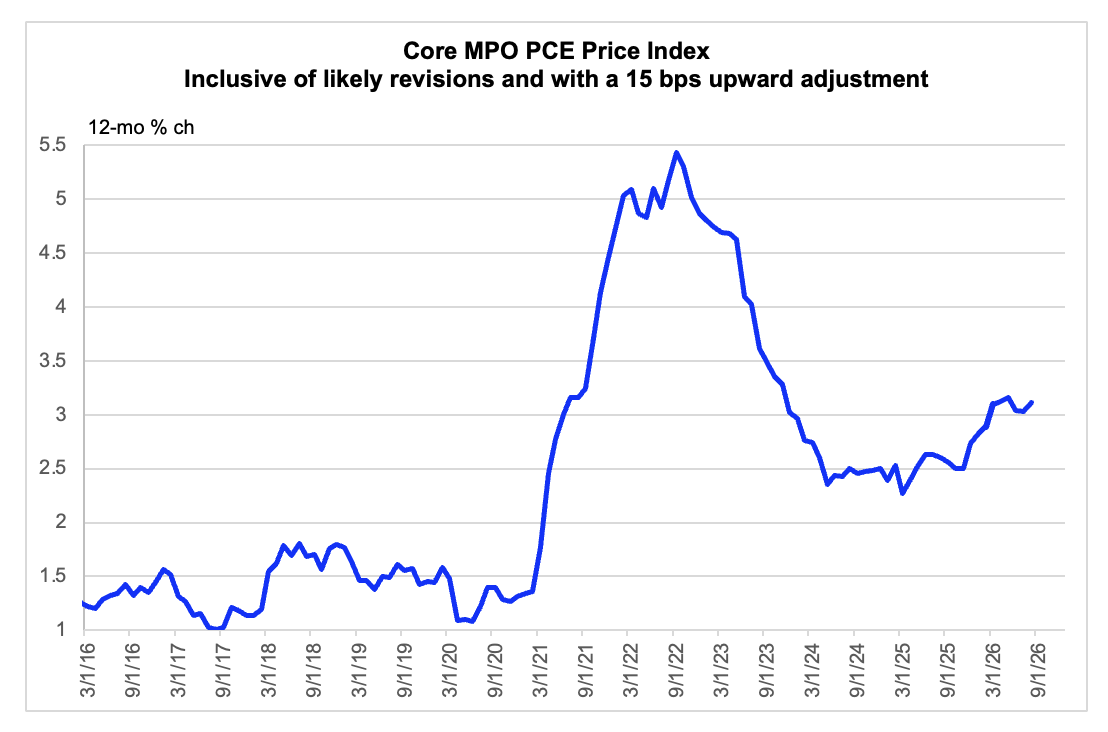
Data are actual inclusive of likely revisions to July and implicit consensus as of today for August.

